
Containerboard Grades Compared: Selecting Liner and Medium for Load Requirements
Introduction: Selecting the right containerboard grades is a critical engineering decision for corrugated packaging performance, especially when compression strength, puncture resistance, stacking height, and material efficiency must align.
Technical evaluators should begin with the distribution environment rather than choosing the highest basis weight. The best board structure reliably survives actual handling hazards at the lowest total converting cost.
Linerboard primarily contributes surface durability, bending stiffness, print performance, and moisture-facing protection. Corrugating medium creates the flute geometry that delivers much of a box's cushioning and compression behavior.
Neither component can be specified in isolation. A strong liner combined with weak medium may lose flute integrity, while heavy medium with under-specified liners can create poor puncture resistance.
This guide compares common containerboard grades, explains the engineering relationships behind board selection, and offers a practical specification workflow for technical evaluation teams managing load-sensitive corrugated packaging.
Start With the Actual Load Case, Not a Familiar Board Grade
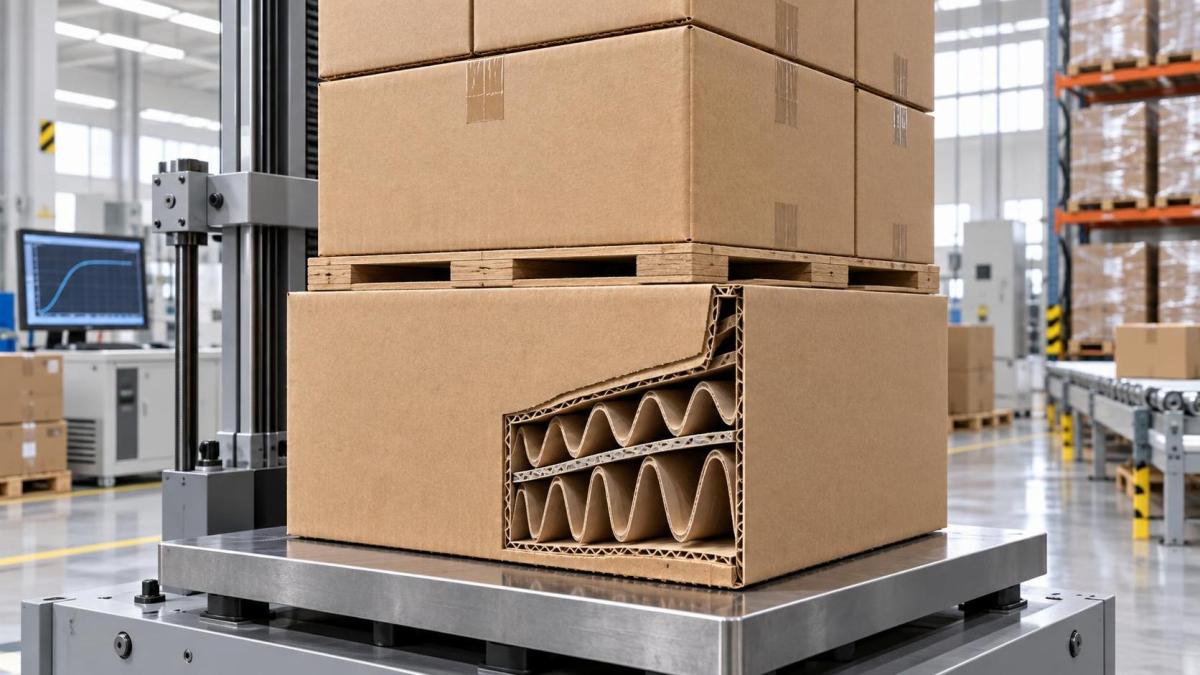
The first question is not whether to use kraft, test, recycled, or white-top linerboard. It is what loading, handling, climate, and product conditions the completed package must withstand.
Define the product mass, pack pattern, internal support, pallet configuration, warehouse dwell time, stacking height, shipment mode, and anticipated reuse cycle before comparing containerboard grades.
A lightweight consumer product may need high puncture resistance because of sharp contents or automated fulfillment. A dense product may instead require exceptional edgewise compression and stack retention.
Technical teams should distinguish static warehouse stacking from dynamic distribution loads. Truck vibration, conveyor transfers, clamp handling, drops, and humidity exposure often govern failures more than nominal weight.
Document whether the box is a regular slotted container, die-cut mailer, tray, wraparound, partitioned shipper, or retail-ready case. Structural geometry changes how board properties become package performance.
Product fragility matters separately from box survivability. A board may remain visually intact after impact while transmitting enough shock or flexing to damage the product inside.
Environmental conditions require explicit attention. High relative humidity reduces fiber stiffness, weakens starch-bonded flute structures, and can materially lower compression strength during storage or transport.
For export or cold-chain use, evaluate condensation, temperature cycling, long transit durations, and possible water contact. Standard dry-condition assumptions may produce misleadingly optimistic grade selections.
How Linerboard Grades Influence Finished Box Performance
Linerboard forms the outer and inner facings of corrugated board. Its tensile strength, ring crush, burst behavior, surface quality, and fiber composition affect multiple package performance outcomes.
Virgin kraft linerboard typically provides high tensile strength, strong wet performance, good tear resistance, and dependable conversion behavior. It is often selected for demanding distribution conditions.
Kraft liners are especially useful when boxes face repeated handling, high stacking loads, abrasive surfaces, or elevated moisture exposure. Their strength efficiency can offset a higher purchase price.
Test linerboard is commonly produced with recycled fiber and may provide cost-effective performance for many dry distribution applications. Performance varies substantially by mill, furnish, and basis weight.
Do not treat “test” as a single technical grade. Request mill data for compression-related values, tensile properties, moisture sensitivity, Cobb water absorption, caliper, and quality consistency.
Recycled-content liners can be appropriate for short supply chains, low-to-moderate stacking requirements, and products with adequate internal protection. They require more careful validation in humid conditions.
White-top linerboard combines a printable white surface with a structural backing. It supports brand presentation, barcodes, and retail graphics without necessarily requiring a fully bleached construction.
For display packaging, assess print smoothness, ink holdout, color consistency, and surface pick resistance alongside structural metrics. A visually premium grade still needs sufficient distribution durability.
Basis weight is relevant but incomplete. Two liners with equal mass per unit area can behave differently because fiber length, refining, recycled content, moisture, caliper, and manufacturing process differ.
Ring crush testing is often valuable because it indicates resistance to compressive loading in the paper plane. However, it should support, not replace, finished-box compression testing.
Higher liner stiffness can improve panel rigidity and resistance to bulging. This matters for large panels, heavy contents, high-speed packing equipment, and packages with minimal internal bracing.
Why Corrugating Medium Often Determines Compression Reliability
Corrugating medium is shaped into flutes and bonded between liners. Its primary task is preserving flute geometry under load while creating separation that increases board bending stiffness.
Medium performance influences flat crush resistance, flute formation, adhesive bonding stability, and edgewise compression. A specification focused only on liner strength can miss a major failure source.
Virgin-fiber medium may offer favorable stiffness and consistency for demanding flute profiles. Recycled medium can provide efficient performance but may need higher basis weight for equivalent results.
Medium must run well on the corrugator. Poor formation, variable moisture, weak internal bond, or insufficient stiffness can cause washboarding, crushed flutes, bonding defects, and unstable board caliper.
Flute crush reduces the separation between liners. Once this structure is damaged, bending stiffness and top-to-bottom compression resistance can fall sharply, even if facings appear undamaged.
For boxes exposed to automated packing and fulfillment equipment, specify acceptable flat crush behavior. Compression damage may occur before the package reaches the warehouse or transport network.
Medium selection should reflect the target flute profile. Fine flutes demand controlled formation and may use different paper characteristics than heavier flutes designed for cushioning and stacking.
Evaluate medium with the chosen adhesive system and operating conditions. Bond quality depends on paper absorbency, moisture, starch formulation, steam conditions, speed, and corrugator heat transfer.
Match Flute Profile and Board Construction to the Failure Mode
Flute profile changes caliper, cushioning, printability, compression behavior, and material use. Selecting containerboard grades without selecting an appropriate flute configuration leaves the engineering decision incomplete.
B flute offers relatively good puncture resistance and print surface support. It is frequently useful where a compact board thickness and robust handling performance are both important.
C flute is widely used because it provides a balanced combination of cushioning, compression resistance, and material efficiency. It suits many general shipping cases and distribution environments.
E flute provides a thinner, smoother structure favored for retail cartons, mailers, and higher-quality graphics. Its compression capacity depends strongly on liners, dimensions, and case design.
A flute offers larger flute height and cushioning potential, but it may be less suitable where compact dimensions, fine printing, or high-speed handling require a flatter board surface.
Double-wall constructions combine flute layers to improve load capacity, puncture resistance, and stiffness. They are appropriate for heavy products, large footprints, export loads, and extended stacking.
Triple-wall board is reserved for extreme bulk loads and industrial applications. Its selection should be supported by package testing because converting, storage, and cost implications are significant.
Mixed-flute combinations can optimize performance. A finer outer flute may support print and puncture resistance, while a larger internal flute contributes compression strength and cushioning.
Board caliper affects box compression, but more thickness is not always better. Poor-quality flutes, weak bonds, or oversized dimensions can undermine performance despite a thicker construction.
Use Strength Metrics Correctly When Comparing Containerboard Grades
Strength metrics are useful when they are interpreted as inputs to package engineering. They are not interchangeable guarantees that a finished box will survive a specific supply chain.
Edge crush test, commonly called ECT, measures resistance to edgewise compression in corrugated board. It is often more directly connected to box compression performance than burst strength.
Burst testing measures resistance to rupture from hydraulic pressure. It can be relevant for puncture-related handling demands, but it does not fully predict stacking performance.
Box compression testing measures top-to-bottom load capacity for a completed package. It captures the effects of box dimensions, score quality, joint design, board construction, and converting consistency.
Flat crush testing evaluates a board's ability to resist compression perpendicular to its surface. It is useful for identifying vulnerability to flute damage during processing and handling.
Puncture resistance testing can be valuable for sharp-edged products, rough handling, and heavy industrial contents. Consider it where localized impacts are more likely than uniform compression.
Water absorption and moisture-related testing should be included for humid, refrigerated, or export conditions. Dry lab values alone may not represent real compression loss in service.
Specify minimum performance at an agreed conditioning state. Paper and board properties change with relative humidity, so test conditions must be documented in supplier and converter agreements.
Avoid comparing grades solely by nominal ECT. Two boards with the same ECT can differ in caliper, puncture resistance, printing surface, moisture tolerance, and converting behavior.
Build a Practical Liner and Medium Selection Workflow
Begin with a written package performance brief. Include product weight, dimensions, fragility, shipping channel, expected stack height, warehouse duration, climate exposure, and customer-specific handling requirements.
Convert the brief into ranked failure risks. For example, a dense appliance component may prioritize compression, while a subscription mailer may prioritize puncture, appearance, and dimensional consistency.
Select an initial flute profile based on required caliper, cushioning, print needs, and available converting capability. Then develop candidate liner and medium combinations around that structure.
Request technical data from multiple qualified mills or board suppliers. Compare measured properties, tolerances, recycled content, certification status, moisture behavior, and historical supply consistency.
Use a matrix rather than an informal preference. Score each candidate against the required performance factors, cost, availability, print requirements, corrugator runnability, and sustainability objectives.
Produce trial board under representative corrugator conditions. Record steam settings, adhesive consumption, line speed, warp, bond quality, flute formation, and waste generated during the run.
Convert trial board using the intended tooling, scores, glue pattern, and packing process. Board that performs well as a sheet can still fail after die-cutting or folding.
Run laboratory tests followed by representative distribution simulation. Compression tests should consider preconditioning, warehouse duration, pallet position, and the safety factor required by the application.
Conduct field validation when the distribution route is complex. Data loggers, damage inspections, and customer feedback can reveal vibration, humidity, or handling conditions missed during laboratory planning.
Approve a grade combination only after documenting acceptable substitution rules. This prevents unreviewed material changes that meet a purchase specification but compromise package performance.
Control Cost Without Introducing Distribution Risk
Material optimization should target the lowest total packaging cost, not simply the lowest paper price. Damage claims, line stoppages, excess void fill, and customer complaints can erase fiber savings.
One common approach is to reduce basis weight only after confirming that critical board and box metrics remain above requirements. Changes should be validated under expected humidity conditions.
Another approach is asymmetric construction. A stronger outer liner may protect against abrasion and puncture, while a cost-efficient inner liner supports suitable overall compression performance.
Consider whether improved box geometry can reduce paper consumption. Smaller unsupported panels, better score placement, internal partitions, and product fit can sometimes outperform a heavier board upgrade.
For high-volume programs, monitor grade variation through incoming inspection and control charts. Consistency can be more valuable than occasional peak strength when automated operations require stable behavior.
Supplier collaboration is essential when optimizing. Share end-use requirements and failure data, because mills may recommend a more efficient furnish, basis weight, or grade combination.
Do not downgrade liner or medium independently without reassessing the full board system. A seemingly modest paper substitution can affect flute formation, adhesive bonding, compression, and print quality.
Common Specification Errors Technical Evaluators Should Avoid
The most frequent error is specifying a board by vague commercial description alone. Terms such as “heavy-duty” or “premium kraft” do not establish measurable acceptance criteria.
Another error is relying on historical packaging without checking whether product weight, fulfillment methods, pallet patterns, or distribution climates have changed since the original qualification.
Some teams overemphasize burst strength because it is familiar. For stacked shipping cases, ECT, box compression, humidity response, and case geometry often deserve greater attention.
Ignoring conversion effects is also risky. Deep scores, complex die-cuts, large hand holes, excessive perforations, and poorly positioned joints can significantly reduce effective compression strength.
Finally, avoid assuming recycled content and strength are mutually exclusive. Modern recycled grades can perform well, but they must be evaluated through relevant data and package-level testing.
Conclusion: Specify the Board System, Then Prove It in Use
Effective containerboard grade selection starts with the real load case and ends with validated finished-package performance. Linerboard, medium, flute profile, and conversion quality operate as one system.
Choose linerboard for surface durability, stiffness, printing, and environmental demands. Choose corrugating medium for stable flute formation, bond performance, and compression-supporting structural integrity.
Use ECT, burst, flat crush, puncture, and box compression results as complementary evidence. The correct balance depends on product characteristics, handling hazards, climate, and supply-chain duration.
For technical evaluators, the strongest specification is measurable, condition-specific, and supported by corrugator trials, conversion checks, and distribution validation. That approach protects products while controlling total packaging cost.
Related News
Get weekly intelligence in your inbox.
No noise. No sponsored content. Pure intelligence.
