
Choosing a Flexible Packaging Technology Manufacturer: Trials, Spares, and Support
Choose a flexible packaging technology manufacturer only when three things are demonstrated: repeatable output with the intended materials, a credible route to restoring production after a failure, and service commitments that remain enforceable after installation. Quoted speed and purchase price are useful comparison points, but neither establishes how much saleable production a line will deliver.
A strong evaluation connects material trials, spare-parts planning, and technical support to the same production requirements. A machine that handles a forgiving demonstration film may struggle with a thinner commercial structure. A stocked replacement drive offers limited protection if its software configuration is unavailable. These dependencies belong in the selection process before the equipment specification becomes a purchase contract.
Define the production envelope before comparing machines
“Flexible packaging equipment” covers different processes, including printing, laminating, slitting, and pouch making. Establish which process the proposed machine must perform and where its responsibility starts and ends. On a laminator, acceptable winding does not establish bond performance after curing. On a pouch line, attractive finished samples do not prove reliable seal integrity throughout a production run.
Build the technical specification around actual jobs. Include film or laminate construction, thickness range, web width, reel dimensions and weight, print repeat where relevant, finished format, and required quality limits. Identify differences between regular work and occasional demanding jobs. A machine selected for the most extreme product could add unnecessary complexity if that product rarely runs.
Material descriptions need more detail than “polyethylene” or “recyclable film.” Stretch, friction, stiffness, heat response, surface treatment, and gauge variation influence transport and conversion. Record the material supplier’s specification and storage condition for trial rolls. Otherwise, an apparent equipment problem can become an unresolved argument about an inadequately defined substrate.
State site conditions alongside product requirements: electrical supply, compressed-air quality, extraction, available floor space, reel handling, and ambient conditions where relevant. Define the boundaries of any integration with upstream or downstream equipment, including signals, guarding, and responsibility for line stoppages.
Make the trial expose the difficult jobs
A useful trial has an agreed protocol, identified materials, measurable acceptance criteria, and a record of adjustments. The manufacturer’s easiest demonstration job establishes very little about the proposed application. Select representative production work plus the combinations most likely to expose limitations, such as a thin extensible web, a demanding sealant layer, or a wide reel with difficult winding behavior.
Send enough material to observe startup, stable running, a relevant changeover, and restart behavior. A short run can conceal drift as the machine warms, unwind diameter changes, or adhesive and ink conditions evolve. Agree on a run duration that addresses those mechanisms and record any limitations caused by insufficient trial material.
The trial record should distinguish settings from outcomes. Temperature setpoints are not proof of seal quality; tension settings are not proof of wrinkle-free transport. Record speed, tension zones, temperatures, pressures, and other relevant settings alongside measured quality, waste, interruptions, and the reasons for each stop.
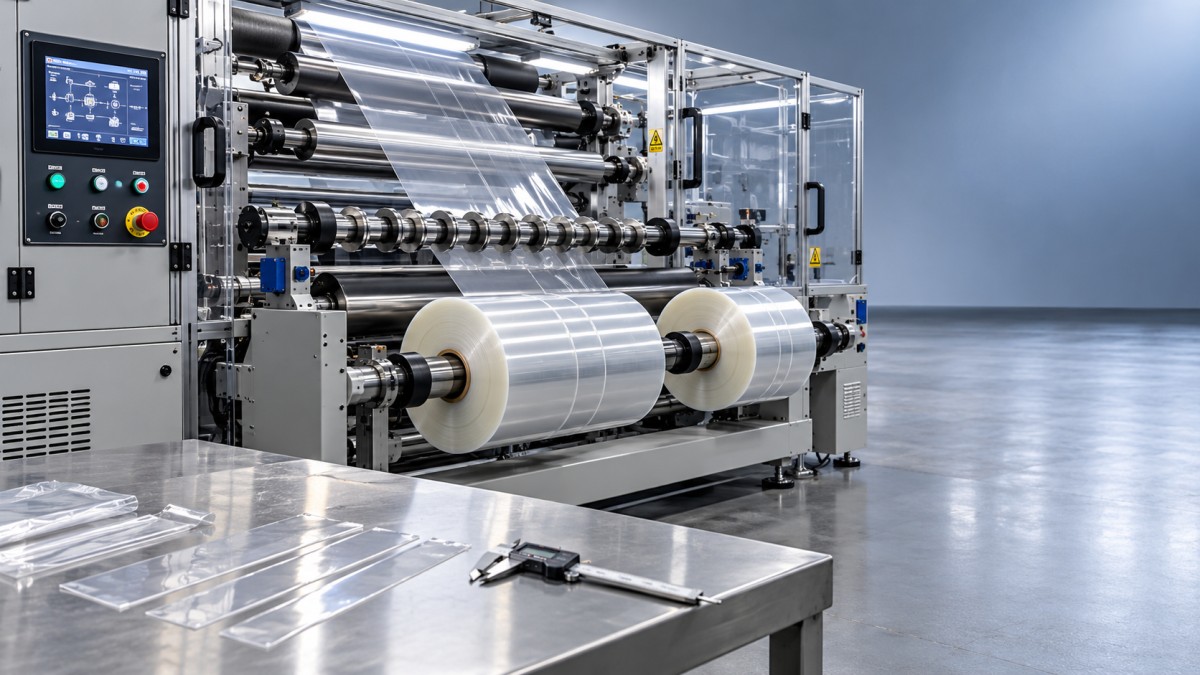
Use acceptance measures suited to the process rather than one generic performance score.
Separate mechanical limits from material and setup effects
Similar defects can have different causes. Wrinkles may originate in incoming reel quality, alignment, roller condition, or tension control. Weak seals can result from inadequate dwell time, uneven jaw pressure, contamination, or an unsuitable sealing window. Increasing heat may improve one symptom while distorting the web or damaging the sealant.
When a defect appears, change one relevant variable at a time and retain samples tied to the settings. Record whether the correction works across the required speed range. A successful sample obtained through constant manual adjustment provides weaker evidence than stable output from a documented recipe.
Preserve the trial’s material identities, settings, quality results, and exclusions in a signed report. If a critical material was unavailable, keep that application unresolved in the commercial evaluation. Extrapolating from a different structure should carry an explicit qualification and a defined route to later verification.
Turn demonstrated performance into acceptance terms
Factory acceptance and site acceptance answer different questions. The factory trial establishes performance under the manufacturer’s conditions. Site acceptance establishes whether the installed equipment achieves agreed results with the actual utilities, material handling, integration, and production environment.
Define acceptance using saleable output over an agreed observation period, with clear treatment of startup waste, planned adjustments, material defects, and machine faults. Peak mechanical speed is a poor substitute for this measure. Also specify the measurement method, sampling frequency, instruments, and authority for resolving disputed results.
Carry the trial configuration into the contract. Identify installed options, control versions, tooling, inspection systems, and auxiliary equipment that supported the result. A quotation based on a different configuration makes the trial difficult to rely on.
Any deferred test needs a named deliverable and contractual consequence. Specify responsibility for repeat testing, associated material and travel costs, and the remedy if performance remains below the agreed threshold. Align payment milestones with verifiable deliverables, including documentation and successful site acceptance.
Assess spare parts by restoration time
A long spare-parts catalogue does not demonstrate readiness. Ask for a machine-specific list divided by failure consequence: parts whose failure stops production, parts that degrade quality, and routine wear items. For each critical item, establish the exact identifier, current revision, stocking location, replenishment basis, and whether replacement requires specialist setup.
Distinguish standard components from proprietary assemblies. A commercially available sensor may be straightforward to source locally, while a custom sealing jaw, coated roller, or motion-control assembly requires drawings, manufacturing capacity, or application-specific configuration. “Available from stock” needs a location and dispatch commitment; it does not automatically mean rapid arrival at the installation site.
The initial spares package should reflect credible downtime exposure. Useful questions go beyond whether a part is included:
- Does a replacement drive arrive with the correct firmware, parameters, and a verified restoration procedure?
- Custom tooling needs drawing revisions, material specifications, and an agreed reorder route. A part number alone leaves too much unresolved.
- For repaired or exchange assemblies, establish the return conditions, turnaround basis, and whether a temporary replacement exists.
- Elastomers, adhesives, batteries, and other storage-sensitive items need suitable storage instructions and replacement planning.
Request the policy for component obsolescence and engineering changes. Establish how replacement parts will remain compatible, who pays for required control modifications, and what documentation accompanies a revised assembly. A nominally available substitute can create a substantial outage if fitting it requires unplanned programming or mechanical work.
Test the support route before relying on it
“Remote support included” leaves several unanswered questions. Specify service hours, applicable time zone, supported languages, initial response targets, escalation routes, and the conditions that trigger an on-site visit. Distinguish acknowledgment of a request from active diagnosis and from restoration of production.
Use a realistic fault scenario during evaluation: a line stops on a drive alarm after a power interruption, or intermittent registration errors appear after a format change. Ask the service organization to explain what information it needs, who reviews it, and what happens when remote diagnosis fails. This reveals whether support follows a usable process.
Remote access also needs a workable technical arrangement. Confirm connection requirements, site authorization, access controls, session records, and the method for transferring diagnostic files. Where continuous connectivity is unavailable, establish an alternative. A support promise is difficult to use when the connection method conflicts with site IT requirements.
For on-site support, verify engineer coverage and relevant process experience. Mechanical availability alone is insufficient when the fault involves web handling, motion control, adhesive application, or seal formation. Clarify travel arrangements, chargeable time, subcontractor involvement, and responsibility when the equipment manufacturer and a component supplier disagree about the cause.
Documentation determines how much support is needed
Request sample documentation before placing the order. Electrical and pneumatic drawings, lubrication schedules, fault descriptions, maintenance procedures, and spare-parts drawings should identify the supplied machine revision. Generic manuals often leave gaps around optional modules and customized controls.
Include backups of machine parameters, recipes, and control software where contractually available, together with the permissions needed to restore them. Clarify software licenses and access rights. Training should cover adjustment limits, fault recovery, changeovers, and routine maintenance using the delivered machine. Record what was taught and retain the supporting material for future staff changes.
Compare lifecycle costs using the same production assumptions
Compare offers against a shared job mix and operating schedule. Include installation, utilities, tooling, changeover waste, consumables, maintenance labor, service charges, software fees, and the initial spare-parts inventory. Keep financing assumptions consistent so that differences in payment structure do not obscure equipment economics.
Use trial results to estimate productive time and waste, then test how the comparison changes when a major assumption changes. Frequent short runs give changeover time greater weight. Long campaigns place more emphasis on stable quality and sustained output. A low purchase price loses its advantage if routine faults require extended overseas service visits.
Separate measured evidence from quotations and unverified claims in the comparison sheet. Treat unsupported lead times or untested material capability as open items with commercial consequences, rather than quietly assigning them favorable values.
The final selection should leave a traceable record: which applications were demonstrated, which performance limits were accepted, what restores the machine after a failure, and who is accountable for unresolved work. Before order release, attach those records to the technical and commercial agreement so that the delivered equipment can be judged against the same evidence used to choose it.
Related News
Get weekly intelligence in your inbox.
No noise. No sponsored content. Pure intelligence.
