
How to Specify Custom Cosmetic Packaging Equipment for Fast Changeovers?
A cosmetic packaging line can appear productive during a long run and still fail the project’s real test: the moment production changes from a small serum carton to a metallic skincare sleeve, a windowed gift box, or a short-run launch SKU. Operators may need to exchange tooling, reset guides, adjust glue patterns, correct registration, and stabilize feeding before saleable cartons appear. The resulting loss is not limited to changeover time; it can create damaged premium substrates, inconsistent shelf appearance, missed production windows, and uncertain scheduling.
The core specification decision is to define fast changeover as a controlled, repeatable production state, not simply a promise that equipment can be adjusted quickly. Custom packaging equipment for cosmetics should be specified around the real SKU mix, the degree of size and material variation, the required decoration quality, and the maximum acceptable time and waste between approved runs. A machine with servo-driven settings and saved recipes may be the right choice for frequent dimensional changes, while a largely mechanical platform can be appropriate when carton formats are stable and tooling changes dominate the reset process.
Start with the changeover events that actually interrupt production
“Cosmetic packaging” is too broad to be a useful equipment requirement. A project team should first separate the work into distinct production events. A folding carton line that processes tuck-end perfume cartons has different demands from a line handling reverse-tuck skincare boxes with tight folds, metallic board, embossing, or glued inserts. The equipment supplier needs to understand which variables change from run to run and which remain fixed.
Build the equipment specification from a representative SKU matrix rather than from the single fastest-selling carton. Include the smallest and largest blank, the lightest and heaviest board, coated and uncoated surfaces, dark printed stock, metallic or laminated material, window-patched blanks where relevant, and cartons with demanding glue geometry. Also identify whether frequent changes involve only dimensions or include carton style, board stiffness, print finish, tooling, glue application, and packing configuration.
Ask production, engineering, quality, and maintenance teams to mark each event as either a routine adjustment, a tooling change, or a format conversion requiring skilled intervention. This distinction prevents a misleading specification. A supplier may describe “quick setup” when the claim applies only to guide movement, while the real delay comes from replacing folding carriers, changing die-cutting tools, warming adhesive systems, or stabilizing difficult substrates.
Define a measurable changeover boundary
Fast changeover cannot be evaluated unless the start and end points are written into the user requirement specification. The start point might be the final acceptable carton of the previous SKU, after clearing material and recording production status. The end point should be the first carton that meets agreed quality criteria at a defined operating condition. It should not be merely the first carton discharged from the machine.
For each changeover class, state what is included: cleanup, material removal, tooling exchange, loading the next recipe, mechanical adjustments, glue stabilization, inspection setup, sample approval, and return to production speed. Separate planned conversion time from time lost to a process that does not stabilize. Both matter, but combining them hides the source of the problem.
A useful approach is to define at least three changeover categories:
- Recipe-only change: same carton family and tooling, with adjustments to dimensions, speeds, and glue settings.
- Format change: different blank size or carton geometry requiring rails, plows, carriers, or other format parts.
- Tooling and material change: a switch involving die-cutting tooling, board type, surface finish, adhesive system, or substantially different carton construction.
Each category should have its own acceptance target. Do not require identical conversion performance from a minor size change and a complete shift from a compact straight-line carton to a highly decorated multi-panel pack. The objective is not to make every change look fast on paper; it is to ensure that the expected conversion workload matches the production plan.
Specify the mechanical features behind repeatability
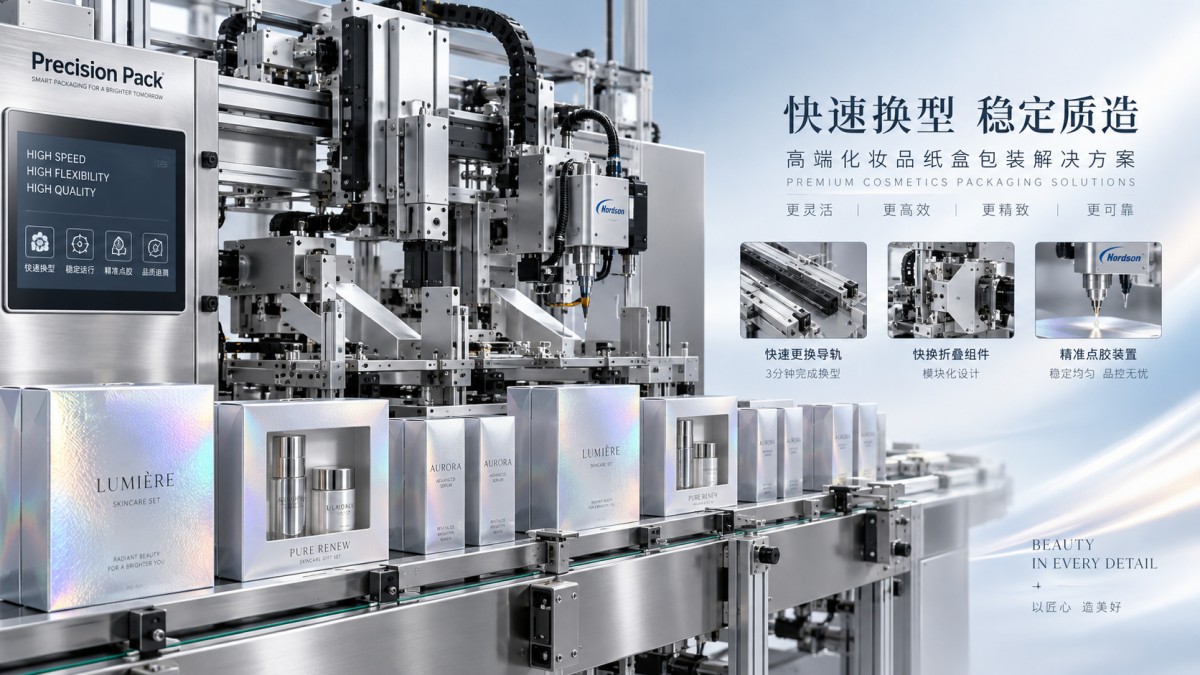
Fast conversion is usually limited by how many settings depend on operator judgment. Hand wheels, unmarked sliding elements, and trial-and-error guide positions can work in low-mix production, but they make short runs difficult to schedule. Where SKU changes are frequent, require indexed adjustment points, readable scales, repeatable locating features, and clearly identified format parts. Mechanical simplicity still has value, provided the machine can return to a known condition without extended tuning.
Recipe control must correspond to physical motion
A stored recipe is useful only when the linked axes and settings actually return to the required position. Specify which settings are servo-controlled, motorized, manually indexed, or manually adjusted without position feedback. This may include feeder timing, side-guide position, transport belts, folding rails, compression section settings, carton spacing, glue gun location, and discharge parameters.
For automated axes, ask whether the operator selects a named product recipe, whether the system confirms movement completion, and whether restricted access prevents unapproved edits. Recipe records should identify the relevant carton revision, board type, adhesive program, format-part set, and quality settings. A generic file name is not enough when artwork or carton construction revisions look similar but require different setup conditions.
Tool-less does not mean error-proof
Tool-less adjustment can reduce physical work, but it does not automatically prevent incorrect setup. A well-written specification should require poka-yoke features where interchangeable components could be installed in the wrong position or orientation. Color coding, part identification, keyed mounting, location sensors, and prompted setup instructions can reduce errors during rushed production changes.
Format parts should be evaluated for change frequency, weight, storage method, cleaning needs, and adjustment sensitivity. A part that takes only a few minutes to exchange may still be unsuitable if it requires careful realignment after every installation. Ask which parts are dedicated to a carton family, which are universal, and what spare parts are necessary to avoid a production stop when a component is damaged.
Protect premium surfaces while improving speed
Cosmetic cartons often expose a conflict between throughput and appearance. High-gloss varnish, soft-touch coatings, foil, embossing, dark solids, and delicate decorative panels may mark or scuff at points that are not obvious during a dry demonstration. A fast line that needs frequent manual intervention to reject damaged cartons is not a flexible line.
Material handling requirements should describe both the carton and the visible surfaces. Specify permitted contact zones where possible, particularly for cartons with a front display panel, foil stamp, or sensitive coating. Discuss belt material, guide design, blank separation method, transport pressure, folding contact points, and delivery accumulation. The supplier should demonstrate handling using representative production materials rather than only plain test stock.
Feed reliability deserves the same attention. Lightweight cartons may double-feed or skew; heavy boards may resist separation; laminated blanks may carry static charge; cut edges can catch on guides. Relevant options can include adjustable air assistance, vacuum separation, static-control provisions, feeder monitoring, double-sheet detection, and jam detection. The correct selection depends on the actual blanks, not on a general assumption that all paperboard behaves alike.
Make quality inspection part of the equipment decision
Changeovers introduce quality risk because a new setup can produce cartons that appear acceptable at low speed but drift when the line accelerates. Define the defects that must be prevented, detected, or rejected: skewed blanks, incorrect fold alignment, open seams, misplaced glue, incomplete glue, crushed edges, surface damage, wrong carton orientation, and mixed product. The appropriate inspection level depends on the consequence of each defect and the practicality of correction.
Vision systems can help with orientation, code presence, position checks, and visible feature verification, but the scope must be specific. A camera intended to confirm that a carton is present is not automatically capable of approving fine decorative registration. Define the feature, tolerance method, inspection location, reject mechanism, image retention requirement, and response to repeated failures. Clarify whether the system stops the machine, rejects individual cartons, alarms the operator, or logs an event for review.
Glue verification should receive particular scrutiny. It is not enough to specify a glue system; the project team needs to define adhesive type, expected open time, application pattern, minimum bond requirement, warm-up and purge procedure, and method for confirming that adhesive is present in the correct location. A recipe-controlled glue program may shorten setup, but only if nozzle positions and carton tracking remain accurate through the full speed range.
Connect the machine to the line without creating new delays
A folder-gluer, die-cutter, cartoner, or inspection station does not operate in isolation. Poor interface design can erase the benefit of a fast local changeover. Before selecting custom packaging equipment for cosmetics, map the upstream and downstream conditions: blank delivery orientation, buffer capacity, batch separation, inspection rejection flow, packing requirements, and how partially processed material is handled during a conversion.
Mechanical interfaces should identify height, direction of travel, transfer control, safe access zones, accumulation behavior, and transfer conditions for delicate cartons. Controls integration should define ownership of start/stop signals, emergency-stop behavior, speed synchronization, fault messaging, production counts, recipe handshakes, and status reporting. If the equipment will connect to a manufacturing execution system, confirm which data are available at machine level and whether production records distinguish gross output, accepted cartons, rejects, and setup waste.
Recipe management across connected equipment is a common weak point. A printing or die-cutting job reference may not match the folder-gluer recipe name, glue recipe, inspection program, or case-packing configuration. Require a documented method for product identification and revision control. The aim is to prevent an operator from loading the right carton blank but selecting a program from an earlier artwork or construction version.
Use representative trials to expose hidden conversion work
Supplier demonstrations are valuable only when they test the conditions that drive the purchase decision. A factory acceptance test should include selected production-like carton samples, approved adhesives where practical, and a defined sequence of conversions. It should not be limited to a single carton run at a favorable speed.
Before the test, agree on the sequence, participating personnel, data to be recorded, and acceptance definitions. Observe who performs each task and whether that task can reasonably be completed by the intended production role. Record adjustments that occur outside the stated procedure, manual touch-ups required to achieve quality, stops during acceleration, and cartons removed before stable output begins.
- Run the first SKU until operating conditions are stable and sample quality is approved.
- Stop according to the agreed boundary and perform the specified format or recipe change.
- Document manual adjustments, component changes, tools used, and any settings that were not part of the stored recipe.
- Restart, bring the machine to the agreed evaluation speed, and inspect cartons over an agreed production period.
- Repeat with a second SKU that challenges different variables, such as board stiffness, carton size, or glue pattern.
The site acceptance test should verify that the installed line performs similarly after transport, commissioning, and integration. It is also the appropriate time to confirm operator training, maintenance access, safety guarding, spare format parts, recipe backup, and documented recovery procedures after a jam or power interruption.
Where specifications often become too vague
Requirements such as “easy operation,” “high automation,” or “quick change” invite interpretation rather than accountability. Replace them with observable conditions. State the number of operators expected during each changeover class, the required tools, whether format parts are included, which settings are recalled automatically, and how the first approved carton is determined. Where a requirement depends on substrate behavior, attach representative samples and describe the condition in which they will be tested.
Also avoid using maximum machine speed as the primary basis for selection. The productive capacity of a cosmetic packaging line is shaped by usable speed, run length, planned conversion frequency, startup waste, rejection rate, and availability of people and materials. A machine that reaches a lower peak speed but returns reliably to approved output can better fit a high-mix schedule than one that performs impressively only on long, stable runs.
The strongest equipment specification treats changeover as a production process with defined inputs, controlled adjustments, verifiable quality, and clear handoffs. That gives engineering teams a practical basis for comparing suppliers and prevents the final decision from resting on broad claims about flexibility.
Related News
Get weekly intelligence in your inbox.
No noise. No sponsored content. Pure intelligence.
