
Panel Edge Banding for Cabinets: How to Choose PVC, ABS or Wood Veneer
Choosing panel edge banding for cabinets involves more than matching colors and finishes. PVC, ABS and wood veneer differ in impact resistance, heat tolerance, moisture performance and processing requirements—factors that affect both cabinet durability and production efficiency. For technical evaluators, the right choice depends on the panel substrate, adhesive system, edge banding equipment and intended application. This guide compares the three materials and highlights the criteria needed to make a well-informed specification.
The most useful starting point is not the edge material in isolation, but the finished assembly. A robust strip can still fail on a poorly prepared particleboard edge, while an attractive veneer can disappoint if its finish and adhesive were not selected for the cleaning conditions. Evaluate the panel, bond line, edge and production process as one system.
Where the three materials differ
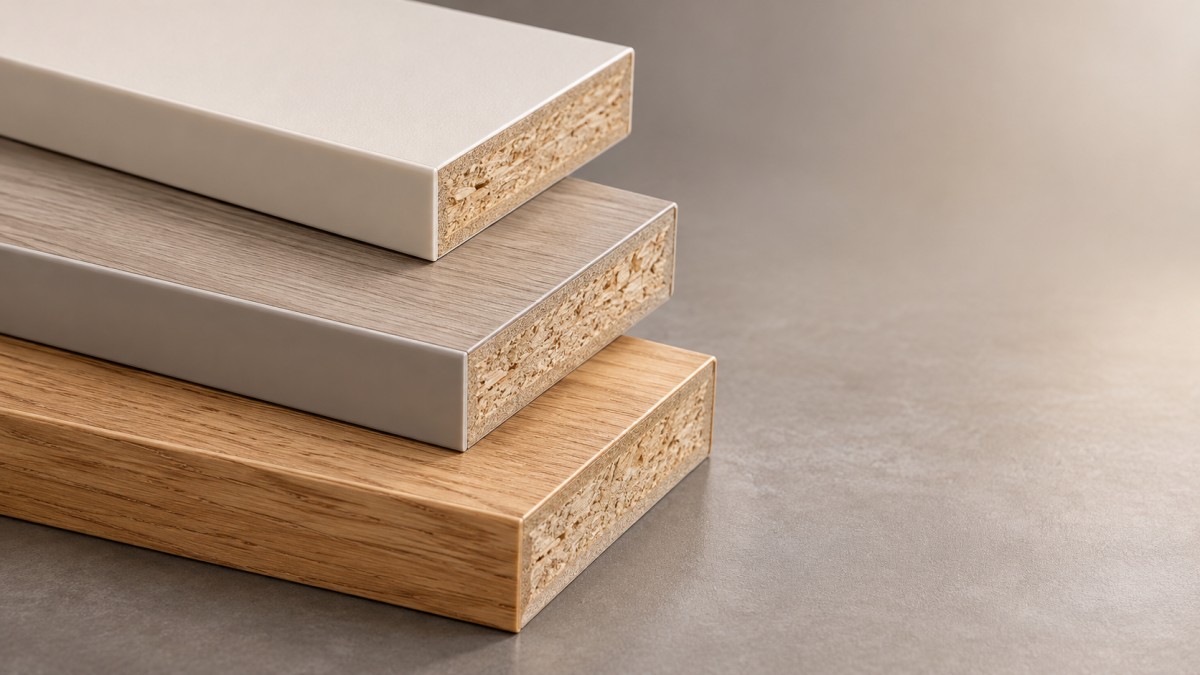
PVC edge banding is a familiar choice for laminated cabinet panels because it is available in many colors, patterns, widths and thicknesses. It is flexible, generally resistant to routine moisture exposure and well suited to automated processing when the correct grade and machine settings are used. A thicker PVC edge can also provide useful protection against knocks on exposed cabinet fronts and shelves.
Its limitations are easy to overlook. Color and gloss can vary between batches or suppliers, especially when matching a decorative panel. Heat performance depends on the formulation and adhesive system, so a sample that passes an ordinary handling test should not automatically be approved for use beside an oven or other heat source. Disposal and recycling requirements also deserve review where the project has material-specific restrictions.
ABS edge banding is another thermoplastic option, often considered where buyers want a chlorine-free material or a particular surface appearance. Like PVC, it can be supplied in decorative finishes and processed on compatible edge banders. It can provide good impact performance, but the result depends on the grade, thickness and temperature in service; the material name alone does not establish which product will resist damage better.
ABS should not be treated as a drop-in replacement without a trial. Cutting and scraping behavior, bonding characteristics and color matching can differ from the PVC already qualified on a line. Ask the supplier for processing guidance and confirm that the specific backing or primer is compatible with the proposed adhesive.
Wood veneer edge banding is selected when a real wood surface matters: for example, where cabinet doors and panels use a matching veneer, or where a transparent finish is expected to show natural grain. It can be stained or finished with the rest of the assembly, subject to the product and finish system. That visual continuity is difficult to reproduce convincingly with a printed decorative strip on some premium work.
Natural variation is part of the material. Species, grain direction and finish absorption influence the final match, and veneer may be more sensitive to chipping during trimming. It also needs a suitable protective finish for the intended exposure. A well-finished veneer edge can serve successfully in cabinetry, but it should not be specified as inherently waterproof or as equivalent to a thermoplastic edge in every impact situation.
Start with the cabinet’s exposure points
A kitchen cabinet may contain several different edge conditions. A visible door edge is handled repeatedly and judged closely for color and glue-line appearance. The lower edge of a sink cabinet may see splashes, damp cleaning cloths or occasional leaks. An internal shelf may face less moisture but more abrasion from stored items. One edge specification for the entire cabinet is convenient, but it is not always the most economical or technically appropriate choice.
For frequently handled fronts, compare impact resistance and edge thickness using actual samples rather than assuming that a thicker strip always gives a better result. Thickness also affects the corner radius, machining requirements and visual transition to the panel face. For less visible internal parts, a thinner edge may be sufficient if it survives handling, assembly and the intended service conditions.
Near sinks and dishwashers, examine the complete moisture path. Water can enter through an interrupted bond line, a damaged corner, an unsealed joint or a cutout that was never edge-banded. PVC or ABS may resist water themselves, but neither can make a vulnerable substrate waterproof. Veneer edges require particular attention to finish coverage at the ends and corners.
Heat needs a similarly local assessment. Cabinets beside cooking appliances may experience conditions very different from those elsewhere in the room. Check the appliance manufacturer’s installation clearances and test the assembled edge for the expected exposure. Do not rely on a generic heat-resistance claim for the strip when the adhesive may be the limiting component.
The bond line is often the deciding factor
Edge banding adheres to the substrate through a combination of surface preparation, adhesive wetting, pressure and cooling or curing. If any part of that sequence is inconsistent, changing from PVC to ABS will not necessarily solve the problem.
EVA hot-melt adhesive is widely used in cabinet production and can be a practical choice for many applications. PUR hot melt is often evaluated where greater resistance to moisture and heat is required. Its suitability still depends on the specific product, application conditions and cure. PUR also requires appropriate handling, cleaning and operator precautions; consult the adhesive supplier’s instructions and safety documentation before specifying it for an existing line.
Laser and other hot-air activation systems can create a visually narrow joint using compatible functional-layer edge bands. They are not simply alternatives that can be applied to any conventional roll of edging. Confirm that the edge construction, activation equipment, line speed and substrate are designed to work together. A nearly invisible joint is an appearance target, not proof that the assembly will resist standing water or prolonged heat.
Substrate quality matters as much as adhesive selection. A chipped or dusty particleboard edge offers uneven contact; an inconsistent panel thickness changes the trimming result; and a poor pre-milled surface can leave gaps that show through the finished joint. MDF, particleboard and plywood can also behave differently at the cut edge. Run qualification samples on the actual board grade rather than a convenient substitute.
Check the equipment before approving the sample
A hand-applied sample can establish appearance, but it does not show how an edge will behave at production speed. Edge stiffness, roll curvature and thickness affect feeding. Pre-milling, glue application, pressure rollers, end trimming, top and bottom trimming, corner rounding, scraping and buffing must all be considered where those functions are present.
For PVC and ABS, inspect the trimmed edge for chatter, whitening, tearing and an uneven radius. Scrapers set for one material may leave marks on another. Excessive buffing or heat can alter gloss, making a color match appear inconsistent even when the original strip and panel were close.
For veneer, inspect the direction of grain against the cutting action and look for splits at the leading and trailing ends. Tool condition is particularly visible on delicate or open-grained material. If the edge will be stained or lacquered after banding, include that finishing stage in the trial: squeeze-out or surface contamination may only become obvious after finish is applied.
PWFS follows both CNC woodworking and panel edge-banding processes because the two are connected. A clean, dimensionally consistent cut coming from the upstream operation gives the edge bander a better starting surface. When edge quality varies, examining cutting, dust extraction and panel handling can be more productive than repeatedly adjusting the glue station.
Specify the details that affect delivery and repeatability
The material designation should be only one line in the specification. Record the panel manufacturer and decor, edge supplier and product reference, nominal width and thickness, surface texture, gloss, color approval sample and acceptable visual variation. Confirm whether the back is primed or carries an activation layer, and identify the approved adhesive and application method.
Width must provide enough allowance for panel thickness variation and trimming without exceeding the machine’s capability or creating unnecessary waste. Thickness must fit the required impact performance and the available trimming and corner-rounding units. Also agree how rolls will be identified and how changes to formulation, primer or decor will be communicated before a replacement batch reaches production.
For veneer, add species, cut, grain expectations and finishing requirements. If responsible sourcing or chain-of-custody documentation is required by the project, request the relevant evidence for the specific material and supply chain. For PVC and ABS, request composition and end-of-life information relevant to the destination market and the customer’s procurement rules. None of these materials should be called universally recyclable or environmentally preferable without considering local collection systems and the complete assembly.
Sealing panel edges can reduce one potential route for emissions from exposed substrate, but it does not establish compliance with formaldehyde limits or make a cabinet emission-free. Check the panel documentation and applicable requirements for the destination market; assess the finished assembly where the project specification calls for it.
Build a qualification trial around likely failures
Before committing to a material change, make representative panels using the actual substrate, edge roll, adhesive and production settings. Include light and dark decors if glue-line visibility is important, and test both straight runs and the shortest or most awkward parts expected in production. Record settings so that a successful result can be repeated rather than reconstructed from memory.
Inspect bond continuity, end trimming, corners, surface damage and color under the lighting used for acceptance. Then evaluate adhesion and exposure performance using agreed test methods and acceptance criteria. Where a PUR adhesive is used, allow the specified curing conditions and time before drawing conclusions from durability tests. Moisture, heat, cleaning chemicals and impact should reflect the cabinet’s intended service, not an arbitrary demonstration.
The choice becomes clearer when the trade-off is stated in operational terms. PVC may be appropriate for a broad decorative program on a well-established line; ABS may fit a chlorine-free material requirement if its processing and finish are qualified; veneer may justify extra finishing and selection effort where genuine wood appearance is central. For each option, compare not just the roll price but also machine setup, scrap, finishing, supply consistency and the consequences of a failed edge.
Approve the combination that survives the intended exposure and runs consistently on the available equipment. If the appearance is right but the bond or trimming is marginal, resolve that issue in a documented trial before releasing the specification for routine cabinet production.
Related News
Get weekly intelligence in your inbox.
No noise. No sponsored content. Pure intelligence.
