
Carton Converting Machinery Prices: How Automation and Capacity Affect Your Budget
A lower carton converting machinery price does not necessarily produce a lower cost per finished carton. When one quotation covers manual feeding and another includes automatic feeding, stripping, inspection, and delivery, the purchase figures represent different production systems. The useful comparison is the installed cost of delivering your required saleable output, including labor, changeovers, waste, and support.
Automation generally raises the initial investment, while higher capacity can require additional spending on material handling, utilities, tooling, and downstream equipment. Neither premium is automatically justified. A short-run plant may gain more from faster setup than higher maximum speed; a repeat-order operation may benefit from sustained throughput and fewer manual transfers. Start with the workload and production bottleneck, then price the equipment configuration that addresses them.
First establish what each quotation actually includes
“Carton converting machinery” can refer to individual die-cutters, folder-gluers, corrugated box converting equipment, or linked production systems. Folding carton equipment and corrugated machinery are not interchangeable purchasing categories: board construction, feeding requirements, creasing behavior, and finished-box handling differ. Comparing their prices without defining the application produces little useful guidance.
Even within one equipment category, a base machine quotation may exclude functions that another supplier treats as standard. A die-cutter supplied without blanking or automated waste removal has a different labor requirement from one that delivers separated blanks. A folder-gluer may need additional modules for particular carton styles, glue inspection, rejection, or packing integration.
Before requesting prices, issue a common production brief covering:
- Materials: board type, thickness or caliper range, coatings, and relevant corrugated flute profiles.
- Product envelope: minimum and maximum sheet sizes, carton styles, finished dimensions, and glue patterns.
- Order profile: annual quantities, typical batch sizes, repeat frequency, and expected changeovers.
- Quality requirements: cutting and creasing tolerances, fold accuracy, glue verification, and acceptable defect criteria.
- Supply boundary: feeding, stripping, blanking, inspection, delivery, conveying, and packing functions to be included.
Ask suppliers to identify exclusions and required options against this brief. Where an option is necessary to process your products, move its cost into the comparable base configuration rather than leaving it outside the investment total.
Automation premiums should solve identifiable production losses
The term “automatic” is too broad to support a purchasing decision. It may describe continuous feeding, motorized adjustment, stored job recipes, in-line inspection, or an entire connected workflow. Each function addresses a different source of cost, and an expensive configuration can still leave operators performing the most time-consuming task.
Labor savings require particular care. Removing a manual transfer does not necessarily eliminate a position: operators may still load materials, replenish adhesive, check quality, remove waste, and pack output. Request a staffing plan showing responsibilities during normal running, replenishment, changeovers, and fault recovery.
Frequent short runs change the economics. Automatic settings may release more usable production time than a faster drive system because the machine spends less time between jobs. However, recipe recall cannot compensate for unsuitable tooling, inconsistent blanks, or carton styles that require extensive mechanical conversion.
Buy usable capacity, not nameplate speed
Published maximum speed is a machine capability under specified conditions, not a guaranteed output for every carton. Large sheets, difficult folds, unstable board, adhesive requirements, and demanding inspection can reduce operating speed. Feeding interruptions and downstream congestion further reduce finished output.
For budget planning, use accepted cartons per scheduled production hour. This captures the capacity available to fulfill orders rather than the speed displayed while the machine is running.
A practical capacity model is:
Saleable output = validated running rate × available running time × first-pass yield.
Available running time should deduct planned changeovers, cleaning, maintenance, and expected interruptions from scheduled hours. Keep the calculation consistent: do not apply another availability factor if those losses have already been deducted. For sheet-fed die-cutting, translate sheets into blanks using the approved layout; for gluing, verify how blanks translate into accepted finished cartons.
Build the model around representative job families rather than one average product. Separate straightforward repeat cartons from difficult formats and short batches. A machine that easily covers annual demand may still miss delivery requirements when several demanding jobs arrive together.
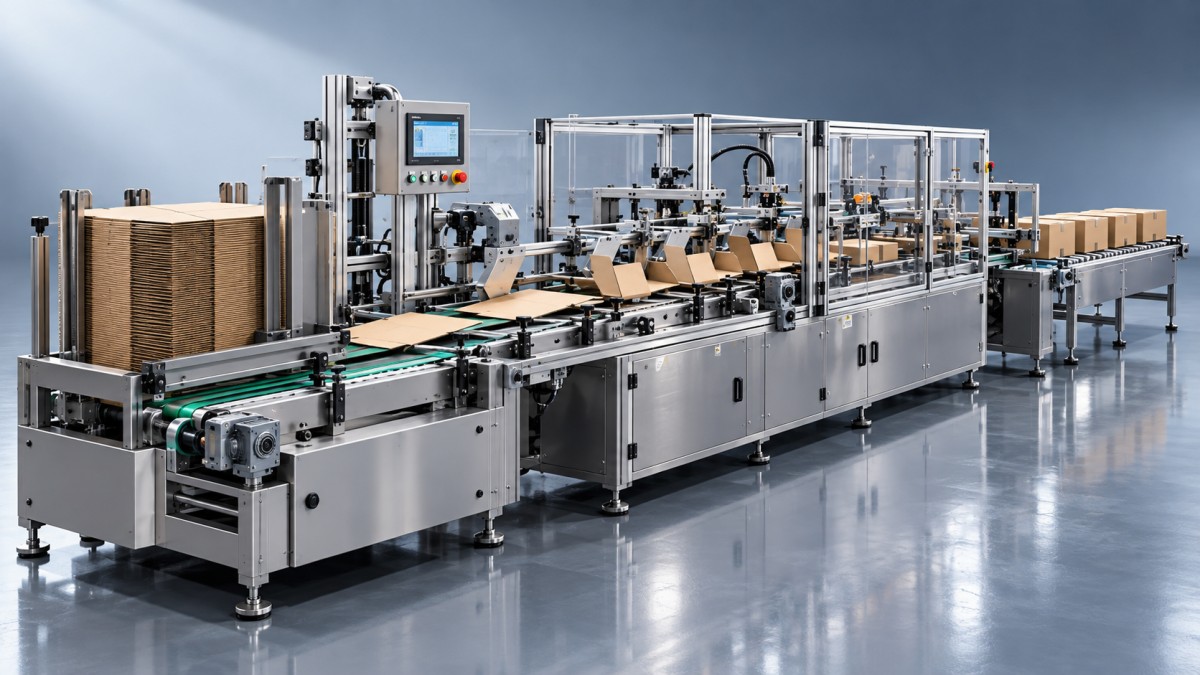
Follow material through the entire route: sheet preparation, die-cutting, waste removal, folding and gluing, inspection, packing, and dispatch preparation. Increasing die-cutting capacity will not improve shipped output when folder-gluing or packing remains constrained. It may instead increase work in progress, handling, and floor-space demand.
Capacity headroom should have a defined purpose, such as seasonal peaks, maintenance cover, or credible additional orders. Separate committed demand from forecast growth in the investment model. Otherwise, an optimistic sales assumption can make an oversized line appear economical before sufficient work exists to load it.
Build the budget from installed cost to ownership cost
The equipment price is only one part of the funding requirement. Maintain separate totals for acquisition, installation and startup, and ongoing operation so that a low base quotation cannot hide costs elsewhere.
Acquisition and site readiness
Include the required machine options, tooling, freight, insurance, applicable duties, unloading, rigging, installation, and commissioning. Confirm delivery terms and responsibility for each item. Currency exposure and payment timing also matter when comparing offers issued in different currencies or with different deposit requirements.
Site preparation may involve electrical distribution, compressed air, extraction, floor assessment, access modifications, and production layout changes. Request documented utility requirements and installation drawings before approval. A machine fitting into the available floor area does not establish that there is sufficient space for maintenance access, pallets, waste handling, and safe movement.
Tooling deserves its own budget line. Cutting dies, stripping and blanking tools, glue-system components, and format-specific parts may be needed before production can start. Confirm whether existing tooling is compatible rather than assuming it can transfer to the new equipment.
Operating and support costs
Estimate labor by shift and task, then add energy, compressed air, adhesives where applicable, wear parts, maintenance, software charges, and technical support. Ask which services are included during the warranty period and which remain chargeable. Remote diagnostics may require subscriptions, network access, or additional controls.
Downtime exposure depends on support arrangements as well as machine construction. Verify critical spare-part availability, service coverage, diagnostic access, and responsibility for travel costs. An inexpensive component can create a disproportionate production loss when replacement delivery is uncertain.
Include startup training, trial materials, commissioning waste, and the production disruption associated with installation. Financing costs should be included consistently across alternatives. If residual value is used, treat it as an estimate and test the decision without it.
Compare alternatives using cost per accepted carton
A consistent ownership model makes different automation levels easier to compare:
Cost per accepted carton = annualized installed investment plus annual operating costs, divided by annual accepted output.
Use the same evaluation period, financing assumptions, labor rates, and production schedule for every option. Include only relevant costs on a consistent basis; for example, do not charge board consumption to one alternative while excluding it from another. Separate conversion cost from material cost when that makes the decision clearer.
Run a demand downside case as well as the expected case. Automation that performs well at high utilization may be difficult to justify when order volume falls. Also test the effect of longer changeovers, lower running speed, and higher maintenance expenditure. These sensitivities show which assumptions need supplier validation before approval.
A simple payback calculation can help screen an upgrade, but it should use net annual cash benefit rather than gross labor savings. Deduct added maintenance, software, energy, and support costs. Count additional output as a benefit only when there is credible demand and the remaining production route can process it.
Avoid counting the same gain twice. Time released by faster setups may support either reduced overtime or additional production, but both benefits cannot automatically be claimed for those same hours.
Turn supplier demonstrations into purchasing evidence
Trials should represent the products that create risk, not only the easiest carton in the portfolio. Provide agreed materials, drawings, tooling requirements, and quality criteria. Record any differences between trial conditions and the proposed production installation.
- Observe a complete changeover. Measure from the last acceptable carton of the previous job to stable acceptable output on the next, including adjustment waste.
- Run difficult materials and formats. Check feeding, creasing, folding, adhesive performance, and inspection using relevant substrates.
- Record staffing and interruptions. Note manual assistance, replenishment stops, waste removal, and downstream congestion.
- Inspect accepted output. Assess agreed dimensional and functional requirements rather than judging quality only by appearance.
- Check restart procedures. Review fault recovery and safe intervention with qualified personnel under the supplier’s procedures.
Translate the findings into written acceptance criteria. Specify the materials, carton formats, tooling, staffing, quality limits, and test conditions attached to any throughput commitment. Distinguish factory acceptance from site acceptance, where utilities, installation, and integration can affect performance.
Choose the configuration whose premium you can defend
A lower-priced semi-automatic machine remains a reasonable option when demand is intermittent, staffing is available, and validated output meets delivery needs. A faster automated system becomes more persuasive when repeat work can keep it loaded and material flow supports sustained operation. For a short-run business, setup automation may deserve priority over maximum speed.
Where future growth is uncertain, request a written upgrade path rather than assuming modules can be added later. Confirm mechanical provisions, controls compatibility, installation downtime, and which upgrades require factory work. Compare the cost of preparing for expansion now with the disruption of retrofitting later.
The approval document should show the comparable installed price, validated saleable capacity, expected staffing, ownership cost, and unresolved acceptance conditions for each offer. Any automation premium should connect to a measurable production constraint. Any capacity premium should connect to a workload the rest of the plant can actually deliver.
Related News
Get weekly intelligence in your inbox.
No noise. No sponsored content. Pure intelligence.