
Paper vs. Wood Retail Displays: Choosing for Load Capacity and Service Life
Corrugated paperboard is a strong candidate for a retail display with a defined campaign period, controlled indoor conditions, and merchandise loads that its structure has been tested to support. Wood-based construction becomes more attractive when shelves must carry sustained loads across wider spans, tolerate repeated replenishment, or remain in service through several campaigns. Neither material comes with a reliable load rating or service life independent of the finished design.
For technical evaluators comparing paper and wood systems for retail, the decision should start with the merchandise, shelf geometry, store environment, and intended handling. A reinforced corrugated display can outperform a poorly supported wood-panel unit in a particular application. A wood display can also outlast several paper units while costing more to transport, maintain, and remove. The useful comparison is between complete structures performing the same job.
Define the load before comparing materials
A statement such as “supports 20 kg per shelf” leaves too much unanswered. Does it describe evenly distributed merchandise or a concentrated load? How long was the weight applied? Was the shelf supported along its sides, across its back, or only at its corners? Were the samples tested under conditions representative of the store? These details determine whether the rating is useful.
Start with the heaviest permitted stocking arrangement, including trays, dividers, and other accessories. Then consider how the merchandise bears on the shelf. Cartons with broad bases spread force differently from bottles with narrow contact areas or products supported on small feet. Two arrangements with the same total mass can produce different local damage and shelf deflection.
The stocking pattern also changes during use. Customers may empty one side first, while replenishment staff may temporarily group products near the front edge. Uneven loading can twist shelves, overload individual supports, or affect stability. A display that performs well when fully and symmetrically stocked may behave differently when partially empty.
Specify both shelf loads and the total display load. The base, sidewalls, connections, and floor contact points must carry the combined weight of the merchandise and the structure itself. A successful shelf test does not establish that the complete display can safely carry every shelf at its maximum rating simultaneously.
Geometry often decides which construction works
Shelf span is one of the most consequential design variables. Moving supports closer together can reduce deflection substantially, sometimes making a paper structure practical where an unsupported shelf would fail. Folded front edges, internal ribs, vertical partitions, and deeper structural sections can all improve performance. Their value depends on whether the assembled display maintains the intended load path.
Corrugated board gains strength from the interaction of its liners and fluted medium. Board construction, flute orientation, creases, cutouts, and assembly details influence how that strength reaches the finished fixture. A board specification or compression result alone cannot establish shelf capacity. A heavily printed and precisely cut component can still perform poorly if a fold buckles or a supporting tab disengages.
For paper displays carrying dense merchandise, examine where the shelf transfers its load into the sides and base. Broad bearing surfaces and well-supported vertical elements can be more useful than simply increasing board thickness. Narrow slots, small tabs, and unsupported edges deserve scrutiny because local crushing or tearing may start there before the larger panels appear distressed.
Wood-based displays require similar attention. Solid wood, plywood, MDF, and particleboard have different properties, and panel thickness is only one part of the assessment. Panel grade, support spacing, fastener placement, and connection design affect stiffness and durability. A thicker shelf will not correct a weak shelf bracket or a poorly secured back panel.
Wood construction also creates choices around assembly. A rigid factory-assembled unit may resist racking well but occupy more shipping space. A flat-packed unit reduces that volume, while its performance depends on assembly accuracy and the durability of its fittings. Repeated dismantling can damage screw holes or loosen connections unless the joints are designed for reuse.
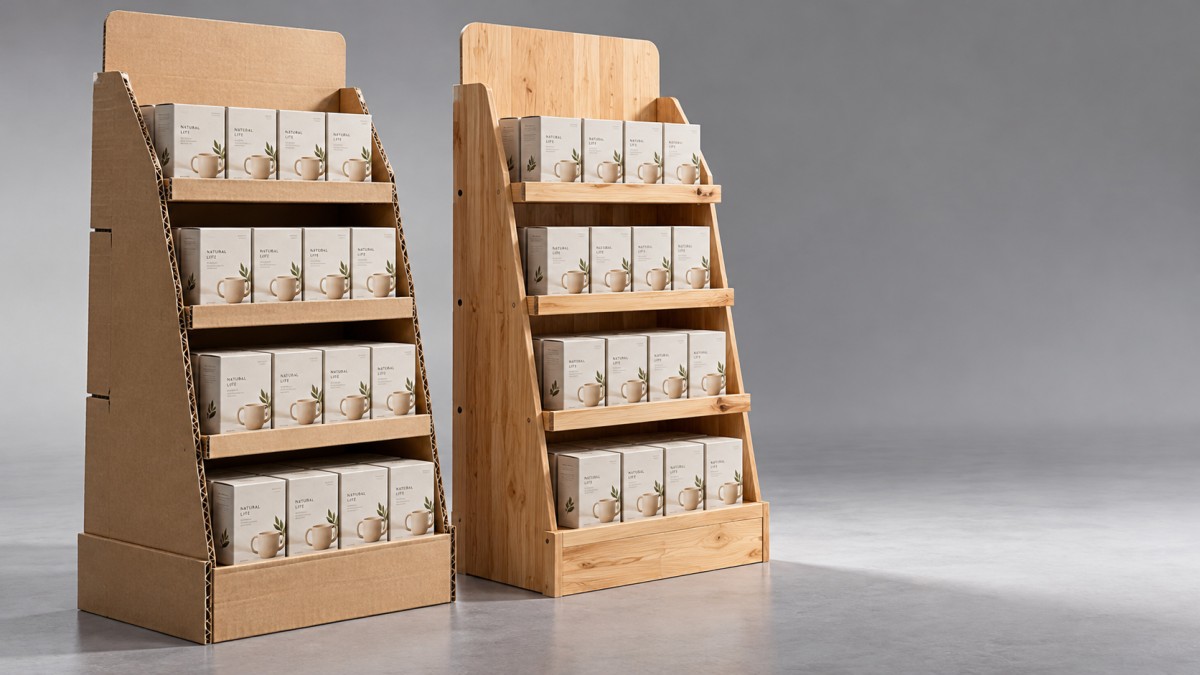
A useful design review follows the merchandise load downward: from the contact surface into the shelf, through its supports and joints, and finally into the base and floor. At each transition, ask what resists bending, crushing, withdrawal, or sideways movement. This makes weak connections easier to identify than a broad comparison of “paper strength” and “wood strength.”
Service life depends on sustained loading and store exposure
A display can survive initial loading and still become unsuitable during the campaign. Both paperboard and wood-based materials can deform under sustained stress, a behavior known as creep. For a retail fixture, the practical concern is whether that deformation interferes with presentation, product retention, or safe use before the planned removal date.
Corrugated shelves may gradually sag, and highly loaded support areas may compress. Moisture exposure can reduce paperboard stiffness and strength, making the combination of sustained load and humidity particularly relevant. A dry indoor store is different from a position near an entrance, a chilled merchandise area, or a floor that is frequently wet-cleaned.
Printing, coatings, and protective films may improve surface resistance, but they do not automatically protect cut edges, joints, and the base. A spill reaching an exposed edge can have a different effect from moisture on the printed face. Any claimed moisture resistance should therefore be assessed on the assembled display, including its vulnerable contact points.
Wood-based displays are also sensitive to exposure. Some panels can swell when moisture enters unprotected edges or fixing holes; finishes may crack, chip, or separate. Plywood and solid wood introduce their own considerations, including construction quality and dimensional movement. “Wood” is too broad a specification to establish suitability for damp conditions.
Handling can become the limiting factor even where static capacity is adequate. Replenishment brings impacts from cartons, abrasion from sliding products, and repeated contact with shelf edges. Moving a loaded display introduces forces that a stationary load test may never address. If staff are expected to relocate the fixture, that operation needs to be part of the design brief and validation.
Define service life through observable limits. These might include shelf sag that obstructs product removal, a leaning frame, loosened fittings, torn supports, or surface damage that makes the display unacceptable to the retailer. Separating structural and appearance criteria helps explain why a unit may remain standing yet already require replacement.
Ask for evidence that matches the finished display
Supplier load claims are most useful when accompanied by a description of the tested configuration and conditions. Results from a different shelf width, reinforcement layout, panel grade, or assembly method may not transfer to the proposed design. Substituting a material after approval can also change performance even when the finished display looks identical.
Before accepting a load rating, request enough information to answer these questions:
- Did the test use the complete production design, including the base, joints, graphics, and reinforcement?
- How was the load distributed, and did it represent the actual merchandise contact pattern?
- How long was the load maintained, and what temperature and humidity conditions were used?
- Were deflection, permanent deformation, joint movement, and stability assessed?
- Did the evaluation include relevant assembly, replenishment, handling, and moisture exposure?
A brief demonstration with weights establishes only a limited point: the sample supported that arrangement for that period under those conditions. It does not establish campaign life. Sustained-load evaluation is particularly useful when shelf deflection or local crushing could develop gradually. Where store conditions vary, testing should cover the credible conditions that could govern failure.
Acceptance criteria should be agreed before testing. “No collapse” is insufficient for a display whose shelves could sag enough to release products or whose frame could lean into a shopping route. Set limits for functional deformation, product retention, connection integrity, and overall stability. The test plan should also address foreseeable stocking imbalances and handling where relevant.
Do not assume there is one universal safety factor that makes every retail display suitable. Required margins depend on material variability, consequences of failure, uncertainty in loading, and the retailer’s requirements. The supplier should explain the basis of the proposed working load and the conditions that limit its use.
Choose around the intended use, then compare lifecycle cost
Corrugated construction deserves serious consideration for a time-limited promotion with compact shelves, manageable product loads, and a controlled indoor location. It can combine the structural package with campaign graphics and may be supplied in a form that simplifies distribution. Its suitability strengthens when the design needs few handling cycles and has a clear removal date.
A short campaign does not automatically make paper appropriate. Dense products, wide unsupported spans, frequent spills, or repeated relocation can make the structure demanding even over a limited period. Adding partitions may solve the strength problem but reduce usable merchandising space. That tradeoff belongs in the selection decision.
Wood-based construction is a stronger candidate for fixtures that remain in place through repeated campaigns, support heavier merchandise, or experience frequent replenishment. Its longer useful life depends on durable joints, suitable finishes, and a layout that can adapt to future products. A robust fixture that becomes commercially obsolete after one campaign may deliver little value from its remaining structural life.
Hybrid construction can resolve a specific constraint. A reusable wood base or frame may carry replaceable corrugated graphics, while a paper display may use a separate reinforcement element where shelf bending governs performance. Such combinations add assembly and material-separation requirements, so the benefit should be clear: a longer usable life, a more reliable load path, or simpler campaign changes.
Compare costs over the same intended operating period. Include purchase, freight volume and weight, store assembly, replacement units, maintenance, storage between campaigns, and removal. A lower purchase price can be offset by replacement labor or damaged merchandise. A higher initial price can also be difficult to justify if return transport and storage prevent reuse.
For a final decision, give competing suppliers the same merchandise layout, shelf dimensions, exposure conditions, handling expectations, and service period. Ask each to identify the component most likely to limit performance and provide evidence that it remains acceptable throughout that use. Choose corrugated paperboard when the validated design comfortably covers a defined campaign; choose wood-based construction when sustained duty and achievable reuse justify it. If neither proposal can support its claimed working life, revise the span, supports, or stocking plan before approving the material.
Related News
Get weekly intelligence in your inbox.
No noise. No sponsored content. Pure intelligence.
