
Choosing a Furniture MES Supplier: ERP and CNC Integration Checks
A furniture order can be correct in ERP yet still reach the CNC router with an outdated drilling pattern, missing edge instructions, or the wrong material thickness. Choosing an MES furniture software supplier therefore starts with proving the complete order-to-machine-to-ERP workflow—not comparing dashboards. Require evidence that revisions, part identities, machine programs, and production results remain consistent across every handoff.
The strongest candidate is not necessarily the one claiming the most integrations. It is the supplier that can document your specific ERP and machine connections, identify who owns each interface, and pass agreed tests using representative furniture orders. Without those checks, procurement risks buying software while leaving the most expensive integration work undefined.
Establish where ERP ends and production engineering begins
Before requesting demonstrations, map the actual information route. In panel furniture production, ERP may hold the sales order and commercial bill of materials, while design or engineering software generates manufacturable parts. CAM or nesting software then creates machining programs. MES typically coordinates release, dispatch, tracking, and feedback, but its responsibilities vary by implementation.
Do not assume MES converts an ERP bill of materials directly into safe, machine-ready CNC code. Ask which application creates geometry, applies machining rules, performs nesting, and runs the postprocessor. A supplier should distinguish its own functions from third-party software and custom development.
Attach this boundary map to the request for quotation. Otherwise, two suppliers may quote apparently similar systems while one includes engineering integration and the other expects the factory to provide finished machining files.
ERP connectivity: test business meaning, not just data transfer
An interface can successfully transmit a message and still create the wrong production instruction. A quantity expressed in sheets may be interpreted as individual panels; a finished dimension may be confused with a rough-cut size. Evaluate mappings at field and workflow level, rather than accepting “API available” as sufficient evidence.
Request a sample interface contract
The supplier should show the supported ERP version, connection method, authentication approach, required modules, and any middleware. Whether the integration uses APIs, managed file exchange, or another supported mechanism matters less than whether it fits your operating requirements and remains maintainable.
For representative orders, inspect mappings for order and line identifiers, part numbers, revisions, quantities, units, material codes, thickness, grain direction, routing, and due dates. Include edge specifications where they affect downstream operations. Check how blank values, unavailable materials, and invalid codes are rejected or held for review.
Custom furniture creates an additional challenge: visually similar parts can belong to different assemblies or installation locations. The integration must preserve the identifiers needed to distinguish them. Confirm whether identity is maintained at order, assembly, part-type, or individual-piece level, and whether that granularity supports sorting and rework.
Follow a change after production release
Ask the supplier to demonstrate an order revision after some parts have already been cut. The system should identify affected work, preserve completed quantities, and prevent obsolete instructions from being released again. It should not simply overwrite the original BOM and leave operators to discover the mismatch.
Define authority for cancellations, quantity changes, substitutions, and due-date changes. Also establish how actual consumption, scrap, work-in-progress, and completions return to ERP. A machine cycle ending does not necessarily mean that every part passed inspection or that an entire order is complete.
CNC integration must match the controller and production method
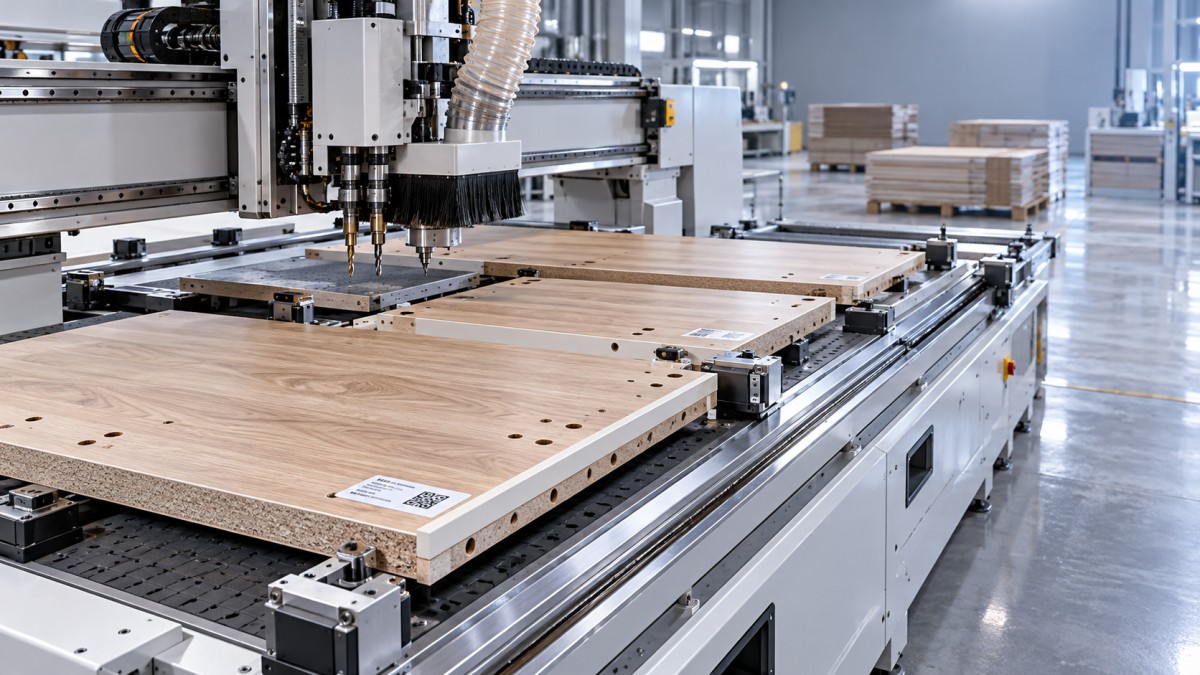
“Compatible with CNC routers” is too broad for a purchasing decision. Supply the exact machine models, controller versions, available communication options, and current programming workflow. Include standalone routers, nesting cells, drilling machines, and any linked handling equipment within the proposed scope.
Separate program delivery from machine feedback. Sending a file to a shared folder is not the same as confirming that the intended program was selected, executed, and associated with the correct parts. Older equipment may require operator scanning or manual confirmation; that can be acceptable when the limitation is explicit and tested.
- Program compatibility: Identify the required output format, responsible postprocessor supplier, and validation process for each machine configuration.
- Machining conventions: Verify units, coordinate origins, face orientation, panel dimensions, drilling depth, and any mirrored-part rules.
- Tool dependencies: Establish who maintains tool mappings and checks whether required tooling and operations are supported.
- Dispatch control: Demonstrate how operators retrieve the approved program and how superseded files are blocked from normal selection.
- Execution evidence: Specify which signals are available from the controller and which outcomes require operator or inspection confirmation.
For nested production, determine how the system connects one sheet-level program to multiple part identities. Labels must remain associated with the correct components through unloading, edge banding, drilling, and sorting. Ask what happens when a label is damaged or printed again: an uncontrolled reprint can create duplicate identities or obscure which physical piece is valid.
A replacement panel also needs a defined route. The workflow should retain its relationship to the original order while distinguishing the replacement from the scrapped piece. Verify whether it enters a new nest, requires engineering review, or uses an approved existing program. Automatic re-release without revision checks is a warning sign.
Actual cutting trials require the machine owner’s authorization and qualified personnel. File transmission alone does not validate toolpaths, workholding, collision clearance, or machining safety.
Make failures part of the demonstration
Normal operation is only half the integration requirement. Ask suppliers to interrupt a connection, resend a message, and introduce invalid data during a controlled demonstration. These tests reveal whether an integration is recoverable or merely functional under ideal conditions.
Duplicate delivery must not create duplicate production orders or inventory postings. Ask how messages are uniquely identified and processed idempotently—meaning that repeating the same request does not repeat its business effect. The supplier should also explain retry limits, quarantine queues, and authorized replay procedures.
During an ERP outage, establish which released jobs can continue and which actions must wait. A cloud-based MES may need a local component for machine-facing work, but the requirement depends on the architecture. Request a specific explanation of cached data, queued events, restart behavior, and reconciliation after connectivity returns.
Recovery must preserve business sequence. A delayed completion event should not silently reopen a cancelled order, and an older revision should not replace a newer one because it arrived later. Logs should connect the order, part, revision, message, and processing result so support teams can trace a discrepancy without reconstructing it from screenshots.
Run a procurement-owned acceptance test
Use anonymized production data with enough variation to expose integration gaps. A simple rectangular panel is insufficient if the factory also produces grain-sensitive doors, handed components, multi-operation parts, or mixed-material orders. Keep the sample manageable, but representative of the work the system must support.
- Release a representative order. Trace approved ERP and engineering information into MES, routing, labels, and the relevant machining workflow.
- Introduce an engineering revision. Confirm that unreleased work updates correctly and already-started work is identified for an explicit decision.
- Reject a part and request replacement. Check identity, scrap recording, replacement release, and the effect on remaining order quantities.
- Disconnect and restore an interface. Verify visible alerts, controlled retries, and recovery without missing or duplicated transactions.
- Reconcile results. Compare ERP balances, MES history, operator records, and available machine events for the same order.
Write pass criteria before testing. Examples include no duplicate order creation after replay, no automatic release of a superseded program, and a traceable reason for every rejected record. Agree timing requirements using your actual release volumes and acceptable production delays rather than adopting a supplier’s generic benchmark.
Distinguish a sales demonstration from contractual acceptance. A demonstration may use simulated equipment or preconfigured data; acceptance should identify the installed versions, interfaces, test environment, and evidence required. Record unresolved limitations with an owner and resolution condition instead of accepting “available after implementation” as a pass.
Compare quotations by integration responsibility and lifecycle cost
A low software subscription can hide separate charges for connectors, postprocessors, machine licenses, middleware, implementation, and support. Request an itemized scope that identifies configuration, custom code, data cleansing, training, test support, and production cutover. State which party supplies each dependency.
Upgrade responsibility deserves its own commercial discussion. An ERP update, controller change, or new machine can break an interface even when MES itself is unchanged. Ask who monitors compatibility, maintains custom mappings, performs regression testing, and pays for modifications. Require documentation sufficient for another qualified team to understand the integration.
Also define ownership and export access for production history, identifiers, mappings, and configuration. Obtain sample exports, not just an assurance that data is portable. Security provisions should cover role-based access, protected service credentials, logged remote support, and appropriate separation between business systems and machine networks.
Support arrangements should reflect the full chain. When an order reaches MES but not the router, procurement needs a named incident owner—not competing claims between the ERP integrator, MES supplier, CAM provider, and machine vendor. Specify escalation responsibilities, diagnostic access, and restoration priorities in the agreement.
Use hard gates before scoring preferences
Reject or defer a supplier that cannot demonstrate a credible route to supported CNC output, controlled revisions, recoverable transactions, and reconciled ERP feedback. These are operational prerequisites; a strong dashboard or attractive license price should not compensate for their absence.
Among suppliers that clear those gates, compare the remaining manual interventions, implementation dependencies, maintainability, support coverage, and total quoted scope. A documented operator scan on a legacy machine may be a better purchase than an unproven promise of full automation. Record every remaining manual step, its owner, and its workload before signing, so the selected system’s limitations become planned operating procedures rather than implementation surprises.
Related News
Get weekly intelligence in your inbox.
No noise. No sponsored content. Pure intelligence.
