
Packaging Converting Equipment Prices: How Type and Automation Affect Cost
Packaging Converting Equipment Prices: How Type and Automation Affect Cost
Two converting machines with similar specifications can carry very different price tags. Sometimes the premium buys better feeding, faster changeovers, or reliable local support. Sometimes it buys capacity your plant will rarely use. Comparing the packaging converting equipment price means separating those differences before comparing quotation totals.
The useful starting point is not maximum speed. It is the packaging you need to make, the condition of incoming sheets, and the number of saleable cartons required per shift. A standalone die-cutter, a folder-gluer, and an integrated corrugated converting line solve different production problems. Their purchase prices only become meaningful when the production scope is clear.
Define the machine boundary before asking for prices
“Packaging converting equipment” covers a wide buying category. A machine that cuts purchased sheets is not comparable with a line that prints, slots, folds, glues, and stacks corrugated boxes. Nor should either be confused with a corrugated board production line, which manufactures board from paper reels and brings substantial steam, adhesive preparation, and material-handling requirements.
PWFS, the Global Print, Woodworking & Furniture Systems intelligence portal, covers both upstream board production and downstream converting equipment. That distinction matters in procurement: a lower quotation may simply start later in the production process or leave more work to operators.
A universal price range across these categories would be too broad to guide a purchase. Request budgetary quotations against the same product specification, currency, delivery basis, and configuration. Without those controls, an apparent price difference may be a scope difference rather than a genuine saving.
Machine type determines where the money goes
Die-cutters: cutting force is only part of the specification
For a flatbed die-cutter, format and cutting force define part of the operating envelope. Feeding consistency and registration determine whether printed sheets become acceptable blanks. Lightweight cartonboard, laminated sheets, and corrugated board can present different handling problems, so a successful demonstration on one substrate does not prove performance on another.
Automatic stripping and blank separation can justify a higher investment when downstream manual work is a real bottleneck. They also introduce tooling, setup, and maintenance requirements. For short runs with frequent design changes, investigate whether the labor saved during production outweighs the extra preparation between jobs.
Folder-gluers: box geometry changes the comparison
A straight-line carton and a crash-lock bottom carton do not require identical folding arrangements. Four- and six-corner work may require additional capabilities. Two folder-gluers with the same advertised belt speed can therefore serve quite different order books.
Ask suppliers to identify every module required for your carton styles. Confirm minimum blank dimensions, material limits, glue application, compression requirements, and changeover procedures. A lower-priced base machine becomes less attractive if routine jobs require attachments that were excluded from the quotation.
Integrated lines: fewer handling steps, greater interdependence
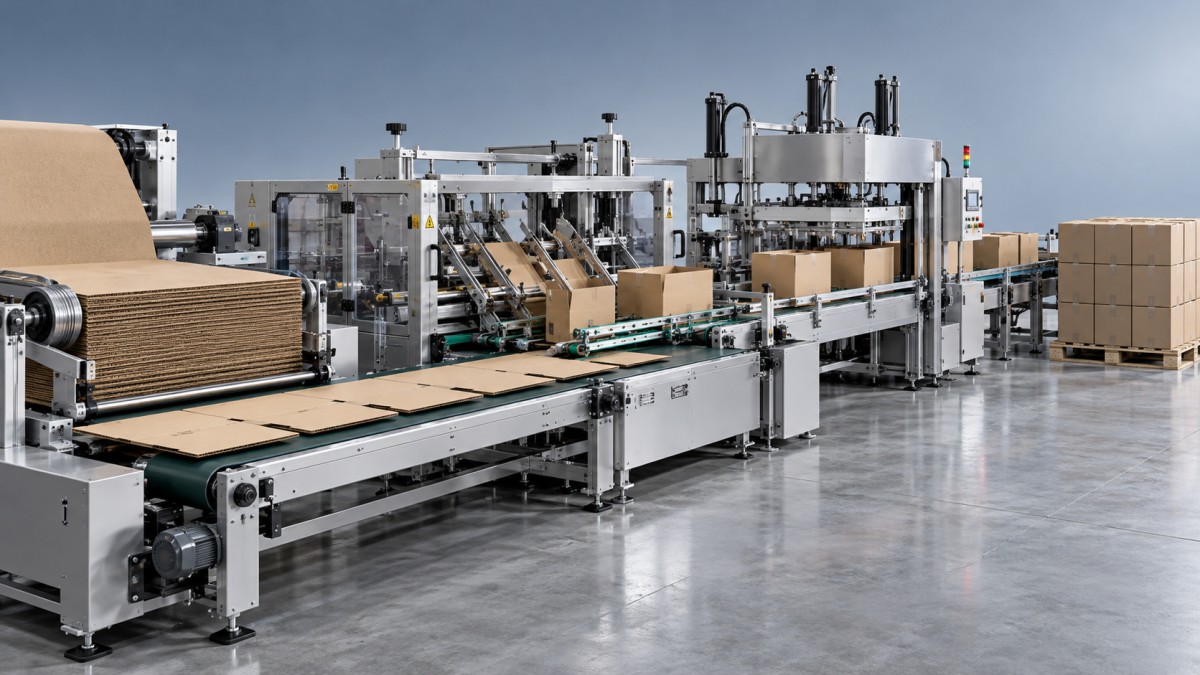
An integrated corrugated converting line can reduce transfers between separate operations. That is valuable when intermediate stacks consume floor space or require repeated forklift handling. However, the line’s output depends on how its sections work together. A fast printing section offers limited benefit if folding, counting, or discharge cannot sustain the same production rate.
Integration also concentrates downtime risk. A problem in one section may interrupt the entire process. Compare the handling savings with maintenance access, buffer arrangements, and the availability of alternative production routes.
Automation deserves a premium only when it removes a real constraint
“Fully automatic” is not a sufficiently precise purchasing specification. It may describe automatic feeding while job setup remains largely manual. In another quotation, it may include stored settings, motorized adjustments, inspection, rejection, and automated delivery. Ask for an operation-by-operation explanation of what the operator still does.
There are three distinct reasons to pay more for automation:
- Less manual handling: feeding, stacking, bundling, or palletizing equipment can reduce repetitive work and help maintain flow.
- Shorter makeready: stored recipes and automated positioning can reduce adjustment work, especially across recurring jobs.
- Better process control: inspection and rejection systems can identify specified defects before affected cartons reach dispatch.
These benefits should be evaluated separately. A plant running long, stable orders may gain more from automatic delivery than elaborate recipe management. A short-run folding-carton operation may find changeover assistance more useful than extra maximum speed.
Inspection also needs a defined task. Checking glue presence is not the same as checking glue placement, print defects, or barcode readability. Ask which defects the quoted system detects, how it rejects affected products, and how performance will be tested. An inspection camera does not by itself guarantee acceptable cartons.
Compare saleable output, not brochure speed
Maximum mechanical speed is useful for understanding machine capability, but it is a weak basis for calculating unit cost. Production time is also consumed by setup, replenishment, cleaning, stoppages, quality checks, and waste removal. The relevant measure is accepted output over the time your factory actually commits to the job.
Request a trial using representative materials and designs. Include a difficult but routine job, not just the easiest carton in the range. For die-cutting, examine cut quality, creasing, registration, and stripping. For folding and gluing, inspect squareness, fold position, glue application, and bond quality after appropriate curing.
Record the full changeover from the last acceptable product of one job to the first acceptable product of the next. Then measure sustained production, staffing, and rejected output. Watching an experienced demonstration crew run pre-prepared material can reveal capability, but it does not necessarily reveal normal factory performance.
For repeat-order work, ask the supplier to recall a stored job and demonstrate the remaining adjustments. This is where claims about automated setup become measurable.
Build the installed cost before calculating payback
The machine quotation is only one part of the investment. Freight, insurance, import charges where applicable, unloading, rigging, electrical work, compressed air, extraction, foundations, and operator training may sit outside the headline price. Responsibilities depend on the contract and delivery terms; confirm them explicitly.
Tooling deserves a separate budget. Cutting dies, stripping tools, printing plates, glue-system parts, and job-specific accessories can affect launch costs. Software may involve recurring licenses, remote-support fees, or separate interfaces for production reporting. “MES-ready” should mean a documented connection scope, not merely an available network port.
A practical comparison uses the same ownership period for every option:
Cost per saleable unit = total ownership cost over the selected period ÷ accepted units produced during that period.
Include installed capital cost, financing where relevant, labor, energy, maintenance, consumables, and expected waste. Apply residual value consistently. Avoid counting extra capacity as a financial benefit unless there is credible demand for it.
For illustration only, an automation package costing an additional $120,000 with verified net annual savings of $40,000 has a simple three-year payback before financing and tax. Those figures are assumptions, not market prices. The important work is validating the savings: reassigned employees do not automatically create cash savings, and higher output has little value without orders.
A cheaper machine may still be the right purchase
A simpler standalone machine can be a sensible choice when demand is uncertain, shifts are limited, or product requirements change frequently. It may preserve capital and allow production stages to operate independently. Buying automation ahead of need can leave expensive equipment underused while still requiring specialist maintenance.
Used equipment presents a different trade-off. Assess wear in feeding, registration, drive, and cutting systems, but also check controls obsolescence, spare-parts support, documentation, and transferability of software licenses. Include dismantling, transport, reassembly, recommissioning, and necessary safety work. A low acquisition price is not necessarily a low installed cost.
Local service can justify paying more, particularly when the machine will carry a large share of production. Ask about technician location, response arrangements, critical-parts inventory, and remote-access conditions. Treat unsupported promises of immediate assistance cautiously.
Turn the quotation into an acceptance agreement
Before awarding the order, attach a common specification covering materials, carton styles, format range, required output, staffing assumptions, included tooling, and utilities. Identify exclusions and optional equipment separately. Any safety or compliance documentation should be checked against the installation location and intended application.
Agree on factory and site acceptance procedures, including test materials, run duration, quality criteria, changeover conditions, and responsibility for correcting shortfalls. Connect payment milestones to clearly defined deliverables rather than vague statements that the machine is “ready.”
The strongest purchasing decision is not automatically the lowest packaging converting equipment price or the highest automation level. It is the configuration whose production benefit you can demonstrate, whose installed cost you understand, and whose performance the supplier is willing to put into the contract.
Related News
Get weekly intelligence in your inbox.
No noise. No sponsored content. Pure intelligence.
