
Comparing Offset Presses for Folding Cartons: Format, Speed, and Board Handling
Comparing offset presses for folding cartons starts with three questions: how many usable carton blanks fit on each sheet, how consistently the press can run the required board, and how much acceptable work reaches finishing within the available production time. Maximum sheet speed matters only after those conditions are satisfied.
A larger format can improve output through a better carton layout, but it can also introduce handling costs and finishing constraints. A faster press may lose its advantage through frequent feeder stops or prolonged color adjustment. A machine rated for thick board may still struggle with a particular combination of stiffness, curl, and surface condition. A useful packaging equipment comparison connects specifications to representative jobs and measures the result through downstream conversion.
Choose the sheet format from the carton layout
Begin with production dielines, including cutting, creasing, and waste areas. Arrange them within each candidate press’s usable printing area, allowing for the gripper margin, side margins, color bars, and finishing requirements. Maximum sheet dimensions alone do not reveal how many saleable cartons a press can produce.
A small increase in available format sometimes allows another row of blanks. Elsewhere, the larger sheet simply creates more waste. The outcome depends on carton geometry, nesting opportunities, grain direction, and the space required for stripping and blank separation. Compare actual layouts across the recurring job mix before assigning value to additional sheet area.
Grain direction needs particular attention. Rotating a blank may improve sheet utilization while changing how the board behaves during creasing, folding, and erection. The preferred orientation depends on the carton structure and material. An apparently efficient printing layout can become expensive if it increases fold cracking or makes finished cartons harder to form reliably.
Check the complete converting route at the same time. The die-cutter must accommodate the proposed sheet, tooling layout, and registration references. Stripping and blanking arrangements must remain practical. The folder-gluer receives individual blanks, but their dimensions, orientation, coating, and crease quality still determine whether the printing layout delivers useful output.
Minimum sheet size also deserves a place in the comparison. A press selected around the largest expected carton may handle small recurring work inefficiently. Build the format decision around the jobs that occupy production hours, with a clear allowance for credible future demand.
Board capability extends beyond maximum thickness
Board grammage describes mass per unit area; caliper describes thickness. Neither fully describes how a sheet behaves in a press. Boards with similar grammage can differ in thickness, stiffness, compressibility, coating, and moisture response. Those differences affect separation at the feeder, transport between units, and stacking at delivery.
Ask suppliers to define the operating conditions behind their substrate range. A maximum caliper specification establishes a mechanical boundary, but it does not establish sustainable production speed on every board within that boundary. Relevant conditions include sheet format, board stiffness, printing coverage, coating, and the installed transport configuration.
The feeder provides an early indication of practical capability. Sheets must separate cleanly, arrive consistently, and enter the registration system without doubles, skew, or damaged edges. Curl, static, dust, and variable pile condition can interrupt this process. Air settings and sheet-separation controls are valuable when operators can adjust them predictably across the intended materials.
Follow the sheet through the entire press. Cylinder geometry, transfer arrangements, gripper control, and sheet guides influence how stiff board moves without marking or excessive deformation. Air-supported guidance can help protect sensitive surfaces, but its performance depends on adjustment and substrate behavior. A feature list cannot establish how cleanly a demanding coated board will travel.
Delivery is equally important. A sheet may print accurately and still become unusable through scuffing, set-off, or unstable stacking. Inspect pile edges, printed surfaces, and sheet flatness after a sustained run. Where continuous pile changing is offered, include it in the demonstration: its value depends on maintaining stable feeding and delivery during the change.
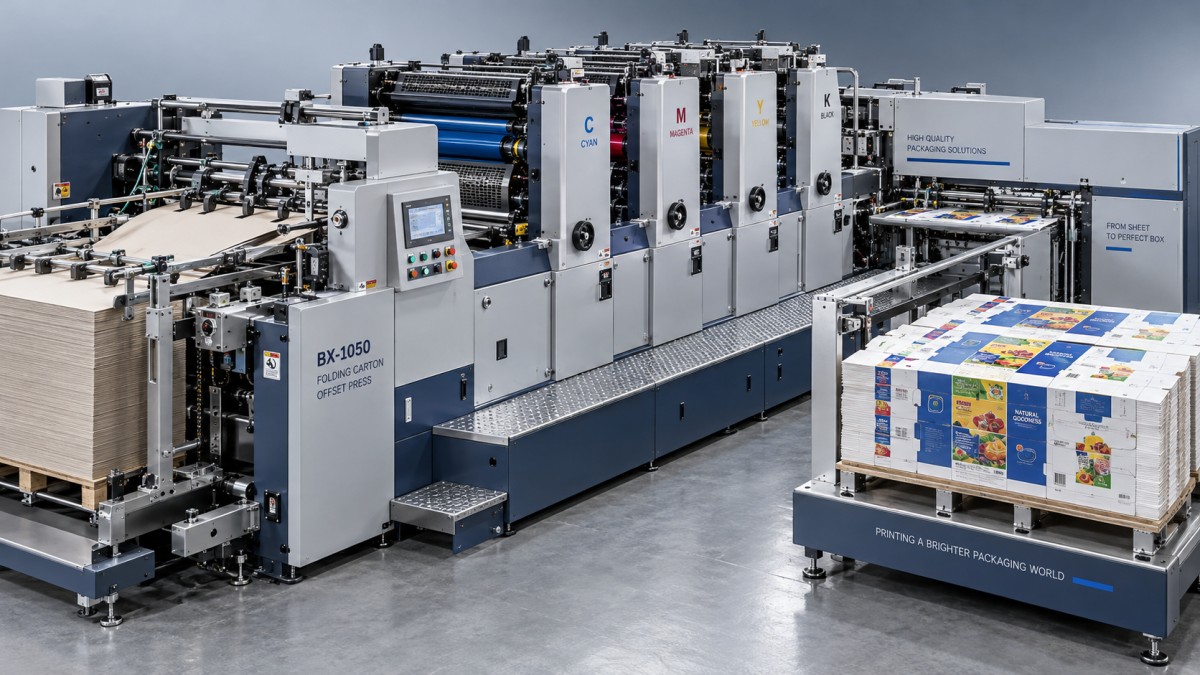
The most informative visual comparison follows one sheet from feeder to delivery, identifying separation, registration, transfer, coating or drying, and stacking points. These are the locations where board behavior can limit otherwise impressive press specifications.
Compare accepted output over elapsed time
Rated speed describes a machine capability under defined conditions. Production capacity depends on how long the press can sustain an acceptable result, how quickly it reaches that result, and how often it stops.
For each representative job, record elapsed time from the agreed starting condition to completion of the accepted quantity. Include plate changes, substrate adjustments, color stabilization, washing, pile changes, interruptions, and rejected sheets. Keep the starting condition consistent between machines so one demonstration does not benefit from preparation excluded from another.
A useful calculation is accepted printed sheets divided by total elapsed job hours. For format comparisons, extend this to usable carton blanks per elapsed hour by accounting for the number of acceptable blanks on each sheet. This prevents a smaller, faster press from being compared unfairly with a larger press carrying more cartons per impression.
Consider an illustrative comparison: one press carries more blanks per sheet but requires longer adjustments when changing board grades. Another carries fewer blanks but returns to stable production more quickly. Long repeat orders may favor the first configuration; a schedule dominated by short, varied orders may favor the second. The result depends on the actual job mix and demonstrated changeover performance.
Automation should be evaluated through that same calculation. Automated plate changing, presetting, washing, and color control can reduce recurring work, but their contribution varies with production patterns. Ask which tasks occur simultaneously, which still require operator intervention, and whether saved settings transfer reliably to a repeat job.
Registration and drying must hold through conversion
For folding cartons, color-to-color registration is only part of the requirement. Print position must remain consistent relative to cutting and creasing. A sheet can show clean overprint while the artwork shifts enough against the cutting reference to affect borders, panels, or small text near a fold.
Compare registration at several locations across the sheet and throughout the run. Include startup, stable production, speed changes, and pile changes. Large solids beside fine text, reversed type, and artwork close to cut lines provide more useful evidence than an undemanding demonstration image.
Inspection and closed-loop controls serve different purposes. Color measurement can identify or correct certain color deviations; registration systems address alignment; defect inspection can flag selected print faults. Establish what each proposed system measures, what it adjusts automatically, and what action follows an alarm. Detection creates value when suspect sheets can be identified and managed.
Drying or curing configuration also changes the comparison. Conventional ink, UV, and LED-UV systems bring different requirements for compatible inks, coatings, energy, maintenance, and process control. Faster readiness for finishing can be valuable, but the complete ink-and-coating system must suit the carton’s intended use.
Test representative coverage and coating combinations, especially demanding solids and sensitive surfaces. Evaluate rub resistance, blocking, odor where relevant, and readiness for die-cutting and gluing. For food packaging, press and curing choices must support the specified packaging construction and migration-control requirements; a curing technology alone does not establish suitability.
Use a controlled substrate trial to expose the differences
A press demonstration should answer the unresolved purchasing questions. Use production files and boards that reflect both routine work and recurring difficulties. Supplier-selected stock can show what a machine is capable of, but it may leave the most consequential handling questions unanswered.
A focused trial set can include:
- The main production board: establishes output and adjustment requirements on the material that will occupy most press hours.
- A demanding stiff or thick board: tests separation, transfer, registration, and surface protection.
- A lighter or less rigid board: reveals whether a packaging configuration handles the lower end of the required range consistently.
- A representative changeover: measures the transition between jobs with meaningfully different substrate or color requirements.
Use equivalent board batches and comparable artwork wherever practical. Record board condition, sheet dimensions, configuration, speed changes, stops, waste, and operator adjustments. When the proposed machines use different ink or curing systems, assess each complete production route against the same finished-carton requirements.
Agree acceptance criteria before the run. They should address color, registration, marking, coating condition, and usable yield, alongside throughput. Run long enough to observe stable operation and relevant production events. A brief acceleration to maximum speed provides little evidence about pile changes, accumulating dust, or consistent delivery.
Retain sheets from different stages of the trial and convert them. Die-cutting and folding can reveal brittle coatings, cracked folds, scuffing, or glue-area problems that were difficult to judge at delivery. This gives the comparison a finished-product basis.
Let production constraints shape the final shortlist
Once format, board handling, and output are demonstrated, compare the resources required to sustain them. Include foundations and access, electrical supply, compressed air, cooling, extraction where required, consumables, maintenance access, and space for piles. A press that fits the floor plan can still create awkward material movement.
Compare cost per accepted carton using the expected job mix. Include substrate waste, plates, blankets, inks, coatings, energy, labor, maintenance, and the cost of additional processing where applicable. A low purchase price can be offset by recurring waste or downtime; extra automation earns its place when it removes a meaningful production constraint.
Service capability needs a concrete assessment: relevant technical coverage, access to critical parts, remote diagnostic arrangements, and training for the installed configuration. Production reporting also deserves scrutiny. Where scheduling or MES integration is planned, establish which job, waste, and machine-status data can be exchanged and how consistently operators must record it.
PWFS’s equipment-comparison approach connects press performance with die-cutting and folding-gluing requirements. Use that connection to set the final decision rule: exclude configurations that cannot meet the essential substrate, format, and quality conditions, then compare the remaining machines on demonstrated output and operating cost across the real workload.
Before requesting final proposals, give every supplier the same dielines, board specifications, workload assumptions, finishing constraints, and acceptance criteria. Require each proposal to identify the configuration used to meet them. That creates a decision based on repeatable production evidence and makes any price premium easier to judge.
Related News
Get weekly intelligence in your inbox.
No noise. No sponsored content. Pure intelligence.
