
How to Evaluate a Corrugator Manufacturer for Board Quality and Uptime
Selecting a corrugator manufacturer is not primarily a question of maximum rated speed. Procurement teams are buying a production system whose value depends on two outcomes that must hold at the same time: board must meet its performance specification consistently, and the line must remain available through normal shifts, grade changes, maintenance cycles, and paper variability.
A supplier can present an impressive machine specification and still be a poor fit if its line cannot maintain bond quality, moisture control, flute formation, and warp control at the mix of papers and board grades a plant actually runs. The most useful evaluation therefore starts with the buyer's operating profile, then tests whether the manufacturer can support it with proven engineering, controls, service capacity, and transparent performance evidence.
Start with the board your plant must make
Before comparing manufacturers, define the board-quality envelope the new line must achieve. “Good board quality” is too broad for a meaningful technical or commercial comparison. A line designed around high-volume transport packaging may have different priorities from one supplying demanding retail, food, display, or converted-sheet applications.
The specification should describe the grades, widths, flute profiles, liner and medium basis-weight range, adhesive system, target moisture condition, and downstream converting requirements. It should also identify the defects that create the greatest commercial loss: weak or uneven bonding, washboarding, warp, poor caliper control, cracked liners, flute damage, unstable cut-off accuracy, or excessive trim and setup waste.
That exercise changes the supplier conversation. Instead of asking whether a corrugator can run a certain speed, a buyer can ask under what conditions it maintains the required board properties. This matters because speed claims often assume a favorable paper combination, a stable steam system, experienced operators, and a limited product range. Those assumptions may not match the planned factory.
Ask for evidence at realistic operating conditions
A capable corrugator manufacturer should be able to discuss the relationship between paper quality, machine settings, heat transfer, tension control, adhesive application, and final board behavior. The discussion should be specific enough to reveal whether the supplier understands the production window rather than only the machine's mechanical layout.
- Which paper grades and basis weights were used when the reference line achieved its stated output?
- What flute profiles, board constructions, and working widths were being produced?
- How were bonding, moisture, caliper, warp, and cut accuracy checked during acceptance?
- What output reduction, if any, is expected during grade changes or more demanding board combinations?
- Which settings are automatically controlled, and which still depend heavily on operator judgment?
Buyers should treat laboratory samples and short demonstration runs carefully. They can show potential, but they do not establish sustained production capability. A more valuable reference is a line with a comparable grade mix, paper supply profile, staffing model, climate, and converting flow that has operated long enough for maintenance and quality-control routines to become visible.
Evaluate the line as a controlled process, not a collection of sections
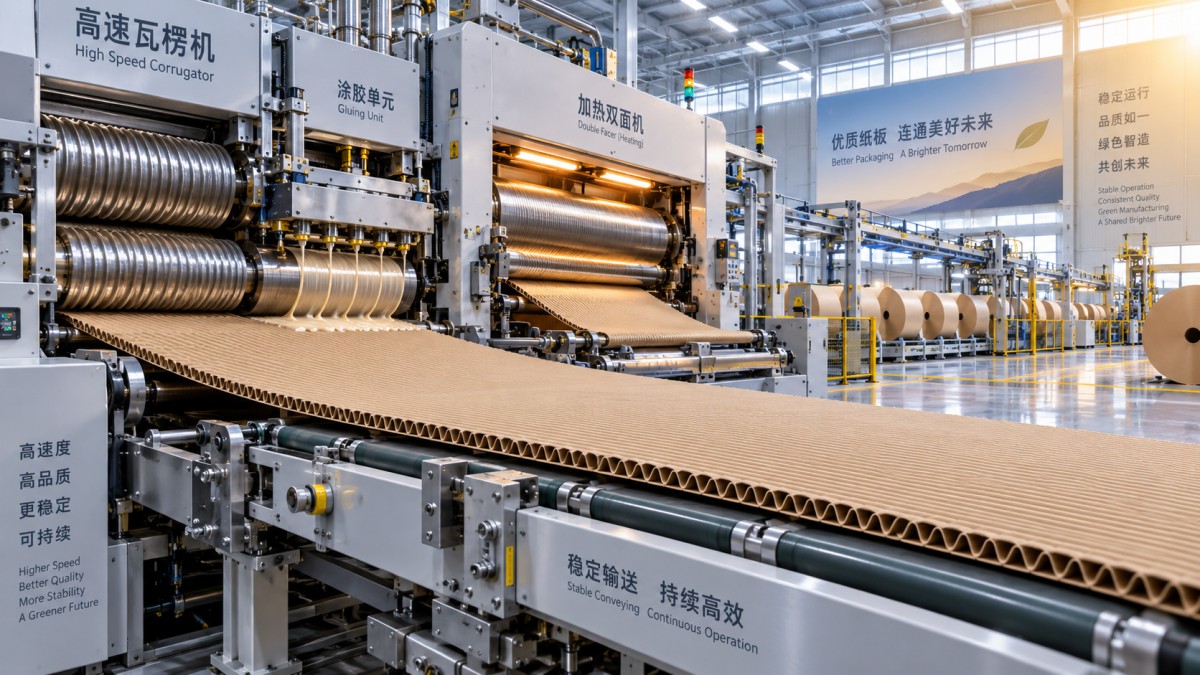
Board quality is created across the full wet end and dry end. Weak integration between paper handling, preconditioning, corrugating, glue application, heating, traction, slitting, and cut-off can turn local instability into repeated defects. For procurement, the question is whether the manufacturer owns and coordinates the process as a whole.
Paper tension and web alignment require stable control before the material reaches the corrugating rolls. Steam and condensate management affect how paper accepts heat and forms the flute. Adhesive control influences bond strength, glue consumption, and moisture load. The double backer and downstream traction sections must provide sufficient and repeatable curing without damaging the board surface or creating warp. A supplier that treats each zone as an isolated module may leave the plant responsible for solving the interactions after commissioning.
Automation should be assessed by its ability to reduce variation, not by the number of screens or servo axes in a proposal. Recipe management, automatic order change functions, condition alarms, glue and temperature control, splice coordination, and production data capture can materially improve repeatability. They only do so when the controls are designed around the plant's actual product mix and operators can diagnose exceptions without waiting for remote intervention.
It is useful to request a clear responsibility map before contract award. It should show who designs and validates the interfaces for paper rolls, steam, compressed air, electrical supply, starch preparation, waste handling, board transfer, and plant-level data systems. Many startup delays arise at those interfaces, where an equipment quotation may appear complete but site readiness and integration obligations are ambiguous.
Uptime depends on maintainability and response speed
A corrugator is a long, interdependent line. A failure in a narrow set of components can stop the entire production flow, so uptime cannot be judged from a general statement about reliability. Buyers need to understand how quickly routine wear can be identified, repaired, and recovered from without compromising board quality.
Review the maintenance design in practical terms. Can operators and technicians reach critical components safely? Are wear parts standardized where appropriate? How are corrugating rolls, pressure systems, belts, knives, sensors, pumps, bearings, and drive components inspected? Does the supplier provide condition-monitoring functions that produce usable maintenance signals, or merely alarm histories? Good accessibility and a disciplined preventive-maintenance plan often matter more over the life of the line than a marginal advantage in headline speed.
Service capability deserves the same scrutiny as the machine itself. A manufacturer with strong engineering but limited field coverage in the buyer's region can create unacceptable recovery times. Request the local or regional service model, escalation path, commissioning team composition, spare-parts stocking arrangement, remote diagnostic access, and training scope. The important test is not whether support is promised, but whether the supplier can define how a production-critical event moves from first call to diagnosis, parts availability, on-site assistance, and restart.
Compare total operating exposure, not purchase price alone
The lowest initial quotation can become expensive when it creates excess paper waste, unstable adhesive consumption, high steam demand, frequent manual adjustment, or extended downtime. Conversely, premium equipment features do not automatically produce a return if the plant operates a narrow, stable grade range and does not need rapid changes or advanced automation.
A disciplined comparison should model the expected operating profile: annual production volume, board mix, changeover frequency, likely paper variation, energy infrastructure, labor structure, maintenance resources, and planned operating hours. Then ask each manufacturer to state the assumptions behind its capacity, utility, waste, and manpower estimates. A proposal that makes its assumptions visible is easier to compare and less likely to create disputes later.
Procurement should also separate items that are included in the base line from those that appear later as options or site costs. Controls, software licenses, recipe development, training, installation support, commissioning consumables, integration work, initial spare parts, and acceptance testing can materially change the true project cost. The same applies to civil, steam, electrical, material-handling, and starch-room work that may sit outside the machine contract but remain essential to achieving rated performance.
Use factory acceptance and commissioning to protect the decision
The commercial agreement should translate the board-quality discussion into an acceptance framework. Vague language such as “high quality” or “stable operation” leaves too much room for interpretation once the line is installed. Acceptance criteria should reflect the buyer's priority grades and define how performance will be measured under agreed production conditions.
For a new line, this typically includes agreed board constructions, paper ranges, operating width, output conditions, measurable quality indicators, safety functions, utility assumptions, and a clear test duration. It should also state how defects, stoppages, rejected board, and planned adjustments are treated during the test. The purpose is not to force a supplier into an unrealistic guarantee; it is to make the operating target explicit before design decisions are locked in.
Reference checks remain one of the strongest safeguards. Speak with users whose lines resemble the intended application, and ask focused questions: how quickly did the line reach stable production, what quality problems required follow-up, how does it handle grade changes, which components have driven unplanned downtime, and how effectively has the supplier responded after handover? A reference visit is most useful when it examines the production floor, maintenance practice, and operator workflow rather than relying only on management presentations.
The strongest corrugator manufacturer is usually the one that can connect a realistic board specification to a credible production method, then support that method throughout the line's working life. For procurement teams, that standard provides a more reliable basis for selection than capacity figures alone: buy the supplier whose engineering, service model, and acceptance commitments can protect both board performance and available production time.
Related News
Get weekly intelligence in your inbox.
No noise. No sponsored content. Pure intelligence.
