
Inside a Corrugated Box Factory: From Board Feeding to Finished Case Inspection
Step inside a modern corrugated box plant and the first impression is usually sound: paper rolls unwinding, steam systems breathing, conveyors moving in rhythm, and converting machines cycling at a pace that leaves little room for hesitation. Yet the apparent speed of the operation can be misleading. A dependable shipping case is not made by one machine or one setting. It is the result of a controlled chain in which moisture, heat, adhesive, web tension, flute formation, print registration, cutting accuracy, and final inspection all have to agree.
For operators, understanding the corrugated paper box manufacturing process factory workflow is more than a matter of learning where material goes next. It explains why a small issue at the roll stand can later appear as warped board, weak glue bonds, inaccurate die-cuts, cracked scores, or cartons that refuse to square properly on the packing line.
Where the process really begins: paper rolls and production planning
A corrugated case starts long before the corrugator. The production team selects linerboard and medium according to the required board grade, flute profile, box style, printing method, expected stacking load, and distribution conditions. A lightweight retail tray, a produce case exposed to humidity, and an e-commerce shipper handling repeated drops may look similar after conversion, but their material requirements can be very different.
At the roll stand, operators load the paper reels that will become the outer liner, corrugated medium, and inner liner. Roll identification matters. Using the wrong grade, width, or grain orientation can create avoidable waste before the board reaches the corrugating section. Checks typically include roll width, visible edge damage, splice quality, moisture condition, and whether the roll is centered correctly for stable web travel.
Paper is a living industrial material in the sense that it reacts to its environment. A roll stored in a cold or overly dry area may behave differently when it enters a hot, humid corrugator. Operators should not treat web breaks, curling, or uneven tension as isolated machine faults until paper condition has been considered. Stable storage and sensible acclimatization support smoother production.
Board feeding, preheating, and the formation of the flute
The core event in a corrugated box factory occurs inside the single facer. Here, the corrugating medium passes between heated fluted rolls. Heat and pressure reshape the paper into the familiar wave-like flute. Adhesive is applied to the flute tips, and one liner is bonded to create a single-face web.
Flute geometry is not decorative. It is the internal structure that gives corrugated board its cushioning behavior and compression resistance. Different flute types balance thickness, printability, stacking strength, and material consumption in different ways. Operators do not need to memorize every commercial application to recognize the practical implication: a poorly formed flute cannot be fully rescued later by good printing or careful folding.
After the single facer, the web travels toward the double backer, where the second liner is applied. This completes the corrugated board structure. Steam, preheaters, wrap angles, braking systems, and adhesive controls work together to bring the paper surfaces into suitable bonding conditions. Too little heat may leave bonding incomplete; excessive heat can dry the sheet too aggressively and contribute to warp. Too much adhesive increases cost and may create wet, unstable board, while too little can produce loose liners and delamination.
The target is not simply “more glue” or “more heat.” The target is a consistent bond with a board profile appropriate for the job. Operators should watch for signs such as open flute tips, uneven adhesive transfer, washboarding, blistering, edge lift, or a board that exits with a pronounced curl. These symptoms offer early clues about paper moisture balance, steam supply, roll condition, pressure, or adhesive preparation.
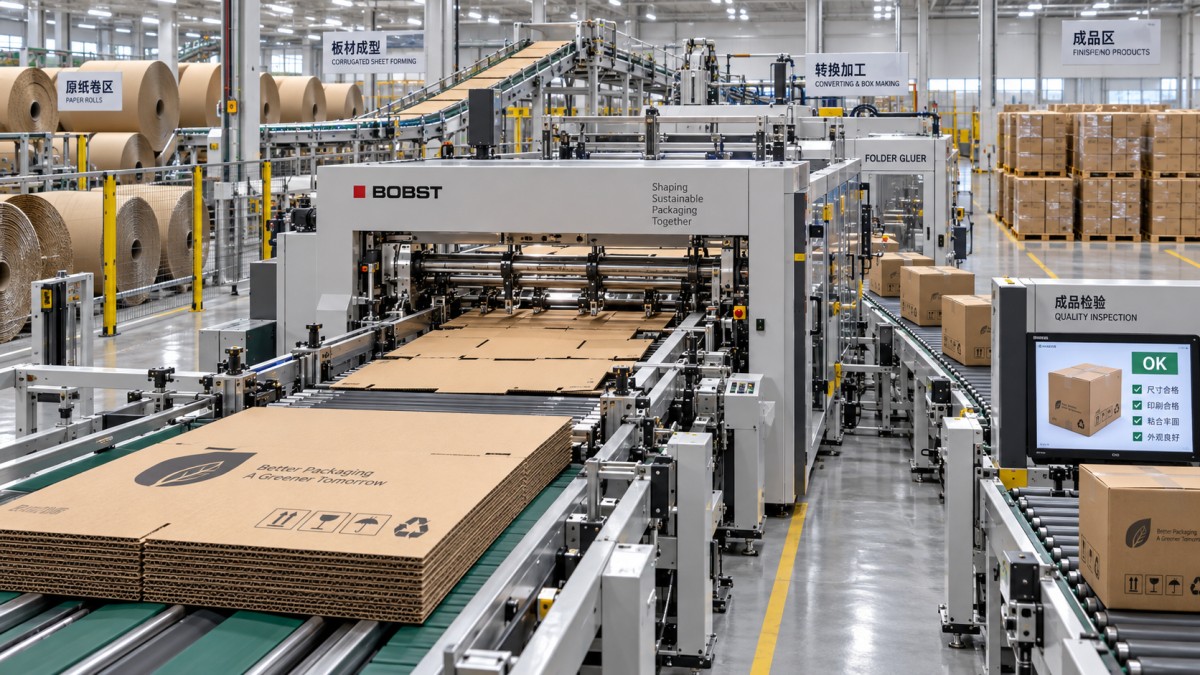
From wet web to usable corrugated board
Once bonded, the board passes through a hot plate or belt section that sets the adhesive and stabilizes the sheet. It then reaches the dry end, where it is trimmed, slit, scored, and cut into sheets or prepared for downstream converting. This transition deserves attention because it defines the board’s fit for the next operation.
Warp is one of the most visible quality issues at this stage. A flat sheet is easier to print, die-cut, fold, and feed. A warped sheet can cause registration shifts, feeding doubles, poor score performance, and jams. The direction of warp can help operators investigate the cause. For example, a moisture imbalance between liners may pull the sheet toward one side, while uneven heat exposure or tension can produce other patterns. Good troubleshooting begins with observation rather than random adjustment.
Scoring is equally important. The score must create a controlled fold line without crushing the structure beyond what the box design allows. A score that is too shallow may crack or resist folding; one that is too severe can reduce compression strength and leave an unattractive crease. During setup, operators should inspect both the score appearance and how the board behaves when folded by hand. The first acceptable-looking sample is not always the first reliable production sample.
Printing: protecting function while adding communication
Many corrugated cases move directly into flexographic printing, while higher-graphic packaging may use preprinted liners, litho-lamination, or other print workflows. Regardless of method, printing is not just a visual stage. Ink coverage, drying behavior, registration, and board handling can all influence converting quality.
For a simple transport case, legible barcodes, handling marks, product information, and brand identification may be the priority. Retail-ready packaging may demand cleaner graphics and tighter color consistency. Operators should confirm that artwork, print plates, substrate, and approved sample expectations match the production order before running at speed.
Common print checks include color density, registration, smudging, missing print, plate contamination, and barcode readability where applicable. Heavy ink coverage can alter the board’s surface behavior, especially if drying is insufficient. If printed sheets begin sticking, marking, or feeding inconsistently, the cause may lie in ink and drying conditions rather than only in the feeder.
Die-cutting, slotting, and the moment a sheet becomes a box blank
A sheet of corrugated board becomes a recognizable box blank in the converting area. Depending on the design and equipment, this may involve rotary die-cutting, flatbed die-cutting, flexo-folder-gluing, slotting, trimming, or a combination of these processes. The goal is exact but practical: cut the outline cleanly, create slots and hand holes where required, and place fold lines so the finished case erects without strain.
Die-cutting demands a balance between cutting through the intended layers and preserving the board around the cut. Dull tools, incorrect pressure, worn anvil surfaces, or unstable board feeding can lead to ragged edges, incomplete cuts, crushed flutes, and dimensional variation. On high-speed lines, a defect may repeat hundreds of times before it is noticed, so first-off approval and routine sampling are essential.
Operators should pay close attention to critical features rather than inspecting only the overall shape. Are the manufacturer’s joint and glue flap cut correctly? Are the slots deep enough and centered? Do hand holes have clean edges? Are scores aligned with printed graphics? Does the blank remain square when placed against a reference surface? These details determine whether the customer’s packing operation will run smoothly.
Folding and gluing: the case must hold its shape
For regular slotted cartons and many other case styles, the blank moves through a folder-gluer or flexo-folder-gluer. Folding rails guide the panels into position, adhesive is applied to the manufacturer’s joint, and compression sections hold the joint long enough for the bond to develop.
This is a stage where apparently minor setup errors become highly visible. A carton may look acceptable when flat but open unevenly when erected. Glue can be too close to an edge, too narrow, intermittent, or misplaced. Panels can be out of square because folding rails are misadjusted or because earlier scores were inaccurate. If the finished bundle contains cases with inconsistent joint overlap, the problem should be traced through the entire chain, not blamed automatically on the glue station.
Adhesive quality is also a working condition issue. Operators should follow the plant’s approved adhesive handling procedures, keep nozzles or applicators clean, and verify that the glue pattern is continuous. A neat glue line is not enough if bond development is weak. Periodic pull checks, visual checks, and inspection after a reasonable set time help confirm that the joint will survive packing, filling, and distribution.
Finished case inspection is not a final formality
The last inspection point is where the factory asks a simple but demanding question: would this case perform as intended in the customer’s real world? A finished carton might travel through an automated erector, be filled by hand, stacked in a warehouse, exposed to changing humidity, and shipped through several handling points. Inspection should reflect that journey.
A practical finished case inspection covers appearance, dimensions, structural condition, and functional assembly. Operators may check:
- Correct board grade, flute direction, and order identification;
- Clean print, readable codes, and acceptable registration;
- Accurate length, width, depth, slot position, and score placement;
- Glue-joint integrity and consistent panel alignment;
- Absence of crushed edges, loose liners, delamination, tears, or excessive warp;
- Whether the case erects squarely and closes as the design intends;
- Bundle count, strapping or wrapping condition, and clear labeling for shipment.
Not every production order requires the same test level. Some customers specify compression testing, moisture checks, burst-related performance criteria, or sampling plans based on their application. The operator’s role is to understand the approved specification and escalate deviations early. “Close enough” is risky when a box is part of an automated supply chain.
Reading defects backward through the line
Experienced operators learn to read a defect as a process signal. A cracked outer liner along a fold may point to score settings, board dryness, or paper characteristics. Repeated poor glue joints may come from adhesive application, but may also be linked to dust, warp, or inconsistent folding pressure. Registration drift may begin with feeder control, sheet variation, or mechanical alignment. The visible fault is often the end of a story that started several stations earlier.
That is why communication between corrugator crews, printing teams, die-cutting operators, maintenance personnel, and quality staff matters so much. Record the conditions when an issue appears: order number, board construction, machine speed, temperatures where relevant, adhesive observations, defect location, and sample frequency. Clear records turn recurring frustration into a solvable technical pattern.
A steadier process produces a more reliable case
The corrugated paper box manufacturing process factory environment is built around synchronized movement, but consistency comes from disciplined attention rather than speed alone. Feed the correct paper under stable tension. Form and bond the flute without upsetting moisture balance. Keep board flat enough for clean conversion. Protect print quality, cut and score with control, build a sound glue joint, and inspect the finished case as a working package—not merely a finished-looking product.
For new operators, the line can seem like a series of separate machines. With time, it becomes easier to see one connected manufacturing system. Every adjustment leaves a trace downstream. Learning to spot those traces is one of the most valuable skills on the factory floor, because the best corrugated case is not simply made quickly; it arrives at the customer clean, square, strong, and ready to do its job.
Related News
Get weekly intelligence in your inbox.
No noise. No sponsored content. Pure intelligence.
