
Choosing Automatic Carton Printing and Converting Equipment for Your Production Needs
Choosing automatic carton printing and converting equipment starts with the carton and the production schedule. A high-speed integrated line can suit a plant running long, repeat orders on a narrow range of board. A flexible arrangement of separate machines may deliver more usable capacity when specifications change frequently or when printing and converting have different workloads.
For technical evaluators, the decision turns on three questions: can the equipment hold the required quality on the actual substrate, how much saleable output can it deliver across the real order mix, and can the plant keep it supplied, maintained and connected? Rated speed helps describe a machine’s limits, but it cannot answer those questions on its own.
Start with the cartons the line must produce
Build the equipment specification around a representative set of jobs, including difficult work as well as high-volume products. Folding cartons made from paperboard and corrugated shipping boxes may both be called cartons, yet they can require different feeding, printing and converting arrangements. Even within one plant, a machine that handles a standard straight-line carton well may need additional modules or a different configuration for more complex designs.
For each representative job, document the blank dimensions, board grade and thickness, print coverage, number of colors, coatings, die-cut features, fold pattern and glue requirements. Include critical tolerances and the method used to inspect them. A range stated only as minimum and maximum sheet size is not enough: the combination of a small blank, thin board and a complex fold can be more demanding than any single dimension suggests.
Map the sequence from incoming material to finished pack. Depending on the product, the required steps may include printing, coating, die-cutting, stripping waste, folding, gluing, counting and bundling. Establish which operations must be automatic, which can be offline and where work in progress can be held. If the plant already has suitable presses or folder-gluers, replacing the entire route may offer less value than removing one constrained process.
Ask suppliers to identify any jobs outside the proposed configuration’s capability, including those requiring optional tooling or attachments. This makes exclusions visible before performance claims are compared.
Choose a process configuration that fits the work
The first major decision is the printing and converting route. Print quality, board structure and order mix often narrow the options faster than a comparison of machine catalogs.
These are starting points, not fixed rules. Corrugated packaging with demanding graphics may use a different print route, while some carton designs require specialist converting equipment. The relevant comparison is the complete manufacturing route for the specified product, including preparation, handling and inspection.
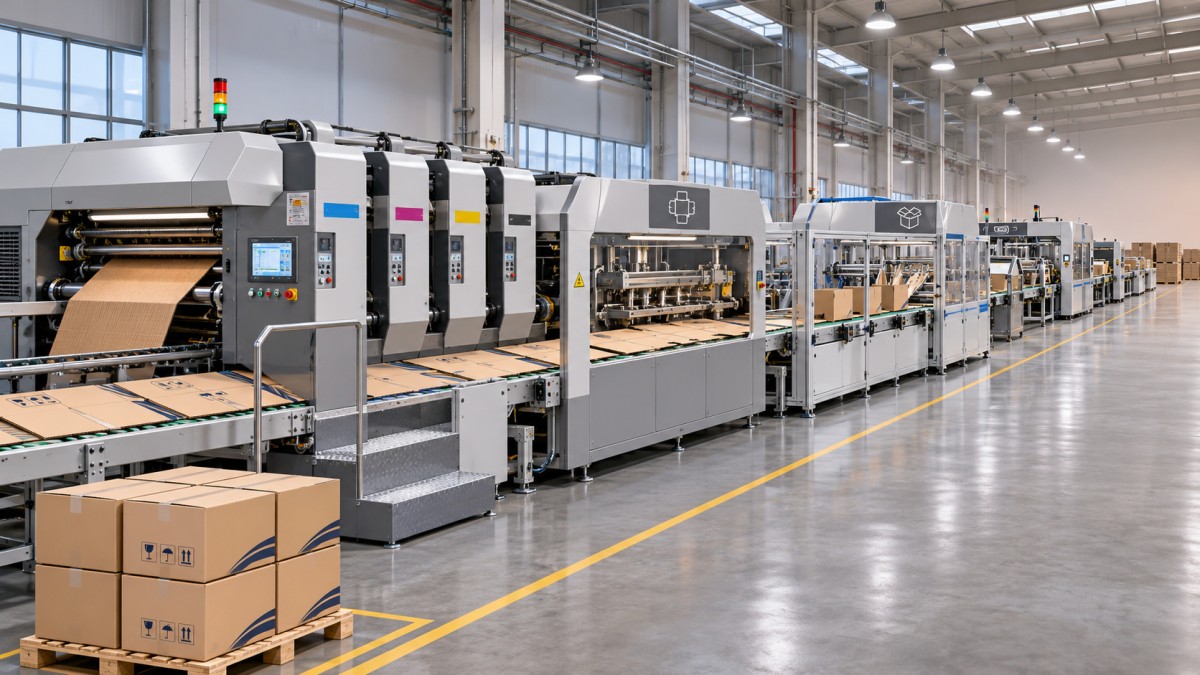
Integration also deserves a practical test. An inline system can reduce handling and synchronize operations, but a fault in one section can stop production through the line. Separate machines provide more scheduling flexibility and allow a buffer between processes, at the cost of floor space, handling and potential damage or mix-ups. Compare both layouts using the plant’s expected order sequence and available labor.
Test quality across the whole route
Print registration, die-cut accuracy and folding performance should be evaluated as connected requirements. A well-printed sheet can still produce an unacceptable carton if the cut shifts relative to the artwork, a crease damages the board, or a glue flap does not align reliably.
Feed and print stability
Confirm that the feeder can separate and transport the intended board consistently, including material at the edges of the proposed range. Warp, dust, variation in sheet dimensions and surface condition can affect feeding and print stability. For corrugated board, excessive handling pressure can also damage the flute structure; the acceptable outcome depends on the box’s performance requirements.
Define registration in terms of the finished job: color-to-color alignment, print position relative to sheet edges, and alignment of print to subsequent cuts or creases. Specify where measurements will be taken and the permitted deviation. Inspect sheets from the beginning, middle and end of a sustained run, as well as after speed changes or interruptions. A few attractive samples alone do not establish stability.
For color-critical work, agree on the approved reference, substrate, ink or coating system, drying conditions and measurement method. Appearance can change with board surface and coating, so a demonstration on a substitute stock may not predict production results.
Die-cutting, folding and gluing
Inspect cut position relative to print, crease quality, waste removal and the condition of narrow features. Poor stripping or incomplete cuts can slow downstream handling even when the machine itself reaches its target speed. For folding cartons, assess whether creases support consistent folding without cracking or damaging the printed surface.
On the folder-gluer, check fold alignment, glue placement and bond performance against the carton design and adhesive supplier’s conditions. Verify that the machine can handle the specified board and carton geometry throughout the run. Difficult products may require carriers, additional folding devices or other options; those items should appear in the quotation and the test configuration.
If the packaging has food-contact or other regulated requirements, define the intended contact conditions and applicable market requirements with the responsible packaging and compliance teams. Equipment selection must accommodate the approved materials and process controls, but a machine alone does not establish compliance of the finished package.
Compare saleable output, not nameplate speed
A useful capacity estimate begins with scheduled production time, then accounts for changeovers, startup, planned maintenance, stoppages and rejected output. Calculate the result for each representative job and combine the jobs in the proportions expected at the plant. The output measure should be accepted cartons delivered to the next usable stage, with the counting point clearly defined.
Changeover deserves particular attention when orders are short. Record the time from the last acceptable carton of one job to the first acceptable carton of the next, then separately track the time needed to reach stable production. Include plate or die changes, cleaning, adjustments, verification and the availability of tools and materials. A faster setup on the converting section may have limited value if print preparation or downstream packing still determines when the next order can run.
Use the same assumptions for each supplier: job sequence, order quantity, staffing, substrate, inspection standard and planned operating time. For an integrated line, assess the rate of the slowest operation under the chosen conditions. For separate machines, include transfer, buffering and the possibility that a bottleneck moves when the product mix changes.
Rejects should be included in both the capacity and cost calculation. A system that runs faster but needs more startup sheets or produces more defective cartons can consume capacity and material without increasing shipments. Conversely, automation that reduces setup waste may be valuable even if its maximum speed changes little.
Define a representative acceptance test
Before comparing final offers, turn the plant’s requirements into a test plan that suppliers can price and accept. A meaningful test should cover at least one routine job and one demanding job within the promised operating range. Use production-representative material, artwork, tooling and adhesives wherever practical, and identify any differences between the test and the plant’s actual conditions.
The plan should state:
- Products and materials: blank dimensions, board specifications, carton style, print design and any difficult features.
- Quality criteria: registration and cut tolerances, fold and glue requirements, inspection locations and sampling method.
- Operating conditions: run duration, target speed, staffing, changeovers, planned stops and the point at which output is counted.
- Results to record: accepted output, rejects by cause, interruptions, setup time and any manual intervention needed to maintain quality.
Separate a supplier demonstration from contractual acceptance. A demonstration helps establish feasibility; the contract should specify the conditions, responsibilities and remedy if agreed performance is not achieved. Where factory acceptance and site acceptance are both used, assign each test a purpose. Transport, installation, utilities and upstream equipment can affect results after delivery.
Check the plant interfaces before committing
A machine’s usable range depends on the environment around it. Confirm floor loading, access for installation and maintenance, power, compressed air, extraction and any process-specific utilities against the supplier’s installation requirements. Allow space for material delivery, tooling storage, waste removal and finished-product handling, not just the machine footprint.
Review the handoffs to existing equipment. Sheet or bundle orientation, stack height, conveyor speed and identification methods can all affect whether an automated line operates smoothly. A manual transfer may be acceptable if it fits the staffing and throughput model; an assumed automatic transfer needs defined mechanical and control interfaces.
For production data, agree on the information the plant needs to exchange, such as job identification, machine status, counts and downtime reasons. Define ownership of the integration work, available interfaces and how data will be validated. Automatic data collection is useful only if the plant can distinguish accepted output from setup sheets, rejects and duplicate counts.
Maintenance and support belong in the technical comparison. Review access to wear parts, preventive maintenance requirements, operator and technician training, diagnostics, software support and local service arrangements. A specialized module may improve capability, but its value depends on the plant’s ability to operate and maintain it consistently.
Compare ownership cost against the production plan
Build a common cost model for each feasible configuration. Include purchase price, options needed for the specified jobs, tooling, freight, installation, utilities, training, integration, consumables, maintenance and expected production waste. Add labor and material handling where the layouts differ. Use the same planning period and production assumptions for every option.
Then test the decision against changes in order mix. A line sized for long runs may be attractive if those orders are secure; frequent small jobs can make setup time and waste more influential. If demand is uncertain, compare the cost of an expandable configuration with the cost of buying capacity upfront. State which assumptions drive the result, especially utilization, accepted output and maintenance downtime.
The strongest choice is the configuration that passes the agreed quality test and meets the required delivery schedule at an acceptable ownership cost. If two machines are close on price, the more useful distinction may be whether each can make the plant’s difficult cartons repeatedly, with the people, materials and interfaces available on the production floor.
Related News
Get weekly intelligence in your inbox.
No noise. No sponsored content. Pure intelligence.
