
Choosing a CNC Router for MDF Doors: Workholding, Tooling, and Throughput
Choose a CNC router for MDF doors by proving that it can hold your smallest components securely, produce paint-ready profiles with the intended tooling, and sustain the required number of accepted doors per shift. Spindle power and maximum feed rate matter only after those conditions are met. A fast machine that needs frequent sanding, repositioning, or vacuum recovery can deliver less usable output than a slower, better-matched system.
A typical production problem appears near the end of a nested sheet: most profiles look clean, but a narrow door shifts during the final perimeter cut, or a deep decorative groove develops fuzzy edges. These faults can combine workholding leakage, cutter forces, and tool wear. Evaluating a woodworking CNC for doors therefore requires a representative cutting trial—not just a specification comparison.
Define the door family before comparing machines
Start with the products that will actually pass through the router. One-piece routed MDF cabinet doors, flat slab doors, and thick interior door blanks impose different demands on the table, spindle clearance, tooling, and handling system. A machine suitable for nested cabinet fronts is not automatically suitable for heavy architectural blanks or edge-machining operations.
Give suppliers a production envelope that includes material thickness, blank dimensions, minimum remaining thickness beneath recesses, smallest finished component, and deepest profile. Identify whether hinge holes, lock pockets, back-face operations, or edge drilling belong in the same production route. These details establish whether a conventional three-axis router is sufficient or additional fixtures, aggregates, or separate equipment are needed.
- Product mix: distinguish repeat designs from frequently changing profiles and sizes.
- Finish requirement: define acceptable fuzzing, breakout, profile consistency, and sanding allowance before painting.
- Material variation: include the MDF grades and thickness tolerances you intend to purchase.
- Output requirement: specify accepted doors per shift, batch sizes, and expected changeover frequency.
For flat, one-piece MDF doors, five-axis capability is usually unnecessary. Prioritize rigidity, reliable tool changes, vacuum control, and CAM support for your profile library before paying for motion capabilities the parts do not require.
Vacuum workholding must survive the final cut
A full MDF sheet can appear secure while concealing a marginal vacuum system. As through-cuts expose the spoilboard and separate components, leakage increases and each part has less effective holding area. Narrow rails, small drawer fronts, and components with extensive pocketing deserve particular attention.
Do not compare pumps on motor power alone. Ask for the vacuum and airflow available under realistic leakage, together with the pump performance curve. A pump’s ultimate vacuum rating does not show how it behaves when a porous spoilboard and an open nest admit air. Instrument readings should represent conditions near the working table, not merely at the pump inlet.
The basic relationship is holding force = pressure difference × effective sealed area. This is only a screening calculation: lateral resistance also depends on friction, while upward cutter forces, acceleration, and local leakage reduce the practical margin. A large theoretical force does not prove that a thin or poorly supported component will remain stationary.
Inspect zone isolation, gasket condition, plumbing restrictions, and spoilboard maintenance access. Unused zones should be isolated where the table design permits. Spoilboard faces need to remain flat and permeable as intended, while exposed edges may need sealing according to the machine supplier’s setup procedure. A bowed sheet or debris beneath it can compromise sealing before cutting begins.
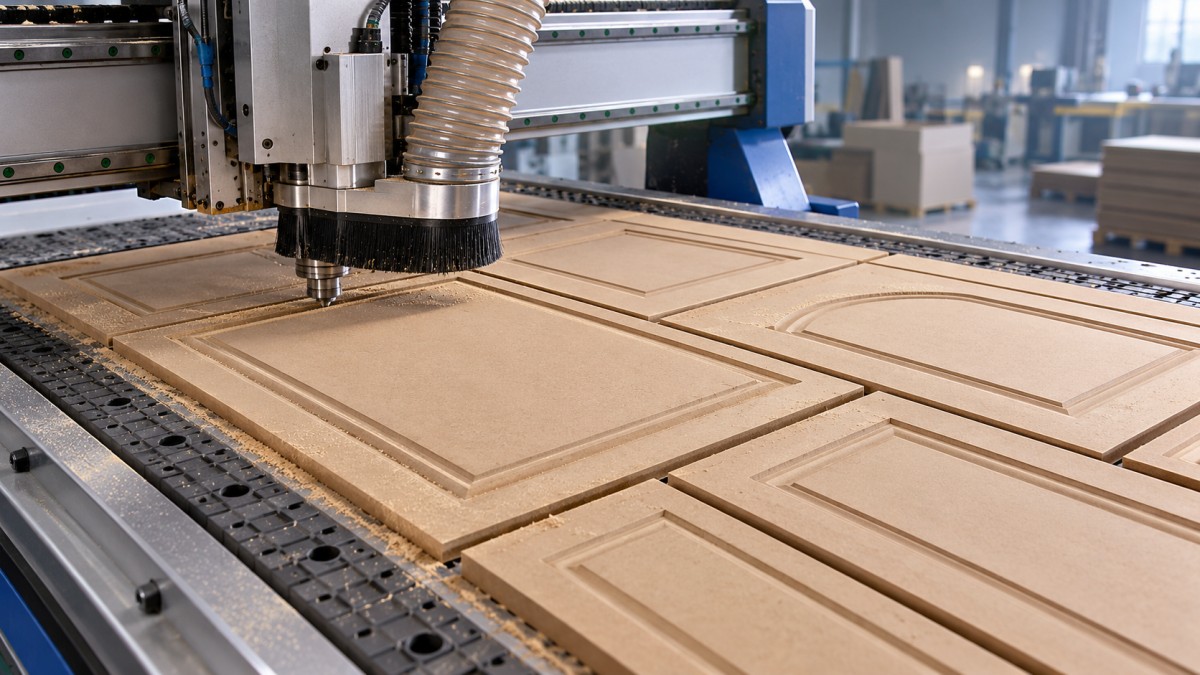
For vulnerable parts, evaluate onion-skin cutting, tabs, or a dedicated gasketed fixture. Leaving a thin membrane until a final pass can preserve stability, but adds cutting time and may require cleanup. Tabs also create finishing work. These are valid process choices, not free substitutes for adequate holding capacity.
During the trial, route internal features before releasing the perimeter where practical, and record vacuum behavior throughout the nest. Check the last small component as carefully as the first large door. Any movement, lifting, or rotation should stop the test for correction rather than be treated as an acceptable production variation.
Match tooling to the profile, not just the material name
MDF is abrasive, and routed surfaces expose its density variation. A cutter that leaves a clean outer face may produce a rougher recessed surface deeper in the core. Tool selection should therefore separate perimeter cutting, bulk removal, and decorative finishing rather than assume one cutter can perform every operation efficiently.
Perimeters and shallow details need different geometries
Compression cutters can protect both faces during through-cutting when the transition between upcut and downcut sections is positioned correctly within the board. They are not automatically suitable for shallow grooves: if only the upcut section engages the top surface, it can lift fibers. Downcut tools can improve top-edge definition but tend to push chips into the cut, making evacuation and cutting depth important.
Use roughing tools to remove substantial pocket volume when that reduces the load on an expensive profile cutter. A separate finishing pass can stabilize profile quality, but its allowance must suit the tool geometry and material. Excessive stock removal during finishing defeats the purpose; an ineffective skim may rub instead of cutting cleanly.
Carbide tooling offers flexibility for changing profiles and smaller batches. PCD tooling may be worth assessing for repetitive MDF work, provided the required geometry, sharpening arrangements, and economics fit the application. Compare tooling on accepted parts and finishing labor over its usable life, not purchase price alone.
Check the spindle at the intended cutting condition
Rated spindle power does not establish available torque across the speed range. Larger profile cutters may need lower rotational speeds than small end mills. Request the spindle torque curve and verify that each tool’s permitted speed, diameter, projection, and balance requirements fit the spindle and holder system.
Use the relationship chip load = feed rate ÷ (spindle speed × flute count) to discuss cutting conditions with the tooling supplier. Begin within the tool manufacturer’s recommendations and validate the result. Reducing feed without adjusting speed can create rubbing, heat, and fine dust; increasing feed can exceed workholding or tool-deflection limits.
Tool runout, dirty collets, worn holders, and excessive projection can make good tooling perform poorly. Include holder inspection and replacement costs in the proposal. Ask how the controller manages tool-length measurement, wear compensation, and replacement tools so that a cutter change does not introduce visible differences between adjacent doors.
Dust extraction is part of the cutting system
Packed MDF dust can degrade groove finish, increase heat, and shorten useful tool life. Verify extraction at the machine connection under the proposed duct layout and simultaneous equipment demand. A collector’s headline airflow is not evidence of adequate capture at the cutter.
The extraction hood must follow the work without disturbing loose components or colliding with clamps. Deep profiles, tall cutters, and automatic tool changes can require different hood positions. During the trial, inspect pockets for retained dust and observe whether collection remains effective at all table locations.
MDF dust also creates occupational exposure and combustible-dust concerns. Have the extraction design, filtration, housekeeping method, and applicable protective measures assessed for the installation. Avoid using compressed air as a routine substitute for effective capture and appropriate cleanup equipment.
Calculate throughput from accepted doors, not rapid-traverse speed
Decorative door paths contain corners, short segments, and direction changes where the machine may never reach its programmed feed. Acceleration, controller look-ahead, path smoothing, and structural stiffness can matter more than maximum travel speed. Smoothing must preserve the specified geometry; a faster path is not useful if profile corners become visibly rounded.
Request a cycle-time breakdown from the actual program:
- Loading, locating, and establishing hold-down.
- Roughing, profiling, drilling, and perimeter cutting.
- Tool changes, probing, and non-cutting travel.
- Unloading, labeling, and routine table cleaning.
- Allocated changeover, spoilboard maintenance, and tool-replacement time.
For mixed production, compare complete batches rather than a single favorable door. Frequent profile changes can make tool-magazine capacity and tool-change time significant. Confirm that the magazine accommodates the actual cutter diameters: large tools may require adjacent pockets to remain empty, reducing usable capacity.
A useful planning calculation is accepted output = completed batches × doors per batch × first-pass acceptance rate. Derive completed batches from measured production time after planned stops and routine losses. Do not apply a machine’s nominal cutting rate to the entire shift.
Also measure downstream sanding and inspection. A setting that shortens routing time but adds hand-finishing can increase total labor per accepted door. Automatic loading and unloading become attractive when handling demonstrably constrains output; they do not correct unstable cutting or poor nesting.
Run a comparison trial that exposes weak points
Supply identical CAD files, MDF specifications, and acceptance criteria to each shortlisted vendor. Include a large recessed door, a narrow component, a deep profile, and the smallest part expected in normal production. Use representative mixed nests instead of a layout chosen solely to maximize material coverage or demonstrate speed.
- Document the setup. Record tools, holders, speeds, feeds, pass strategy, vacuum configuration, extraction conditions, and spoilboard condition.
- Measure the output. Check dimensions, diagonals, profile depth, remaining web thickness, and hinge-feature locations where applicable.
- Inspect finishing demand. Compare edge fuzzing, pocket texture, chatter, and witness marks under consistent lighting. Use the intended coating-preparation process on samples.
- Repeat the sequence. Evaluate sustained operation and a representative tool-wear condition, not only a fresh cutter on one clean sheet.
- Count interventions. Log repositioning, manual cleanup, vacuum alarms, tool adjustments, rejected parts, and extra sanding.
Agree on dimensional and cosmetic limits before cutting. The relevant tolerance comes from the door design, assembly requirements, and coating process—not an unloaded machine positioning claim. Preserve program versions and sample parts so comparisons remain traceable.
Choose the configuration around the constraint you measured
For high-mix nested MDF doors, a zoned vacuum table, adequate tool storage, effective extraction, and dependable CAD/CAM-to-machine workflow are often the practical starting point. Repetitive sizes may justify dedicated fixtures. Edge access or substantial secondary machining may favor pod-and-rail processing or a separate operation rather than forcing everything onto a nesting router.
Reject configurations that cannot retain the smallest part, meet the agreed finish requirement, or sustain output without unplanned intervention. Among the machines that pass, compare cost per accepted door, including tooling, sanding, handling, maintenance, extraction, and software. Make the demonstrated material, cutting strategy, quality limits, and sustained cycle part of the purchase acceptance criteria; that is a stronger basis for selection than maximum spindle power or an isolated demonstration time.
Related News
Get weekly intelligence in your inbox.
No noise. No sponsored content. Pure intelligence.
