
Integrating Flexible Manufacturing into Existing Lines for Mixed-Model Production
Integrating mixed-model production into an existing line works best when the first upgrade addresses a specific constraint: slow changeovers, unreliable job identification, incompatible controls, or a downstream process that cannot absorb a changing product mix. Adding automation before understanding that constraint can increase work in progress without improving delivery.
Choosing flexible manufacturing technology for line integration therefore starts with defining which products must share equipment, how frequently they will alternate, and what output the line must maintain. In packaging, printing, and woodworking, successful integration connects machine settings, material movement, and production instructions while preserving stable operation during the transition.
Define the production mix before selecting equipment
“More product variety” is too broad to serve as an equipment specification. Build a representative product matrix using the characteristics that change the manufacturing process. Include both common orders and difficult combinations that regularly disrupt scheduling.
Group products into families with compatible setup requirements. A family might share a cutting die, board construction, machining tool set, or edge treatment. This gives scheduling a practical basis for reducing changeovers without requiring every machine to handle every product.
Distinguish mixed-model production from unrestricted alternation. A CNC router may switch programs between individual panels, while a connected edge bander may still benefit from grouping compatible edge materials. A printing press can receive digital presets yet still require physical plate changes and cleaning. Flexibility must account for these physical tasks.
Find the constraint under the intended product mix
Record current performance across representative jobs, including setup, startup scrap, waiting, minor stops, and quality release. Rated machine speed provides little guidance when small batches spend much of their available time in preparation.
Measure changeover from the last acceptable item of the previous job to the first acceptable item of the next job. Measuring only adjustment time hides trial sheets, test panels, inspection delays, and corrections. Separate activities that require a stopped machine from preparation that can happen while the previous order is running.
The bottleneck may move as the mix changes. Faster CNC nesting can overwhelm sorting and edge banding when panels need different routes. Shorter die-cutter setups can expose slow tooling preparation or folder-gluer adjustment. Model these interactions using the proposed order sequence, rather than extrapolating from a long run of one product.
Check whether sequencing and offline preparation can remove the constraint before specifying new equipment. Pre-staged tooling, verified programs, and organized materials may deliver more immediate value than a faster machine with the same setup limitations.
Audit compatibility at the machine, material, and control levels
An integration audit should establish what each existing asset can actually support. A network port alone does not demonstrate that a machine can accept recipes, report reliable production states, or coordinate with adjacent equipment.
- Mechanical compatibility: Check working dimensions, transfer heights, orientation, datum references, handling stability, and access for tooling changes.
- Process capability: Confirm that the machine can hold the required quality across the proposed materials and product range.
- Control access: Identify controller versions, supported interfaces, available documentation, backup procedures, and restrictions on modifying machine logic.
- Supporting services: Assess power, compressed air, extraction, vacuum, and other utilities under the intended operating conditions.
- Safe operation: Review guarding, access zones, interlocks, emergency stops, and restart behavior across connected equipment.
Choose the depth of integration machine by machine. Monitoring may be sufficient for a reliable legacy asset whose settings remain manual. A gateway can translate selected signals where interfaces differ. Direct recipe transfer is more valuable when the controller supports it and the settings are well defined. Controller replacement becomes a stronger option when obsolete hardware or inaccessible logic prevents the required operation.
A gateway can translate data, but it cannot create mechanical adjustment capability or restore worn components. Equipment with unstable registration, positioning, feeding, or clamping needs its underlying condition addressed before automatic settings can produce repeatable results.
Make job identity reliable before automating decisions
Every operation needs to associate the physical material with the correct job, revision, process route, and approved settings. Without that link, faster data exchange can simply distribute the wrong instructions more efficiently.
For panel furniture, an identifier may connect a cut panel to drilling instructions, edge requirements, and its final assembly. In folding-carton production, job identity links artwork, substrate, tooling, inspection settings, and packing instructions. Where individual marking is impractical, identification may operate at stack, pallet, or batch level, with controlled rules for splitting and merging material.
Define how identification survives normal disruption: damaged labels, rework, rejected pieces, partial batches, and manual removal. A scan failure should lead to a clear hold or recovery procedure. Material should not silently continue under the previous job’s settings.
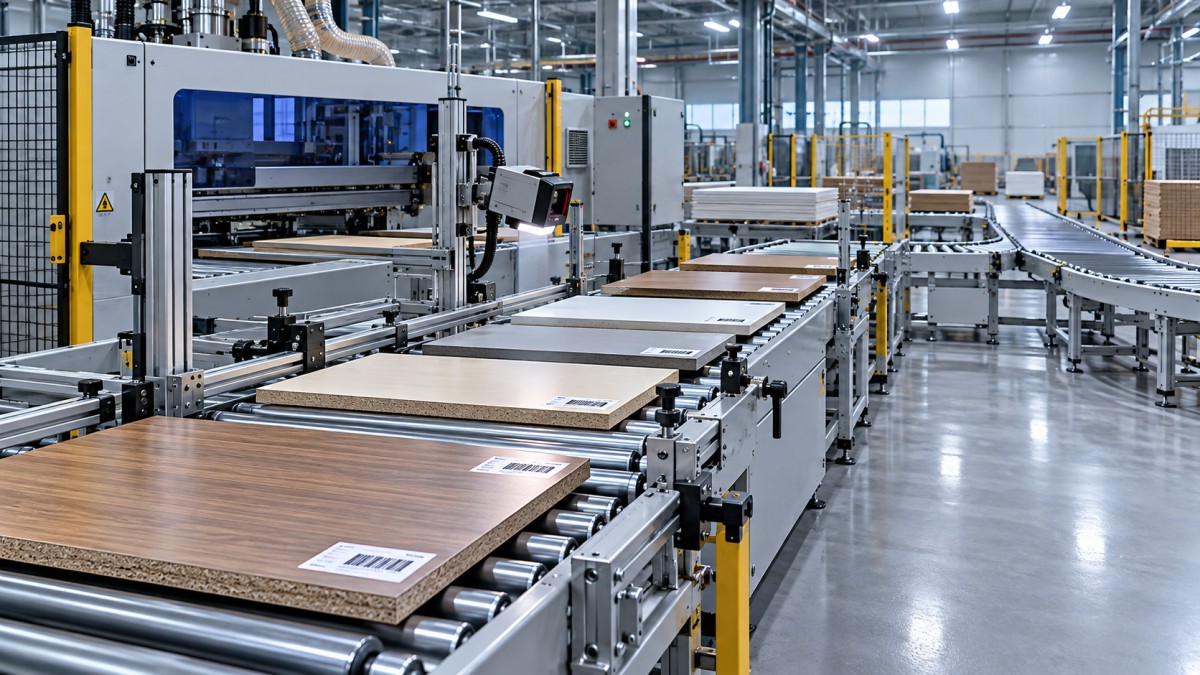
The control architecture should separate business scheduling from machine execution. ERP typically supplies order requirements; an MES, where used, coordinates dispatch and production records; machine controllers execute local sequences and interlocks. Safety functions require an appropriate safety control architecture, independent of ordinary production messaging.
Write an interface specification covering identifiers, units, recipe versions, machine states, acknowledgments, and failure behavior. Define the difference between “job received,” “setup complete,” and “ready to run.” Also specify what happens when a connection fails after a command is sent but before acknowledgment returns, so retries cannot accidentally create duplicate actions.
Choose communication methods according to the equipment’s supported capabilities and required behavior. A common protocol helps connectivity, but shared definitions make the exchanged data usable.
Automate changeovers where settings can be reproduced
Automatic positioning and recipe management are useful when a repeat order can return to a known setup. They work less reliably when material variation, tooling condition, or operator judgment strongly affects the result.
Evaluate each changeover task separately. Guides and stops may suit motorized adjustment. Tool preparation may benefit more from standardized mounting and offline staging. Printing presets can reduce initial adjustment while still requiring color approval. Edge-banding recipes can recall parameters, but adhesive, substrate, edge material, and equipment condition must remain compatible.
Use a controlled recipe lifecycle: create, approve, release, revise, and archive. Restrict who can overwrite validated settings, and record changes. Otherwise, a temporary correction for one material batch can become the default for later jobs.
Automatic setup should finish with the quality checks appropriate to the process. Successful positioning confirms that a commanded adjustment occurred; it does not establish that the printed sheet, carton, or furniture panel meets specification.
Use buffers and scheduling to protect flow
Directly linking machines can reduce handling, but it also allows one stoppage to affect the whole line. A controlled buffer may be preferable where adjacent processes have different cycle times, changeover patterns, or quality-release requirements.
Size buffers around likely disruptions and recovery needs. Available floor space alone is a poor sizing rule. Excess inventory consumes space, complicates job tracking, and can conceal recurring equipment problems. Too little buffering leaves the constraint repeatedly starved or forces it to stop when downstream equipment pauses.
Dispatching rules should balance due dates with setup compatibility. Grouping every similar job may improve local efficiency while delaying urgent orders. Conversely, accepting every urgent insertion can destabilize the schedule and multiply setups. Define when a released sequence can change, who authorizes the change, and how affected machines receive updated instructions.
Some routes should remain separate. Products with incompatible handling, extensive cleaning, unusual tooling, or substantially different processing times may suit a parallel cell better than the main line. A flexible production system can include shared resources and dedicated operations.
Commission in stages with explicit release criteria
Select a pilot family that represents normal operating difficulty. An exceptionally easy product may conceal integration weaknesses, while the most unusual product can make the first stage unnecessarily complex.
- Establish the baseline. Record accepted output, changeover duration, scrap, queue time, and manual interventions for the selected mix.
- Test interfaces before cutover. Use representative job data to check recipe selection, acknowledgments, invalid identifiers, and communication interruptions.
- Prepare the installation window. Complete available panel work, software preparation, backups, tooling, and operator instruction before production stops.
- Run controlled production. Begin with a limited route, then introduce more demanding transitions and recovery scenarios.
- Release against agreed evidence. Expand only when output, quality, traceability, and recovery performance meet the defined conditions.
Acceptance should cover a representative job sequence, including difficult transitions. A successful demonstration on one product does not establish mixed-model capability. Test recovery after a jam, rejected batch, missing identifier, and loss of production communications.
Agree on a practical rollback method before installation. Preserve controller backups and establish whether temporary manual transfer or an alternate route can support production. Any fallback must retain the necessary safety functions and product identification.
Assign responsibility across machine suppliers, controls specialists, software providers, maintenance, and operations. Interface faults often cross supplier boundaries; a named owner for each exchange and one lead for integrated acceptance prevent unresolved handoffs.
Judge the investment by usable capacity and delivery
Compare proposals using the same product mix, operating hours, staffing assumptions, and acceptance conditions. Include integration engineering, tooling, material handling, training, startup losses, maintenance, software support, and spare-parts availability alongside equipment cost.
Useful measures include changeover time to first acceptable output, accepted units per scheduled hour, schedule adherence, work in progress, and manual interventions. Track performance by product family where possible; an overall average can hide a route that consistently fails.
Avoid counting the same benefit twice. Reduced setup time creates capacity, but its financial value depends on demand or on a specific cost it removes, such as overtime. Lower staffing requirements also depend on whether remaining tasks can realistically be combined.
The next practical step is to assemble a representative order sequence, a machine capability map, and a measurable acceptance plan. These give equipment and integration suppliers a concrete problem to solve—and make it possible to judge whether the proposed changes will support greater variety while preserving dependable production.
Related News
Get weekly intelligence in your inbox.
No noise. No sponsored content. Pure intelligence.
