
Automatic Corrugated Board Production: Choosing Line Speed and Working Width
Automatic Corrugated Board Production: Choosing Line Speed and Working Width
Specifying an automatic corrugated board production line requires more than comparing maximum speed and working width. The real challenge is matching usable capacity to order mix, paper grades, flute profiles, and downstream constraints without increasing trim waste or compromising bonding quality. A wider, faster line can increase output, but only when steam capacity, drying performance, roll handling, and scheduling support sustained operation.
The most useful question is not “How fast can this corrugator run?” It is “How much saleable board can this configuration deliver through a representative production schedule?” That distinction should guide equipment comparisons, utility design, acceptance testing, and the investment case.
Start with the order book, not the machine specification
Before requesting quotations, assemble a production profile covering normal demand and credible peak periods. Monthly square metres alone are insufficient. Two plants with similar output requirements may need different configurations if one produces long runs of repeat packaging and the other handles frequent changes in board construction, sheet dimensions, and delivery priority.
Useful inputs include sheet width and cut length, order quantity, flute combination, liner and medium grades, basis weights, required delivery windows, and downstream routing. Record which orders can genuinely run together. Similar dimensions do not make orders compatible when paper specifications or board constructions differ.
Separate confirmed demand from speculative growth. Capacity reserved for a plausible new product family may be justified; capacity justified only by a broad sales forecast deserves closer scrutiny. Model the current workload first, then test growth scenarios without assuming that every additional order will improve width utilization.
Distinguish maximum speed from dependable running speed
Maximum mechanical speed describes an equipment capability under stated conditions. It is not a guaranteed operating speed across all paper combinations. For automatic corrugated board production, the relevant figure is the speed achievable while consistently meeting agreed bonding, moisture, flatness, dimensional, and strength requirements.
Ask suppliers for a speed matrix tied to representative board constructions rather than one headline number. It should identify paper assumptions, flute profiles, working widths, steam conditions, and any restrictions associated with splicing or short cut lengths. Where performance depends on paper quality, define the acceptable input range instead of leaving “suitable paper” open to interpretation.
Several mechanisms determine the practical limit:
- Heat transfer and bonding: Higher speed reduces the time available for heating and adhesive setting. Paper absorbency, initial moisture, adhesive condition, and thermal control affect the available operating window.
- Web control: Tension stability, roll condition, and splice performance influence whether the line can maintain speed without breaks or misalignment.
- Board handling: Cutting, separating, conveying, and stacking must remain stable at the actual sheet dimensions being produced.
- Changeovers: Frequent transitions can consume more scheduled time than a higher maximum speed recovers during short runs.
Do not assume that heavier board is always the slowest construction. Lightweight papers can present tension and moisture-control challenges, while different double-wall combinations impose different heating demands. The limiting grade needs to be established through technical review and representative trials.
Calculate output without hiding the losses
A transparent estimate is more useful than an optimistic efficiency percentage. One practical calculation is:
Saleable area = running speed × loaded web width × running minutes × width yield × quality yield.
Use metres per minute and metres to obtain square metres. Here, width yield is the proportion of the loaded web retained as product after trim; quality yield excludes rejected board. Running minutes must already exclude stops. If average speed includes stopped time, do not apply a second availability deduction.
Calculate separate production segments where grades, widths, or operating speeds differ, then add the results. A single plant-wide average can conceal the jobs that actually determine delivery performance.
Working width pays only when the schedule can use it
Maximum working width is the equipment envelope, not the width automatically converted into saleable sheets. A wider line may accommodate more lanes, larger formats, or better order combinations. It may also spend substantial time running narrower reels because compatible orders are unavailable.
Keep three measures separate: installed working width, loaded reel width, and combined finished-sheet width. Running a narrow reel on a wide machine reduces installed-width utilization, but does not inherently create trim across the unused machine width. Trim loss occurs within the web actually being processed. Confusing these measures can distort both paper-cost and capacity comparisons.
Evaluate proposed widths using historical orders and feasible reel-width inventories. The scheduling exercise should respect delivery dates, flute and paper compatibility, permitted trim, slitter-scorer limitations, and the machine’s ability to handle different cut lengths. A mathematically efficient layout is not useful if it delays urgent orders or requires excessive finished-board stock.
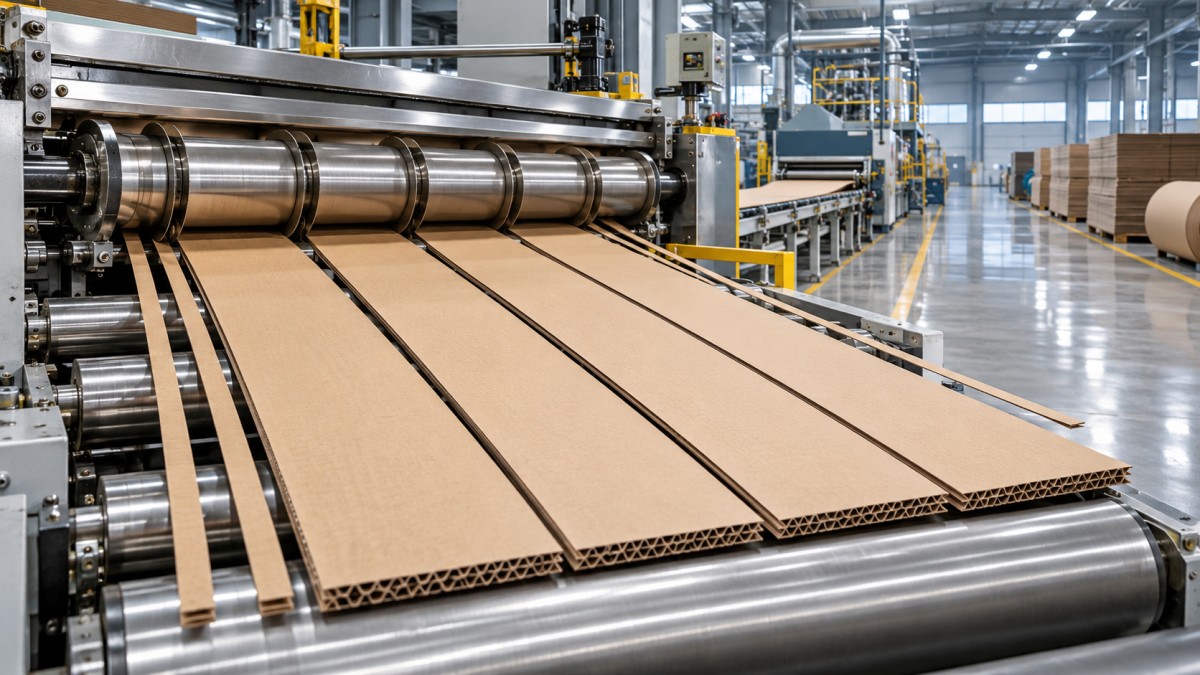
A useful comparison shows the same order basket arranged across candidate working widths, with reel edges, sheet lanes, trim, and unfilled capacity identified separately. This exposes whether additional width creates repeatable production value or merely improves a few unusually favourable combinations.
Reel procurement matters too. More stocked widths may improve scheduling flexibility, but they also increase inventory complexity and the risk of slow-moving paper. Confirm what the paper supply chain can support before treating every theoretically available width as a practical option.
Check the systems that must support width and speed together
Increasing width and speed raises the area of paper processed per minute. That affects thermal demand, adhesive consumption, reel replenishment, waste extraction, and board discharge simultaneously. Evaluating these systems separately from the corrugator can leave an otherwise capable line constrained by its installation.
For steam, review conditions at the equipment under production load—not only the boiler nameplate. Distribution losses, condensate removal, control response, and simultaneous demand elsewhere in the plant can affect usable heating performance. Request the supplier’s utility requirements for the proposed board mix and have the site system checked against them.
The adhesive system also needs operating discipline. Preparation consistency, temperature, viscosity, application control, and circulation affect bonding and moisture balance. Adding adhesive to compensate for insufficient process control can increase the drying burden rather than solve the underlying problem.
Wider reels introduce handling questions beyond whether the roll stand accepts them. Check reel mass and diameter limits, unloading equipment, storage access, transport routes, splice preparation, and safe operator access. Faster consumption also leaves less time for replenishment.
At the dry end, verify minimum and maximum cut lengths, stack-change behaviour, discharge arrangements, and conveyor capacity. Downstream printing, die-cutting, and folding-gluing capacity must be assessed in compatible units and against actual product sizes. Otherwise, higher corrugator output may simply become work-in-progress.
Choose the configuration around the dominant constraint
A long-run operation with repeat dimensions and reliable paper supply may benefit substantially from higher sustained speed. A mixed-order sheet plant may gain more from scheduling flexibility, reliable splicing, rapid order changes, and stable performance across varying paper grades.
Additional width deserves priority when it repeatedly enables useful lane combinations or serves required sheet formats. Additional speed deserves priority when enough uninterrupted running time exists to exploit it. Neither is an adequate substitute for the other: extra speed does not fix poor width matching, and extra width does not remove thermal limitations.
Run sensitivity checks rather than relying on one forecast. Test shorter average orders, less favourable paper, a different flute mix, and delayed downstream clearance. Compare paper loss, labour, energy, maintenance, inventory, and financing costs per saleable square metre. A configuration that remains acceptable under imperfect conditions is easier to defend than one that pays back only at ideal utilization.
Make acceptance testing reflect the intended workload
The purchase specification should translate the production model into measurable acceptance conditions. A demonstration using one easy construction at steady speed cannot establish performance across a mixed workload.
- Define the test basket: Include commercially important constructions and challenging combinations, with paper properties and conditioning requirements recorded.
- Measure transitions: Observe splices, order changes, width changes, stack changes, and recovery to acceptable board—not just uninterrupted running.
- Agree quality methods: Set sampling procedures and acceptance limits for dimensions, bonding, warp, moisture, and relevant board-strength properties.
- Record the complete result: Capture saleable area, waste, stops, speed history, utility conditions, and operator interventions over an agreed duration.
Clarify which results can be demonstrated at the supplier’s facility and which require site acceptance with installed utilities and production paper. Also establish responsibility for operator training, process recipes, spare parts, controls support, and production-data integration.
This connected view reflects the industrial intelligence focus of Global Print, Woodworking & Furniture Systems (PWFS): equipment capability matters most when understood alongside process physics, automation, and downstream manufacturing requirements. For corrugated board, the useful comparison is the complete production system, not an isolated speed rating.
Before final selection, ask each shortlisted supplier to evaluate the same order basket under the same quality and utility assumptions. Require clear treatment of trim, downtime, rejects, and changeovers. Choose working width and line speed only after that comparison shows where the capacity will come from—and what the plant must provide to sustain it.
Related News
Get weekly intelligence in your inbox.
No noise. No sponsored content. Pure intelligence.
