How CNC Furniture Manufacturing Improves Accuracy for Custom Cabinet Production
How CNC Furniture Manufacturing Improves Accuracy for Custom Cabinet Production
Custom cabinet production is often described as a design business, but the difficult part begins after the renderings are approved. A kitchen may include angled walls, appliance cut-outs, floor-to-ceiling pantry units, concealed lighting channels, mixed panel finishes, and hardware systems that each demand a slightly different drilling pattern. In a whole-house project, those variations multiply across wardrobes, vanity units, media walls, storage systems, and interior doors.
That is where CNC furniture manufacturing changes the production equation. Its real value is not simply that a router cuts panels faster than a conventional saw. The greater advantage is that a single digital definition can drive cutting, drilling, grooving, labeling, and downstream assembly. When the workflow is properly controlled, cabinet components arrive at the assembly station with a more predictable relationship to one another: holes align, edge-banded panels remain identifiable, drawer boxes fit their openings, and installers spend less time compensating for avoidable workshop variation.
For complex custom cabinetry, accuracy should be treated as a system outcome rather than a machine specification. A highly capable CNC router cannot correct a flawed site measurement, an outdated drawing revision, poor material conditioning, or an edge-banding process that changes the final panel dimension. The strongest results come from connecting design data, machining logic, material handling, and inspection into one disciplined production flow.
Accuracy starts before the panel reaches the CNC machine
In traditional cabinet shops, a drawing may be interpreted several times: once by the estimator, again by the cutting operator, then by the driller and assembler. Every handoff introduces room for different assumptions. One person may read a cabinet width as finished size; another may subtract edge banding differently; a third may place a hinge cup according to an old template. These are rarely dramatic mistakes at first. They become expensive when a batch of otherwise finished panels cannot be assembled on schedule.
A CNC-led workflow reduces these interpretation points. Cabinet design software or CAD/CAM software can convert the approved cabinet model into part dimensions, machining operations, material descriptions, labels, and nesting instructions. The operator still has an important role, but it shifts from manually recreating geometry to validating that the released production data, tooling, material, and machine setup match the job.
This matters especially where design revisions are common. A late change to a countertop depth, a built-in refrigerator model, or a wall condition may affect several connected units. If the change is made only on a printed shop drawing, outdated panel data can easily remain in circulation. In CNC furniture manufacturing, revision control needs to be explicit: one approved job version, a clear release point, and a way to prevent superseded programs from returning to the machine queue.
The practical lesson is simple: do not measure CNC accuracy only at the spindle. Measure how reliably the correct design revision becomes the correct finished part.
Nesting, drilling, and routing create repeatable cabinet geometry
Panel processing centers and nesting CNC routers can combine several operations on a sheet before parts are separated. A programmed sequence may cut the perimeter, drill shelf-pin rows, create dowel or connector holes, machine hinge cups, route a back-panel groove, and add pockets for fittings. Because these features are positioned from the same digital origin, their relationship is more consistent than when each feature is established separately on different machines.
That relationship accuracy is more important than an isolated dimension. A cabinet side panel can be cut to the expected height yet still cause trouble if its hinge holes, stretcher holes, or drawer-slide positions drift relative to the finished edges. A cabinet is an assembly of references. CNC machining makes those references repeatable when the datum strategy is correct.
For example, a manufacturer may choose one visible finished edge as the primary reference for door-related drilling, while using a different edge for construction holes. That choice should not be accidental. It must reflect the assembly method, the direction of edge banding, the handedness of the cabinet, and whether panels can be flipped during machining. Mirrored parts are a frequent source of errors in custom work because they can look nearly identical until installation.
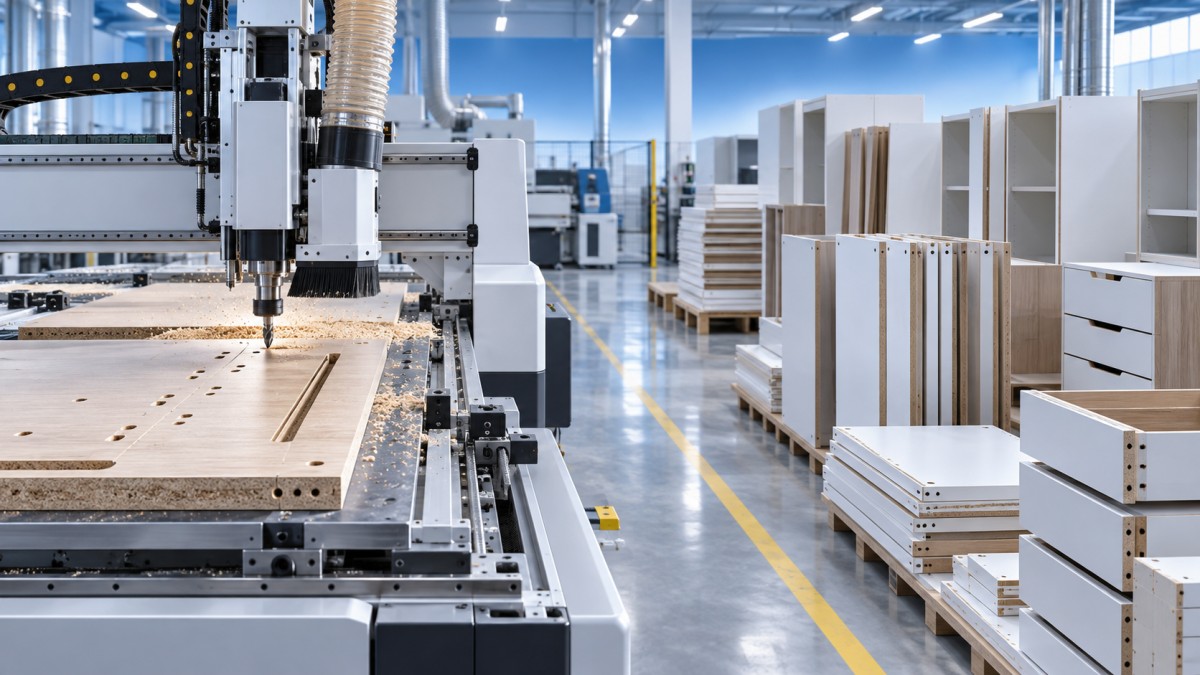
Nesting also influences accuracy indirectly through material use and handling. Efficient layouts can reduce offcuts, but an overly aggressive nest may leave narrow bridges, fragile small parts, or difficult-to-sort components. The lowest theoretical waste is not always the best production result. If an operator spends time identifying parts or if small pieces shift during cutting, the apparent material saving can be lost in rework. Good nesting balances yield, part stability, toolpath direction, grain orientation, and how quickly parts can move to edge banding or assembly.
The machine is only as accurate as its tooling and material control
It is tempting to blame a CNC router when cabinet parts begin to fit poorly. Sometimes the machine does need calibration or maintenance. Just as often, however, the cause is less obvious: worn cutters, insufficient vacuum hold-down, incorrect tool data, panel bow, chipped melamine surfaces, or a board thickness that differs from the value assumed in the program.
Tool condition deserves more attention than it gets in many shops. A dull compression bit may still cut a recognizable shape, yet it can increase edge breakout, heat buildup, and cutting resistance. Those effects are especially unwelcome in laminated particleboard, MDF, plywood, and finished decorative panels, where the edge quality determines how well subsequent banding and assembly will perform. Feed rate, spindle speed, cutter geometry, and chip evacuation should be treated as a matched set rather than as isolated settings.
Vacuum performance is another quiet accuracy factor. A sheet that lifts or shifts even slightly can produce poor hole positioning, incomplete cuts, or damaged small parts. Shops processing narrow rails, open-frame components, or heavily nested sheets may need to review spoilboard condition, vacuum zoning, gasket integrity, and toolpath sequencing. Leaving small components until later in the cycle can sometimes improve stability, but the right approach depends on panel material and machine configuration.
Material control has a similar effect. Sheet goods can vary by supplier batch, storage environment, core composition, and nominal thickness. Cabinet programs should not assume every board behaves identically. When tight-fit joinery, hardware drilling, or finished face alignment is involved, incoming material checks and sensible storage conditions are part of quality control, not administrative overhead.
Edge banding can preserve—or undo—machining accuracy
A panel may leave the CNC router dimensionally correct and still become unsuitable after edge processing. Edge banding changes the finished condition of the panel, particularly where doors, drawer fronts, fillers, and visible end panels must maintain controlled reveals. Glue line quality, trimming setup, corner rounding, panel feed stability, and tape thickness all affect the final appearance and fit.
This is why cabinet dimensions should be defined around the intended manufacturing sequence. Is the programmed part size the substrate size before banding, or the final size after edge trimming? Which edges receive tape? Are opposing edges treated symmetrically? These questions sound basic, yet they are the source of many assembly disagreements between design, CNC, and edge-banding teams.
Edge finishing also has implications beyond appearance. Properly applied edge material can help protect vulnerable panel edges from moisture and everyday wear. Claims about indoor emissions, however, should be assessed through the board specification, adhesive system, finished-product requirements, and applicable local rules—not assumed simply because an edge band has been applied.
Labels and traceability prevent accurate parts from becoming wrong parts
A precisely machined cabinet side is of little use if it is mixed with a similar panel from another room or another revision. This is one of the reasons labeling is so valuable in custom cabinet production. A useful label can connect the component to a room, cabinet number, part name, material, edge treatment, machining status, and assembly position. The exact fields depend on the factory, but the objective is consistent: preserve identity after panels leave the machine.
For larger projects, this becomes a planning tool as much as a quality tool. Production teams can group parts by room, delivery sequence, finish, or installation zone rather than producing a mixed pile of panels that must later be sorted manually. When installation dates are tight, the ability to verify whether a specific cabinet’s full component set has been cut, edged, inspected, and packed can be more useful than a general statement that the job is “mostly complete.”
This thinking mirrors other precision manufacturing environments. In high-speed printing and packaging, color registration and die-cut geometry only create value when the correct artwork, substrate, and converting process remain connected through the job. The same principle applies to furniture: digital precision is strongest when information travels with the physical workpiece.
Where CNC workflows make the biggest difference in whole-house projects
CNC furniture manufacturing is particularly useful when a project contains repeated construction logic with controlled variation. Wardrobe interiors may share drilling patterns while changing in width. Kitchen bases may use standard hardware positions but require different appliance openings. A media wall may combine repeated vertical partitions with one-off cable routes and display niches. CNC programming makes it possible to standardize what should be standard while retaining the freedom to customize visible dimensions and layouts.
The workflow is less effective when the front end remains informal. If site dimensions are captured inconsistently, if hardware decisions are made after machining begins, or if installers routinely “make it work” on site without feeding those changes back to design, the CNC machine will reproduce confusion very efficiently. Automation does not remove the need for engineering discipline; it makes that discipline more visible.
Before releasing a custom cabinet batch, it is worth checking a short set of practical questions:
- Has the site measurement been verified against the latest architectural conditions and appliance information?
- Are material thickness, panel orientation, edge treatments, and finished dimensions defined in the same source of truth?
- Have hinge, slide, connector, and shelf-support drilling patterns been checked against the actual hardware selected?
- Can labels distinguish room, cabinet, panel orientation, and drawing revision without relying on memory?
- Is there a first-off inspection process before a full nested batch is released?
A more useful definition of CNC accuracy
The best CNC cabinet operations do not judge accuracy only by whether a router can hold a stated tolerance under ideal conditions. They judge it by whether the finished cabinet can move from design approval to installation with fewer manual corrections, fewer unidentified parts, and fewer surprises at the final fit stage.
For manufacturers navigating the demand for fast, highly individualized interiors, the practical priority is digital continuity: design data that can be trusted, machining programs that reflect the latest revision, stable panel processing, controlled edge finishing, and traceable parts. This is the operating logic behind modern CNC woodworking systems and a central concern for industry observers such as PWFS, where flexible wood-cutting workflows are viewed alongside the broader precision disciplines of print, packaging, and industrial converting.
When those links are in place, CNC equipment becomes more than a cutting platform. It becomes a reliable way to turn a complicated room-by-room cabinet design into components that are ready to assemble, ready to inspect, and far less likely to create a problem when the installation crew is already on site.
Related News
Get weekly intelligence in your inbox.
No noise. No sponsored content. Pure intelligence.
