
CE Marking for Packaging Converting Equipment: What Buyers Should Check
A CE mark on a machine is only the starting point for assessing compliance—not a substitute for checking the documentation behind it. For procurement teams sourcing CE packaging converting equipment, incomplete declarations, unclear safety responsibilities, or missing instructions can lead to costly delays and operational risks. This guide explains what buyers should verify, from the applicable EU legislation and Declaration of Conformity to guarding, documentation, and the responsibilities involved when integrating equipment into a production line.
The distinction matters because a folder-gluer, die-cutter, printing press, or corrugated board line is rarely purchased in isolation. Equipment has to be installed, connected, adjusted, cleaned, and maintained. A machine that looks acceptable in a supplier’s video can present different risks when its delivery conveyor meets an existing production line or when operators need frequent access to clear jams.
Start with the machine’s legal status and intended market
CE marking is the manufacturer’s declaration that a product meets the applicable EU requirements providing for the marking. It is not, by itself, proof that an EU authority has inspected or approved the machine. Independent assessment is required in some circumstances, but a third-party certificate is not automatically required for every machine.
For machinery placed on the EU market or put into service before 20 January 2027, the Machinery Directive 2006/42/EC is generally the relevant machinery legislation. Regulation (EU) 2023/1230 applies from 20 January 2027 and replaces that directive. The applicable framework depends on the facts and timing of the project, so a long-lead order should address the expected placing-on-the-market or putting-into-service date before the contract is signed.
Other legislation may also apply, depending on the equipment and its features. Electromagnetic compatibility is one example; radio equipment, potentially explosive atmospheres, or pressure equipment may require additional consideration in particular projects. Do not assume that every directive mentioned in a supplier’s brochure applies to the machine being purchased—or that the brochure lists everything relevant.
Confirm the destination too. EU CE requirements should not be treated as a complete answer for every European market. Great Britain, for example, has its own product-marking and machinery rules. Check the current requirements for the destination and the date of supply rather than relying on a generic “European compliant” claim.
Read the declaration before accepting the price
Ask for a draft Declaration of Conformity during technical evaluation and the signed, machine-specific document at delivery. Under the Machinery Directive, this is an EC Declaration of Conformity; terminology and documentation should match the legislation applicable to the project.
A useful first check is whether the declaration identifies the actual manufacturer and machinery, refers to applicable legislation, and is signed by an authorized person. Compare its model and identifying details with the quotation, nameplate, manual, and delivered configuration. A document for a related machine in the same product family is not a substitute for clarity about the machine on order.
If harmonised standards are listed, ask which editions were used and how they relate to the delivered configuration. Appropriate application of harmonised standards can provide a presumption of conformity with the requirements they cover, but listing a standard does not prove that every relevant requirement has been addressed. Equally, a supplier may use another technical route if it can demonstrate compliance.
Be cautious with a generic “CE certificate” issued for an unspecified product, especially if it is presented instead of the manufacturer’s declaration. A test report or certificate can be useful supporting evidence, but its scope, issuing body, and relevance to the exact machine still need checking.
Inspect the hazards hidden by the production-rate figure
A specification may lead with sheets per hour or boxes per minute, yet the procurement decision should also account for how people interact with the machine at those speeds. Ask the supplier to explain the protective measures in normal operation, setup, jam clearing, and maintenance—not just during a demonstration run.
On a die-cutter, assess access to the cutting and feed areas, including the consequences of opening a guard while hazardous motion is possible. On a folder-gluer, look closely at exposed belts, nip points, glue application, and access around transfer sections. A corrugated line introduces a different mix of concerns, potentially including hot surfaces, steam-related systems, large moving rolls, and long distances between workstations.
The point is not to prescribe one guarding arrangement for every machine. It is to verify that the proposed safeguards fit the tasks operators actually perform. If a guard must be bypassed to remove routine waste or adjust a belt, the project has a design and operational question that should be resolved before installation.
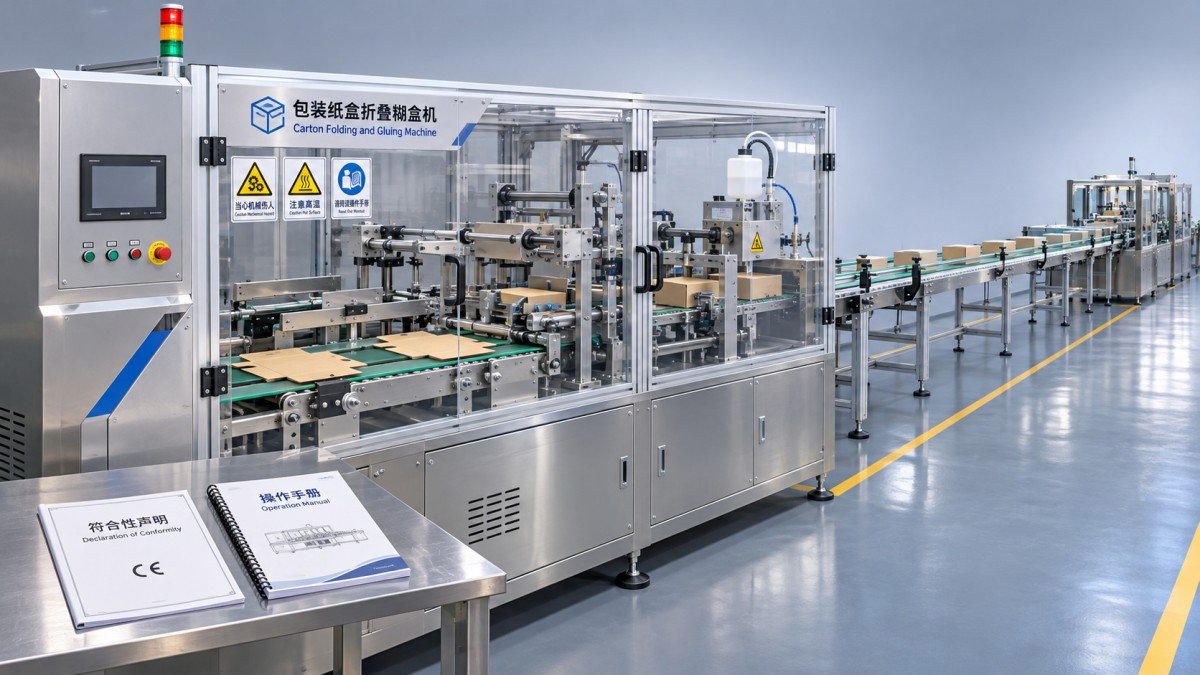
Request a review of emergency-stop locations, guard interlocking, isolation of electrical and pneumatic energy, and safe restart after a stop. Where powered adjustments or slow-speed setup functions are offered, clarify the operating conditions and protective measures. Safety-related control functions should be validated against the applicable requirements; a component’s safety rating alone does not establish that the complete function is adequate.
Separate a complete machine from partly completed machinery
This distinction can change both the purchase price and the project workload. A complete machine supplied for a defined use normally comes with the applicable Declaration of Conformity and CE marking. Partly completed machinery is intended to be incorporated into or assembled with other machinery and cannot perform a specific application on its own in the same way.
Under the Machinery Directive, partly completed machinery is accompanied by a Declaration of Incorporation and assembly instructions rather than being CE-marked under that directive as a complete machine. It may still need CE marking under other applicable legislation. Ask the supplier to identify which essential health and safety requirements have been applied and fulfilled, and what remains for the party completing the assembly.
This is a procurement issue, not merely a legal detail. A lower-priced converting module may require additional guarding, controls, engineering, documentation, and conformity work before it can be used as intended. Those costs belong in the comparison with a complete machine.
Define who owns the interfaces
Connecting individually marked machines does not automatically make the resulting line compliant as a whole. Whether the combination constitutes an assembly of machinery depends on how the units are arranged, controlled, and function together. A standalone stacker placed beside a press is not necessarily equivalent to a tightly integrated line with shared controls and coordinated operation.
Before issuing the purchase order, map each interface: sheet or board transfer, conveyors, shared guarding, safety signals, emergency stops, utilities, and production-control connections. Identify who designs, installs, tests, and documents each one. Where a new assembly is created, establish who will assume the applicable manufacturer responsibilities for that assembly. A contractual label alone does not determine those legal responsibilities.
Existing equipment deserves the same attention. Replacing a folder-gluer’s upstream feeder, adding automated handling, or changing the safety controls can affect the risk assessment. The legal consequences of a modification depend on its nature and the applicable rules; involve a qualified machinery safety specialist before assuming that the original documentation covers the altered line.
Make documentation a deliverable, not an afterthought
The manufacturer must compile the required technical documentation and make it available to competent authorities as required. Buyers should not assume they are automatically entitled to the entire technical file. They can, however, specify the information needed to install, operate, maintain, and integrate the equipment safely.
The purchase specification should identify required instructions and their language, drawings and utility requirements, electrical and pneumatic information needed for maintenance, safety interface details, residual-risk information, and the declaration appropriate to the supply. Confirm the applicable language requirements for the destination and who pays for translations. Also establish whether manuals cover optional equipment and the final configuration rather than only a standard model.
For a factory acceptance test, agree in advance which safety functions can be demonstrated at the supplier’s site and which must be checked after installation. A site acceptance test can then address interfaces, actual access routes, stopping functions, and changes made during commissioning. Record outstanding items with an owner and a closure date; otherwise, documentation gaps can survive into production startup.
Compare the full cost of compliance
Two quotations are not comparable if one includes line integration and translated instructions while the other leaves those tasks to the buyer. Ask suppliers to price the same scope or clearly identify exclusions. In addition to the machine itself, examine the following potential cost items:
- Additional guarding, access platforms, perimeter protection, and modifications required by the site layout.
- Engineering and validation of safety interfaces between new and existing equipment.
- Electrical, compressed-air, extraction, steam, or other utility work where relevant.
- Translation, final drawings, operator instruction, and maintenance training.
- Travel and commissioning time, retesting, corrective work, and delays caused by unresolved documentation.
Do not treat every exclusion as a supplier defect. A local integrator may be better placed to handle site-specific work. The commercial risk arises when nobody has allowed for it. Tie the scope to acceptance milestones and agree how design changes, missing documents, and failed tests will be handled before the machine ships.
PWFS follows equipment across corrugated production, printing, die-cutting, and folder-gluing, where the interface between machine performance and factory operation is often as consequential as the headline specification. For a practical next step, circulate the proposed layout, machine list, destination market, and responsibility matrix to the supplier and integrator together. Resolve the gaps while there is still time to change the order—not after the equipment is on the factory floor.
Related News
Get weekly intelligence in your inbox.
No noise. No sponsored content. Pure intelligence.
