
CE-Marked Folding Carton Equipment: What Documents Should Buyers Check?
A CE mark on a folder-gluer or die-cutter is a starting point, not proof that the machine being delivered is ready for safe use. Before accepting an offer for folding carton equipment described as CE certified, check the signed EU Declaration of Conformity, the machine identification, the applicable legislation and standards, and the operating instructions. Then confirm that those documents cover the exact configuration being supplied.
The distinction matters when a quotation shows a complete line but the paperwork refers only to a basic machine, or when an optional feeder, delivery unit or safety enclosure is added later. A mismatch can delay installation and leave responsibility for the final assembly unclear. Document review should therefore begin before the contract is signed, not after the equipment reaches the factory.
Start with the EU Declaration of Conformity
The EU Declaration of Conformity is the manufacturer’s formal statement that the machine satisfies the applicable legal requirements. Request a copy for the machine or assembly being purchased, rather than relying on a catalogue, a certificate for a component, or a photograph of a CE plate.
Compare the declaration with the quotation and the equipment specification. The declaration should identify the manufacturer and the machinery sufficiently to link it to the supplied equipment. Depending on how the declaration is prepared, identification may include the machine type, model and serial number. Check the person who signed it, the date and place of issue, and the person authorised to compile the technical file where required by the applicable machinery legislation.
The declaration should also identify the relevant legislation and, where used, the standards applied. Its legal references should be appropriate to the machine and the date on which it is placed on the EU market or put into service. Do not assume that a declaration copied from an earlier model remains appropriate for a later delivery.
For machinery, the transition from the Machinery Directive 2006/42/EC to the Machinery Regulation (EU) 2023/1230 is particularly important: the regulation applies from 20 January 2027, subject to its transitional provisions. Ask the supplier to explain the legal framework used for the intended placement on the market. Other legislation, such as electromagnetic compatibility requirements, may also apply according to the equipment and its configuration.
Check the scope, not just the heading
A declaration for a standalone folder-gluer does not automatically establish conformity of a line that also includes a feeder, inspection system and delivery conveyor. Likewise, a declaration for an electrical cabinet or a safety component is not a declaration for the complete machine.
Ask the supplier to identify the physical boundaries covered by the declaration: infeed, processing sections, outfeed, guards, control panels and supplied interfaces. The description should be consistent with the layout drawing and the contract. If equipment is shipped in separate sections for transport, establish whether it is declared as one complete machine or whether further assembly and assessment are necessary.
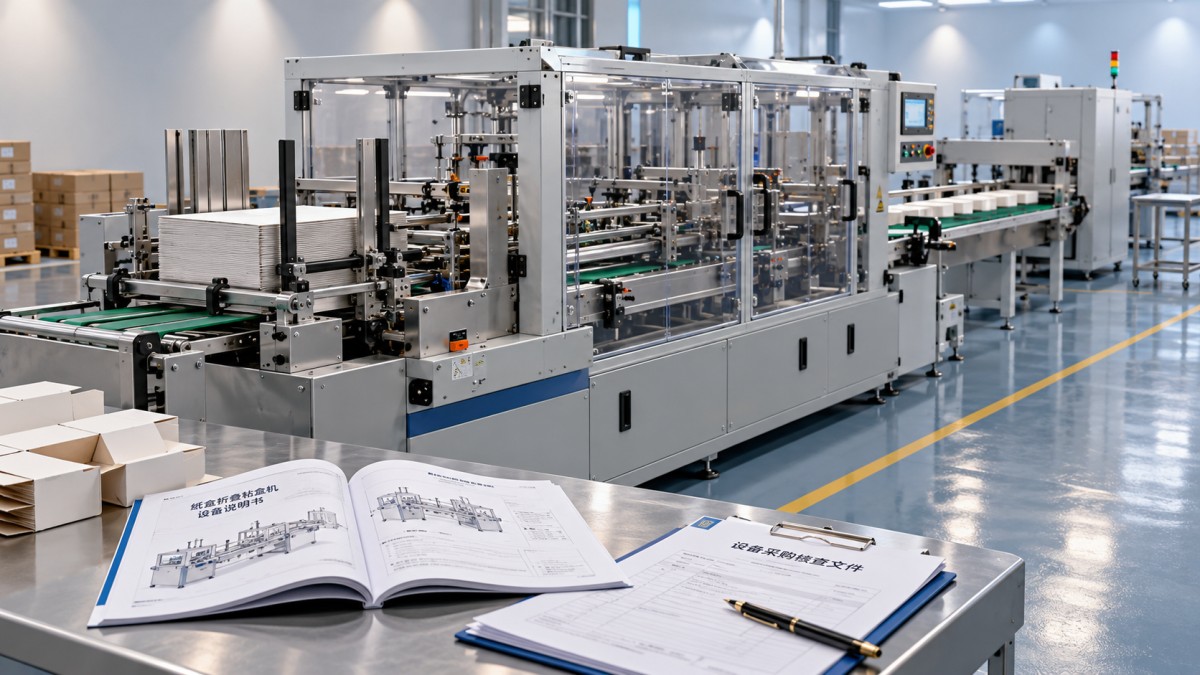
Match the documents to the machine plate
The identification on the equipment should allow it to be connected to the declaration and instructions. Inspect the proposed nameplate information before shipment and verify the plate again on delivery. Relevant details normally include the manufacturer’s name and address, machine designation, series or type, serial number where applicable, and year of construction, alongside the CE marking and other required information.
A model designation alone can be too broad when the same platform is offered with different guarding, drives or automation packages. Ask for the serial-specific declaration when the final serial number is available. Resolve differences in manufacturer names, model codes or configuration descriptions in writing; an unexplained discrepancy is a reason to pause acceptance, not a minor filing issue.
The CE marking is a legal conformity marking, not a general quality grade. It does not establish output speed, carton quality or fitness for a particular production job. Those commitments belong in the technical specification and acceptance criteria.
Read the instructions against the actual installation
Request the operating instructions early enough for the maintenance and production teams to review them before the factory acceptance test. The instructions should accompany the machine in the language or languages required by the EU country where it will be used. Clarify who supplies any required translation and whether the delivered version includes the complete machine and its options.
For carton-converting equipment, the useful test is whether the instructions describe the tasks operators and technicians will actually perform. Review the sections covering:
- Transport, lifting, installation, anchoring and connection of power and other utilities.
- Intended use, foreseeable misuse and limits on materials, tooling and operating conditions.
- Setting up feeders, folding sections, glue systems, dies and delivery equipment, as applicable.
- Guarding, interlocks, emergency stops, safe access, isolation and procedures for clearing jams.
- Cleaning, maintenance, replacement of wear parts and residual risks that remain after protective measures.
A manual that covers operation but omits safe jam clearance can be a serious gap on equipment with rollers, belts or moving tooling. Equally, instructions for a standard machine may not explain an added hot-melt unit or an integrated inspection station. Ask for the relevant supplementary instructions and check that they are consistent with the final line layout.
Site conditions also matter. A supplier may assume that the buyer will provide extraction, a perimeter fence or a safe access route. Those assumptions should be explicit in the installation requirements and reflected in the purchase agreement; otherwise, an apparently complete delivery can arrive with essential protective work still to be defined.
Understand which technical documents are available
The manufacturer is responsible for compiling the technical file required by the applicable machinery legislation and making it available to the competent authorities when required. Buyers should not assume that the complete file, including confidential designs, must automatically be handed over with every machine. It is nevertheless reasonable to agree on the evidence and technical information needed to evaluate and operate the equipment.
Request a document schedule that distinguishes between documents supplied routinely, summaries available for review and information retained by the manufacturer. Depending on the machine, useful material may include:
- A description of the machine and its intended operating limits.
- Layout drawings and drawings showing safety-related interfaces and access points.
- A risk assessment summary identifying significant hazards, protective measures and residual risks.
- Electrical, pneumatic and other relevant schematics needed for installation and maintenance.
- Evidence of checks or tests relevant to the supplied configuration, where agreed or applicable.
- Instructions and declarations for incorporated equipment where these help explain the complete assembly.
A risk assessment summary is not a substitute for examining the machine, but it can reveal whether foreseeable tasks have been considered. On a die-cutter, for example, ask how access to hazardous movement during tool change is controlled. On a folder-gluer, ask how operators can clear a jam near driven belts without being exposed to unexpected restart. The supplier’s answer should align with the guards, controls and procedures shown in the documentation.
Standards: verify their relevance and edition
A declaration may list harmonised standards used by the manufacturer. These standards can support a presumption of conformity with the legal requirements they cover when their references have been published in the Official Journal of the European Union and the relevant conditions are met. Applying a standard does not, by itself, prove that every hazard on every configuration has been addressed.
Check the complete designation and edition, not merely a familiar standard number. Ask which parts of the machine and which safety functions each cited standard addresses. If the declaration lists a standard that appears unrelated to the supplied equipment, or refers only to general electrical practice while omitting an explanation of machine guarding, request clarification.
Standards are not the same as legislation, and their use is generally voluntary unless a particular legal provision makes otherwise. A manufacturer may use another technical route to meet the essential requirements, but should be able to explain and support that choice. Where a cited standard has changed or its harmonised status is uncertain, verify its status for the relevant legislation and date rather than treating an old certificate as conclusive.
Certificates and test reports: useful, but not a replacement
Suppliers sometimes provide a document labelled “CE certificate” from a testing or inspection organisation. Read what it actually covers. It may concern a component, an earlier model, a limited test or a voluntary assessment. Check the issuer, model, configuration, test scope and date, and compare them with the declaration and the machine on order.
Third-party involvement is required only in particular circumstances under the applicable legislation and conformity assessment route; it is not a universal requirement for every folder-gluer or die-cutter. A third-party certificate alone does not transfer the manufacturer’s responsibility for the declaration or establish that the complete delivered line complies. Conversely, the absence of a voluntary certificate does not by itself prove non-compliance.
Where a report is offered as evidence, ask whether the evaluated safety functions and protective devices are the same as those on the supplied machine. A report for one electrical cabinet, for example, cannot automatically validate guarding and emergency-stop behaviour across an expanded line.
Pin down responsibility for a combined line
Procurement becomes more complicated when different suppliers provide the die-cutter, feeder, stacker or conveyor. The question is not simply who sold each section, but who takes responsibility for conformity of the completed assembly where the connected units constitute an assembly of machinery. Shared controls, coordinated operation and linked safety functions are important factors in that assessment.
Before ordering, document who will design and validate interfaces, connect emergency-stop circuits, assess access between sections and issue the declaration for the completed assembly where required. A collection of individual declarations does not automatically cover hazards created at the interfaces.
Some equipment may be supplied as partly completed machinery rather than a complete machine. In that case, expect a Declaration of Incorporation and assembly instructions, not an EU Declaration of Conformity for a finished machine. The partly completed machinery must not be put into service until the final machinery into which it is incorporated has been declared compliant where required. Make sure the contract identifies who completes that work and supplies the final documentation.
Modifications after delivery can also affect the assessment. Adding a feeder, changing control logic or altering guards may introduce hazards that were not covered by the original declaration. The party making a substantial modification may acquire manufacturer obligations under applicable rules; assess the proposed change before it is made rather than assuming the original CE marking covers it.
Make document delivery part of acceptance
Include the agreed document list, language, configuration and delivery dates in the contract. Require the supplier to identify outstanding items and resolve discrepancies before final acceptance. The factory acceptance test can then be used to compare the documents with the actual machine: check identification, guards, access points and safety functions, while following agreed safe test procedures.
On arrival, confirm that transport changes or site assembly have not left gaps between the declared configuration and the installed equipment. Retain the declaration, instructions, drawings, test records and correspondence with the machine’s asset records. If the final line differs materially from the documented scope, obtain a clarified assessment and the appropriate declaration before putting it into service.
Related News
Get weekly intelligence in your inbox.
No noise. No sponsored content. Pure intelligence.