
How to Select Die Cutters for Label Converting Across Materials and Run Lengths
How to Select Die Cutters for Label Converting Across Materials and Run Lengths
Selecting die cutters for label converting is fundamentally a risk-management decision. The right platform must control material behavior, registration, waste, tooling cost, and uptime at the production mix you actually run.
For technical evaluators, the best choice is rarely the machine with the highest stated speed. It is the configuration that consistently produces saleable labels across substrates, repeat lengths, and order profiles.
Rotary systems usually favor stable, high-volume work. Semi-rotary platforms improve flexibility and reduce tooling exposure. Flatbed die cutters remain valuable where difficult materials, short runs, or specialized constructions dominate.
The evaluation should begin with a realistic job matrix, not a supplier brochure. Map current and expected label formats, materials, adhesives, finishing requirements, annual volumes, and acceptable waste levels.
Start with the Production Mix, Not the Machine Category
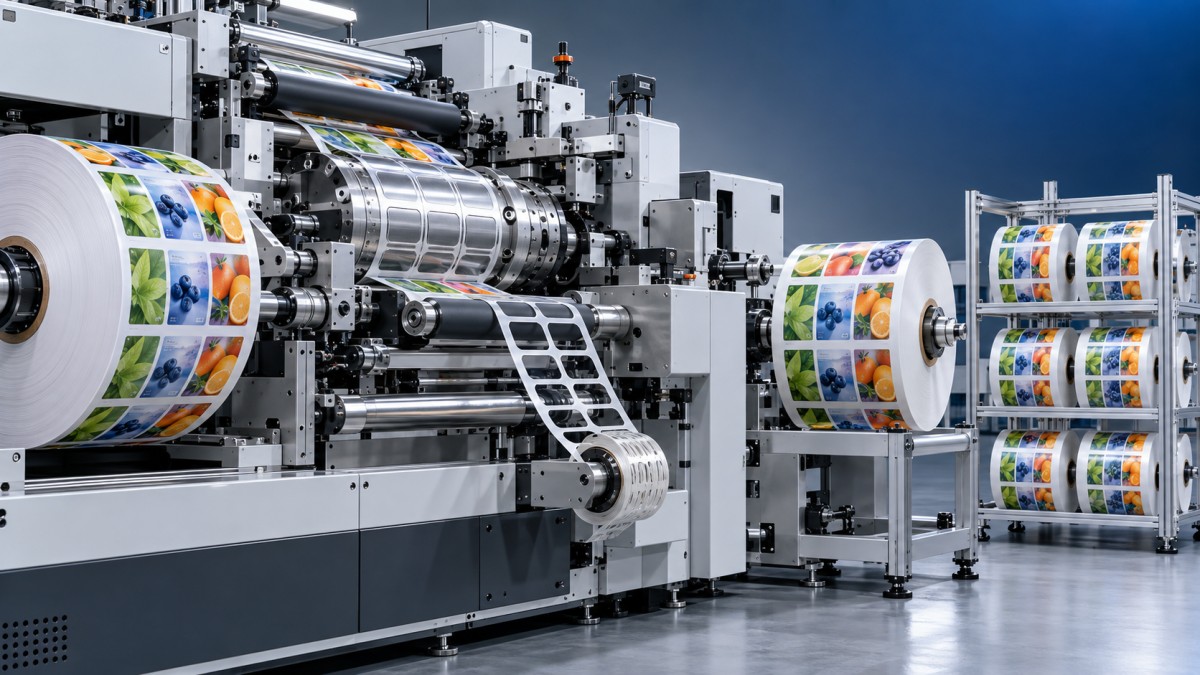
Before comparing die cutters for label converting, classify work by run length, web width, repeat length, substrate construction, number of SKUs, and required delivery frequency. These variables determine useful machine capability.
A converter producing millions of identical pressure-sensitive labels has different priorities from a plant serving regional food, chemical, pharmaceutical, or craft-product brands with frequent artwork changes.
Long runs reward continuous operation, rapid web speed, durable tooling, and minimal operator intervention. Short runs reward faster changeovers, lower die inventory, efficient setup, and flexible repeat-length management.
Do not use average order length alone. A monthly average can hide the fact that a few large accounts consume most footage while dozens of smaller jobs create most setup hours.
Build a run-length distribution showing jobs below 5,000 meters, between 5,000 and 25,000 meters, and above 25,000 meters. Adjust these bands to local operating conditions.
Then identify the production constraints behind missed delivery dates. In many converting plants, the bottleneck is not press speed but die changeover, matrix stripping, inspection, or downstream rewinding.
Technical evaluation should therefore model the full converting cell. A die station that runs quickly but causes rewinder breaks, excessive inspection rejects, or slow tooling changes may reduce total throughput.
Ask suppliers for demonstrated output data using representative jobs. Rated speed is useful only when paired with setup time, waste during stabilization, material limitations, and sustained production performance.
Match Rotary, Semi-Rotary, and Flatbed Technology to the Work
Rotary die cutting uses a cylindrical die against an anvil cylinder. It offers high speed, consistent repeatability, and strong economics when jobs are long enough to absorb dedicated tooling costs.
For high-volume paper labels, film labels, and established SKU programs, rotary systems can deliver excellent productivity. Their continuous motion also supports integrated printing, varnishing, laminating, and inline inspection.
The tradeoff is less economical flexibility. Each repeat often requires purpose-built tooling, and cylinder logistics, storage, maintenance, and lead time become significant when SKU counts increase.
Semi-rotary die cutting alternates or indexes web movement while retaining rotary cutting geometry. It can use flexible dies over a variable repeat range, reducing tooling requirements for shorter jobs.
This makes semi-rotary equipment attractive for digitally printed labels, frequent artwork revisions, seasonal promotions, and converters serving many modest-volume accounts with varied die-line formats.
However, intermittent motion introduces acceleration, deceleration, and web-tension demands. Evaluate whether the platform maintains register and clean matrix removal on lightweight films and challenging adhesive constructions.
Flatbed die cutting applies a reciprocating platen action. It is generally slower than rotary processing, yet it provides force, versatility, and useful control for difficult stocks and specialty applications.
Flatbed systems may be appropriate for thick paper, multi-layer laminates, certain tags, unsupported materials, unusual shapes, or operations where low tooling cost outweighs maximum linear speed.
The correct comparison is economic rather than ideological. Calculate sellable labels per shift, including planned changeovers, tooling preparation, material waste, cleaning, quality checks, and expected maintenance interruptions.
Assess Substrate, Adhesive, and Liner Behavior as One Construction
A label is not simply paper or film. Die-cutting results depend on the interaction among face stock, adhesive, release coating, liner, printing layers, varnish, laminate, and environmental condition.
Paper face stocks are often forgiving, but coated papers can crack at tight radii or produce dust. Uncoated materials may require different pressure settings to prevent rough edges or incomplete cutting.
Film labels demand closer control. Polypropylene, polyethylene, polyester, and PVC differ in stiffness, elongation, memory, heat response, and static behavior, all of which affect registration and matrix stripping.
Thin extensible films can stretch during acceleration or under excessive tension. A machine that performs well on paper may create label-position variation, necking, or web breaks on unsupported film.
Foil, metallized constructions, laminated materials, and textured stocks require trials under real production conditions. Surface finishes can alter friction, while laminate thickness changes the force needed for reliable die penetration.
Adhesive formulation is equally important. Aggressive permanent adhesives can build up on dies, while high-tack materials may complicate matrix removal. Removable and cold-temperature adhesives introduce different release behavior.
Evaluate liners carefully. Glassine, filmic, kraft, and PET liners differ in caliper, dimensional stability, release characteristics, and tolerance for kiss-cut depth. Poor liner compatibility causes expensive downstream failures.
For pressure-sensitive labels, the target is normally a clean face-stock cut without liner damage. This kiss-cut window may be narrow, especially with thin liners, variable caliper, or highly abrasive coatings.
Require test data for representative constructions, including cold starts, roll changes, splice passage, and long runs. A short sample trial may conceal heat buildup, adhesive transfer, and cumulative registration drift.
Define Cut Quality and Registration Requirements Before Comparing Specifications
Technical evaluators should translate quality expectations into measurable acceptance criteria. “Clean cutting” is too vague for equipment selection, supplier qualification, or factory acceptance testing.
Specify allowable die-cut registration variation relative to printed graphics, especially for clear labels, metallic substrates, small cosmetic labels, security features, and narrow borders around product imagery.
Also define acceptable cut-depth variation, edge quality, matrix-break frequency, label lifting, liner scoring, and waste percentage. These conditions should be reviewed for each priority material family.
Printed-to-cut registration depends on the press, web handling, sensors, servo architecture, encoder feedback, and material stability. A sophisticated die module cannot compensate for poor upstream web control.
Check how the system reads print marks and handles variable contrast. Transparent films, reflective foils, dark graphics, and UV varnishes may require sensor selection beyond a standard registration package.
Consider repeat accuracy during speed changes. Some machines hold tight register at a stable speed but drift during startup, deceleration, or intermittent operation, increasing waste on short orders.
Die pressure control deserves detailed scrutiny. Determine whether adjustment is manual, mechanical, pneumatic, hydraulic, servo-controlled, or closed-loop, and how repeatable settings remain between operators and shifts.
Document the minimum practical die line, corner radius, gap between labels, and matrix width for each material. Narrow webs of waste are particularly sensitive to die sharpness, adhesive behavior, and web tension.
Inspection capability should match label risk. Vision systems can verify print-to-cut alignment and missing labels, but evaluators must confirm defect detection thresholds, false-reject rates, and data traceability.
Calculate Tooling Economics and Changeover Time Honestly
Tooling strategy frequently determines whether a die-cutting investment achieves its business case. Machine price is visible, while dies, cylinders, storage, handling, sharpening, and replacement costs accumulate over years.
Solid rotary dies offer durability and precision for repeat programs. They are often justified for stable high-volume labels, particularly where long uninterrupted runs spread their acquisition cost over substantial output.
Flexible dies can reduce initial cost and simplify storage. They are commonly paired with magnetic cylinders and suit applications requiring frequent design changes, multiple repeats, or lower-volume production.
Ask for expected die life by material type, coating, adhesive, and operating speed. A single lifecycle estimate is insufficient because abrasive papers and foil laminates can wear tooling far faster.
Measure complete changeover time from the last good label of one job to the first approved label of the next. Include die installation, register setup, pressure adjustment, web threading, and quality approval.
Some platforms advertise fast die replacement while hiding lengthy mechanical alignment steps. Observe an operator completing a normal changeover using production-grade tooling, not a simplified exhibition demonstration.
Tooling management also affects response time. Evaluate whether dies are locally available, digitally traceable, protected from damage, and linked to job recipes that preserve proven settings.
For converters with many SKUs, reducing die inventory can free cash and floor space. Yet savings should not come at the expense of cut quality, repeatability, or unacceptable service lead times.
Test Waste Control, Web Handling, and Matrix Removal Under Real Conditions
Waste is where an apparently capable die cutter can become costly. Material loss includes setup footage, registration rejects, die-cut defects, matrix breaks, splices, inspection rejects, and unusable partial rolls.
Matrix stripping is especially revealing because it combines die quality, adhesive behavior, web tension, label geometry, and waste-path design. Ask to test the smallest and most complex commercial shapes.
Sharp corners, tiny labels, close spacing, unsupported films, and aggressive adhesives can create unstable waste matrices. Equipment must provide controlled tension without stretching the matrix until it breaks.
Review the unwind, infeed, servo pull, die station, stripping section, rewind, and waste rewind as a linked system. Local improvements rarely solve failures caused by inconsistent web transport.
Closed-loop tension control can be valuable, but its real benefit depends on sensor placement, response time, usable tension range, and operator accessibility. Request evidence across roll diameter changes.
Static management matters for films and lightweight papers. Static can cause label lifting, web attraction, dust accumulation, poor inspection reliability, and difficult rewinding, especially in dry production environments.
Waste handling should be designed for daily operation. Check waste-roll change procedures, access around the stripping path, web-break recovery, and whether operators can safely clear adhesive contamination without extensive downtime.
Run acceptance trials long enough to expose variation. Include material from more than one roll, samples with normal gauge variation, and a realistic speed ramp rather than one ideal operating point.
Evaluate Automation, Data, and Maintainability as Productivity Controls
Automation has value when it removes repeatable sources of variation. Recipe-driven pressure settings, register presets, tension control, automated inspection, and job tracking can improve consistency across shifts.
However, automation should be assessed against the plant’s engineering capability. Complex systems require training, reliable service access, spare parts, calibration routines, and disciplined data management.
Ask whether job recipes capture all critical settings, including die pressure, register offsets, tension ranges, speed limits, sensor configuration, and inspection thresholds. Partial recipes still leave operator-dependent variation.
Connectivity can support root-cause analysis. Useful machine data includes run speed, stop reasons, web breaks, waste length, rejected labels, pressure adjustments, register corrections, and tool usage history.
Do not accept a dashboard as evidence of operational improvement. Confirm that data can be exported, contextualized by job and material, and used to distinguish equipment losses from material or process losses.
Maintainability should be inspected physically. Check access to anvils, dies, bearings, sensors, waste paths, lubrication points, and electrical cabinets. Poor access extends routine maintenance into unplanned downtime.
Clarify consumables and wear components. Anvil refurbishment, bearing intervals, knife replacement, sensor cleaning, lubrication requirements, and service response times should be incorporated into lifecycle cost calculations.
For regulated labels, evaluate auditability. Pharmaceutical, food-contact, chemical, and traceability applications may require validated recipes, controlled access, inspection records, and reliable retention of production evidence.
Use a Weighted Selection Model and a Representative Factory Trial
A structured scorecard prevents decisions from being dominated by headline speed or initial purchase price. Weight criteria according to the actual constraints of the converting operation and customer commitments.
Typical categories include material compatibility, run-length fit, changeover time, cut quality, registration, waste control, tooling cost, automation, maintainability, service coverage, and total cost per saleable label.
Assign higher weighting to non-negotiable risks. For example, a converter serving premium clear-film labels should prioritize registration and matrix stability above theoretical maximum speed on standard paper.
Include finance and operations in the evaluation, but keep technical ownership clear. Capital teams need credible payback assumptions, while production teams must validate that claimed performance is repeatable.
The factory acceptance test should use approved job files, real printed material, normal adhesive constructions, and documented pass-fail limits. Supplier-selected demonstration stock is not a sufficient benchmark.
Record startup waste, stable speed, quality adjustments, actual changeover duration, stoppage causes, and output after inspection. These data points form a more reliable investment case than nominal specifications.
Also assess supplier capability beyond the machine. Installation competence, application engineering, training quality, tooling support, remote diagnostics, regional parts availability, and escalation procedures affect lifetime performance.
A good equipment supplier will discuss limitations directly. Claims of universal suitability across every substrate, label geometry, and run length should trigger deeper technical questioning rather than confidence.
Conclusion: Select the Configuration That Produces Saleable Labels Reliably
The right die cutter is the one that matches your material portfolio and order profile while protecting quality, uptime, and waste performance. Technology category alone does not determine success.
Rotary systems remain compelling for stable, high-volume work. Semi-rotary platforms often improve economics for variable repeats and shorter runs. Flatbed solutions retain a practical role in difficult specialty applications.
For technical evaluators, the most defensible decision comes from representative trials, measurable acceptance criteria, complete changeover analysis, and lifecycle costing based on saleable output rather than rated speed.
When evaluating die cutters for label converting, treat the die station, web path, tooling system, inspection process, and operator workflow as one production system. That approach reveals the genuine cost per label.
Related News
Get weekly intelligence in your inbox.
No noise. No sponsored content. Pure intelligence.
