
Industrial Woodworking in Europe: Automation and Labor Market Trends
Industrial woodworking in Europe is entering a new phase as manufacturers balance automation investments with changing workforce needs and demand for more customized products.
For decision-makers, the strongest investments connect equipment, production data, and employee training to a clearly defined bottleneck, with returns measured against realistic operating conditions.
From CNC routers and edge banders to connected production systems, technology is changing how factories work and which skills they need to remain competitive.
Where Can Automation Deliver the Greatest Business Value?
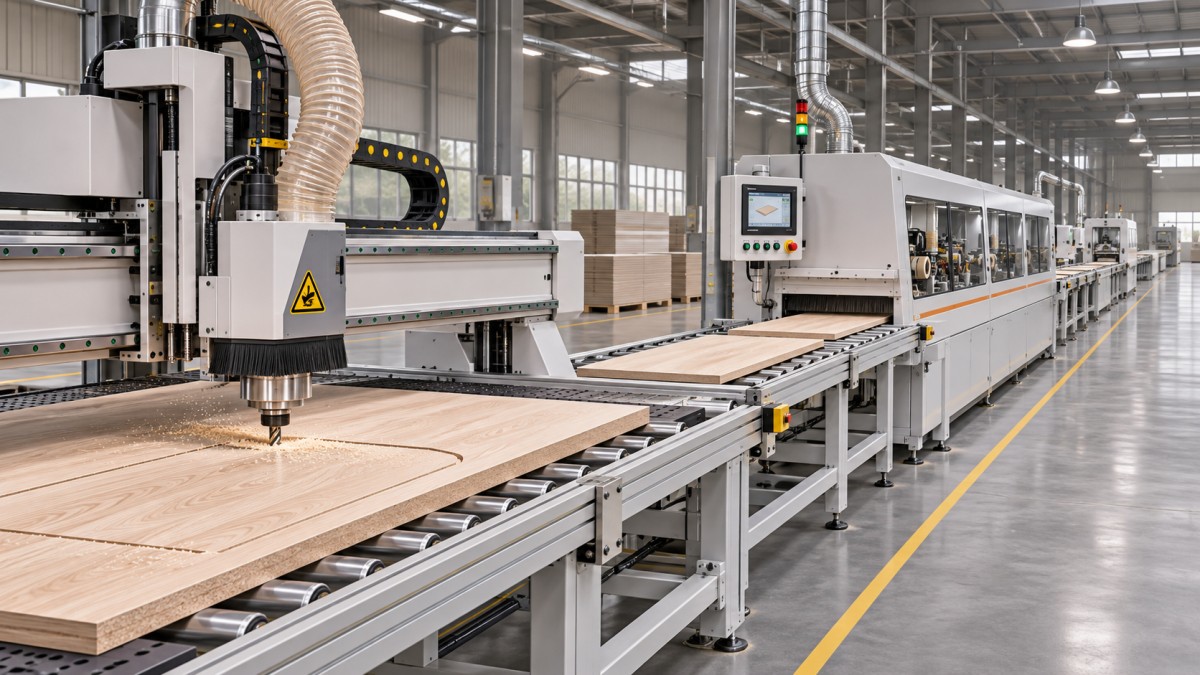
For many European furniture and wood products manufacturers, the opportunity lies in reducing delays between production steps, rather than simply buying the fastest machine.
Shorter product runs, expanding design options, and delivery commitments can make setup time, material handling, and production scheduling as consequential as cutting speed.
A plant producing standardized cabinets may benefit from automated loading and continuous flow, while a customized furniture producer may gain more from flexible programming.
Start by mapping orders from design approval to shipment. Record waiting time, rework, material movement, machine utilization, and the points where orders accumulate.
Then compare improvements against business priorities: capacity for additional orders, shorter lead times, more consistent quality, or reduced reliance on hard-to-fill roles.
For example, a fast CNC router adds limited value if panels wait for edging or operators spend hours correcting incomplete production files.
The best initial project often removes a constraint across the entire process, even when its equipment has a lower headline speed than competing alternatives.
How Are CNC Machines and Edge Banders Changing Production?
CNC routers, nesting machines, and drilling centers translate digital production instructions into repeatable operations, helping factories handle varied dimensions and machining patterns.
In panel furniture, nesting software can arrange parts on sheets, while automated labeling and unloading help connect each component to its order.
These capabilities can reduce manual layout and improve traceability, but results depend on accurate design data, suitable tooling, and disciplined maintenance.
Five-axis machines offer additional access to complex shapes and angled surfaces. Their higher cost is harder to justify for simple, repeatable panel work.
Automated edge banders can apply, trim, and finish edging consistently, reducing manual handling and supporting higher throughput when settings match the material mix.
PUR adhesives and other edge-banding methods have different requirements for application, cleaning, appearance, and moisture resistance. Selection should reflect the finished product’s specifications.
Well-applied edges can improve appearance and protect panel edges, but they do not guarantee waterproof furniture or eliminate all emissions from a product.
When evaluating equipment, request demonstrations using your own materials, panel sizes, edge types, and production files, including difficult jobs and frequent changeovers.
Why Does Software Integration Matter as Much as Equipment?
Connected production can link sales orders, design files, machine instructions, material inventory, and shop-floor progress, reducing repeated data entry and avoidable errors.
For customized orders, the benefit is especially clear: a validated design change can flow into cutting lists and machining instructions before production starts.
However, connectivity is not automatic. Different machines may use incompatible formats, and existing software may require interfaces, configuration, or substantial data cleanup.
Before purchasing, ask vendors to demonstrate the complete workflow from an actual order to finished components, including revisions, exceptions, and recovery from errors.
Clarify who owns production data, how it can be exported, which interfaces are included, and what support costs apply after installation.
Cybersecurity and backups also deserve budget. A connected factory depends on reliable access to production information as well as functioning mechanical equipment.
What Is Happening to the Woodworking Labor Market?
European manufacturers face different labor conditions by country and region, but many compete for technicians, machine operators, maintenance specialists, and experienced production planners.
Workforce availability can also vary sharply within one market: a factory near a technical training center may recruit differently from a remote plant.
Automation changes the composition of work. Some repetitive handling and manual adjustment may decline, while programming, troubleshooting, quality control, and maintenance become more important.
Traditional woodworking knowledge remains valuable because machine settings, material behavior, finishing quality, and product tolerances still require practical judgment and experience.
A skilled operator may spend less time moving panels and more time checking tool condition, interpreting alarms, verifying dimensions, and coordinating production priorities.
For management, the central question is whether employees can transition into these responsibilities quickly enough to support the investment and keep equipment productive.
Headcount savings should therefore be treated as a scenario, not an automatic outcome. A growing business may instead use available staff to increase output.
Which Skills and Training Investments Should Leaders Prioritize?
Begin with a skills assessment covering machine operation, digital production files, tooling, preventive maintenance, safety procedures, and the ability to diagnose common faults.
Compare those capabilities with the proposed workflow. Identify which tasks require advanced specialists and which can be learned through structured, supervised training.
Include operators and maintenance staff in equipment selection. Their knowledge of material variation, changeovers, and recurring failures can expose unrealistic assumptions early.
Vendor training should cover normal operation and practical exceptions: damaged labels, incorrect files, tool wear, machine alarms, and safe restart after interruptions.
Appoint internal champions and document procedures so knowledge does not remain with one employee or disappear when a supplier’s commissioning team leaves.
Build a training period into the investment case. Output may temporarily fall as staff learn new processes, even when the long-term business case is sound.
Partnerships with vocational schools, apprenticeships, and equipment suppliers can strengthen recruitment, although availability and funding depend on local programs and national conditions.
Retaining experienced workers matters too. Clear progression from operator to programmer, team leader, or maintenance specialist can make technology adoption more attractive.
How Should Manufacturers Calculate Automation ROI?
A credible return calculation starts with a baseline: current output, scrap, overtime, lead times, maintenance costs, and the labor hours required for each process.
Estimate benefits using the production mix the factory actually expects, including small batches, changeovers, material variation, downtime, and periods of lower demand.
Potential gains include additional saleable capacity, lower scrap, fewer quality claims, reduced overtime, and the ability to meet orders that currently exceed capacity.
Avoid counting the same benefit twice. For example, faster production only increases revenue when the company can sell and deliver the additional output.
Include the full investment: equipment, installation, extraction, utilities, software interfaces, tooling, training, floor modifications, maintenance, and any financing costs.
As an illustration, suppose a project costs €500,000 and produces €125,000 in annual net operating benefits after recurring expenses. Simple payback is four years.
That example excludes financing, taxes, depreciation, and changes in working capital. Use discounted cash flow when comparing projects with different lifespans or timing.
Test conservative, expected, and optimistic scenarios. A decision that works only at maximum machine utilization may be too exposed to demand or implementation delays.
Also identify operational benefits that matter but are difficult to price, such as reduced dependence on scarce skills or improved delivery reliability.
When Is a Fully Automated Line the Wrong Choice?
A highly integrated line can suit stable volumes and predictable product families, especially where handling between machines consumes significant time and floor space.
It may be less suitable when demand fluctuates, products change frequently, or the business cannot keep the line supplied with compatible orders.
Interdependence creates another risk: a failure at one stage can disrupt the entire flow unless buffers, maintenance plans, and recovery procedures are adequate.
For smaller manufacturers, a staged approach may offer more flexibility: connect design and CNC production first, then automate handling around proven bottlenecks.
Modular investments can also preserve options while the company validates order volumes, workforce readiness, and the quality of its production data.
Ask suppliers about spare parts, local service response, preventive maintenance, and upgrade paths. A favorable purchase price can lose value through prolonged downtime.
Request references from factories with similar materials and production volumes, and compare actual availability and support experiences rather than relying solely on specifications.
What European Market and Compliance Factors Affect the Decision?
Industrial woodworking in Europe operates across diverse markets, with different wage levels, energy costs, customer requirements, and access to technical talent.
Compare locations using total operating costs and service availability, not labor rates alone. Transport, energy exposure, and delivery expectations can change the calculation.
Manufacturers should assess applicable European Union and national requirements for machinery safety, dust extraction, worker exposure, and product emissions before finalizing specifications.
For example, wood dust controls affect extraction design, housekeeping, and operating procedures. Requirements depend on the material, process, jurisdiction, and applicable exposure limits.
Where buyers request certified wood or traceability, verify the relevant scheme and chain-of-custody requirements across procurement, production records, and sales documentation.
Environmental claims also need evidence. Lower scrap or improved material yield can support measurable progress, but automated production does not guarantee zero waste.
Energy consumption should be tested against realistic operating schedules, including extraction and standby loads, rather than judged only by a machine’s rated power.
How Can Leaders Turn These Trends Into an Investment Plan?
First, define the commercial objective: serve more customized orders, reduce lead times, improve quality, or expand capacity for a specific product family.
Second, measure the current process and choose one constraint with a clear owner, reliable baseline data, and a practical route to improvement.
Third, compare equipment and software options against representative jobs, workforce capabilities, service coverage, and total lifetime cost, including integration and training.
Finally, set milestones for commissioning, employee proficiency, quality, throughput, and financial performance. Review results after the factory reaches a stable operating rhythm.
The direction of travel is clear: competitive factories will combine flexible equipment with reliable data and people who know how to use both.
For European woodworking businesses, the strongest investment is the one that solves a verified production problem, fits demand, and gives employees a workable transition.
Related News
Get weekly intelligence in your inbox.
No noise. No sponsored content. Pure intelligence.
