
Choosing Packaging Printing Solutions for Different Materials and Print Runs
For a long, stable run of folding cartons, offset can deliver a strong balance of image quality and unit cost. For changing artwork or small batches, digital printing may reduce setup time and obsolete inventory. Corrugated packaging often points toward flexography, although the choice changes when the job requires high-quality graphics, frequent version changes, or printing before the board is formed.
Choosing among industrial printing solutions for packaging starts with the material and the jobs that must run on it. The most useful comparison then follows those jobs through prepress, printing, drying or curing, and converting. A press that performs well on one substrate or run length may create extra handling, waste, or bottlenecks elsewhere.
Start with the material and the finished pack
A substrate specification should describe more than its name. Surface finish, thickness, stiffness, absorbency, heat sensitivity, and dimensional stability all affect how a material feeds through a press and accepts ink. The finished structure matters too: a design that looks good on a flat sheet can crack at a crease, rub during distribution, or interfere with a glue joint.
These are starting points rather than interchangeable process recommendations. A supplier should identify the exact material grades and thickness range that the proposed press can handle, then demonstrate performance on the buyer’s own material where possible.
Carton board: look beyond the printed sheet
Offset is a strong candidate when folding cartons need detailed imagery, consistent brand colors, and repeat orders large enough to absorb plate and setup costs. Sheetfed production also gives converters a clear path to downstream coating, die-cutting, and folder-gluing, provided sheet dimensions and production rates match the rest of the line.
Digital becomes more attractive when a carton range has many versions, short campaigns, or uncertain demand. It can reduce the need to hold printed stock, but the printed surface must still withstand creasing, folding, scuffing, and any required coating. Check glue adhesion in the actual joint area; an acceptable flat-sheet proof does not establish that a finished carton will run reliably through a folder-gluer.
Corrugated: decide where the graphics are applied
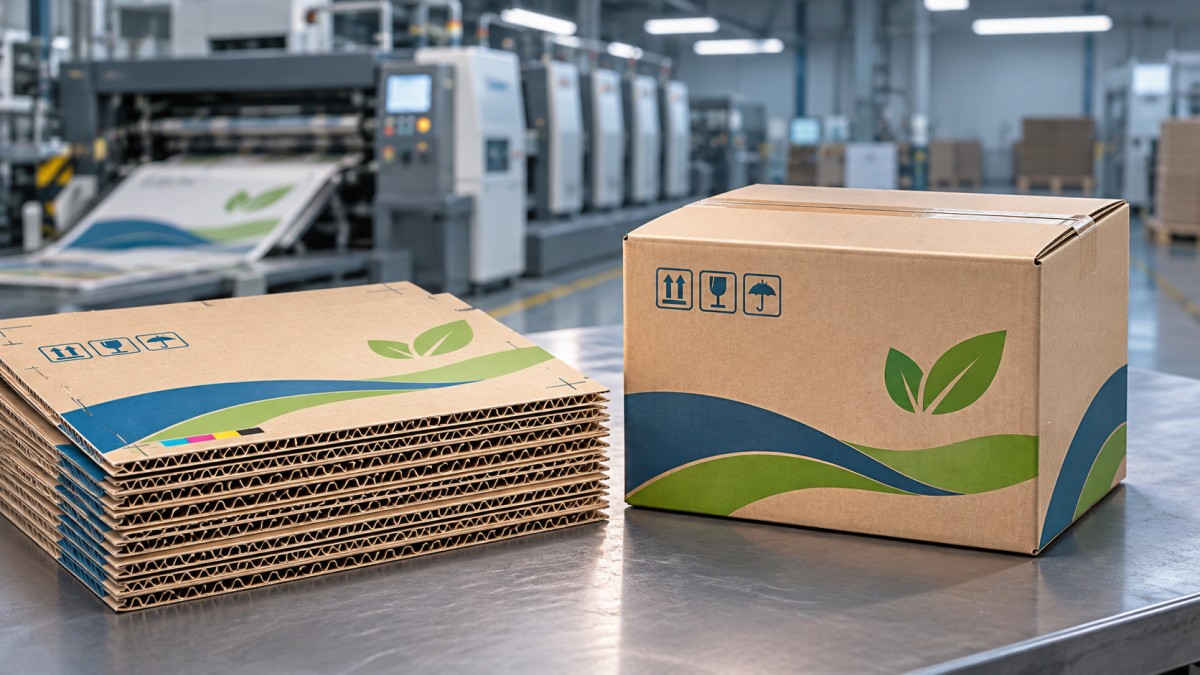
Direct printing on corrugated board avoids a separate printed liner for many shipping-box applications. Flexography can suit repeat work with relatively simple graphics, while digital can be useful for shorter batches, versioning, or jobs where plates and changeovers would consume a large share of the order value.
For demanding retail graphics, an offset-printed sheet can be laminated to corrugated board before converting. That route adds materials and processing steps, but may be justified by the required appearance. Compare the complete laminated structure with a directly printed alternative, including lead time, finishing capacity, and board performance.
On direct-print systems, assess how the equipment controls pressure across different flute profiles and board grades. Excessive pressure can damage the structure and reduce protective performance. Print quality should therefore be assessed alongside the strength requirements of the finished box.
Films and flexible materials: qualify the complete structure
For film, ink adhesion depends on the specific substrate, its surface condition, and the chosen ink system. A film that feeds successfully may still fail a downstream adhesion or lamination test. Tension control and drying or curing also matter because distortion or retained solvents can affect converting and finished-pack performance.
Flexography and gravure are candidates for repeat flexible-packaging production, while digital can be attractive for shorter jobs or frequent design changes. Compare them using the actual film, ink, adhesive, and laminate construction. Reverse-printed work, for example, places different demands on the print and adhesive interface than a surface-printed pack exposed to abrasion.
Calculate the crossover using real order patterns
Run length matters because conventional processes generally carry job-specific preparation costs, while digital processes can reduce some setup steps but may have a higher cost per printed unit. There is no useful universal crossover quantity: it depends on the artwork, material, number of colors, press configuration, consumables, and finishing route.
Build the comparison around the number of units in each individual order, rather than annual volume alone. A large annual requirement divided into many artwork versions can create repeated setup and changeover costs. Conversely, a modest product range with stable artwork and predictable repeat orders may justify conventional tooling.
For each representative job, calculate:
- Job preparation: artwork handling, proofing, plates or cylinders where required, and press setup.
- Production: substrate, ink or toner, coatings, labor, energy, and the time needed to produce acceptable output.
- Waste: setup sheets or web, defects during the run, and losses during downstream converting.
- Finishing: drying or curing, lamination, die-cutting, folding, gluing, and any additional handling.
- Inventory: storage, minimum order quantities, and the risk that printed material becomes obsolete after a design change.
Use these costs to compare the same finished quantity at several plausible order sizes. Include separate calculations for a repeat order and a new design: tooling may be reusable, but only if the artwork and condition of the tooling allow it. If a product range changes frequently, also estimate the cost of unused printed stock; a lower press cost per unit can be outweighed by cartons or film that never reach production.
Capacity calculations deserve the same care. Rated press speed is useful for understanding a machine’s capability, but scheduling depends on saleable output across the shift. Changeovers, color adjustment, cleaning, inspection, and downstream interruptions all reduce productive time. Ask suppliers to model throughput using the actual mix of job sizes and substrates, not a single uninterrupted run.
Set quality limits that match how the pack is used
A process comparison is meaningful only when each candidate is asked to meet the same acceptance criteria. Define which elements are critical: brand colors, fine text, barcodes, image detail, solid areas, or alignment between printed and cut features. Agree on how color and registration will be measured, where measurements will be taken, and what variation is acceptable across a run and between repeat orders.
Substrate variation can make identical color targets harder to achieve across a product family. A brown corrugated surface, coated carton board, and transparent film do not provide the same background for an ink. White ink, an opaque layer, or a different color strategy may be needed, with consequences for cost and production time.
Inspect the finished pack as well as the press sheet or web. Creasing can expose cracking, coatings can change appearance, and rubbing during packing or transport can damage a surface that initially looked acceptable. Barcodes should remain readable after the converting and handling conditions expected for the product.
For food, pharmaceutical, or other sensitive applications, define the intended use and destination markets before selecting inks and coatings. Suitability depends on the complete packaging structure, potential migration, manufacturing conditions, and applicable requirements. A supplier’s statement about an individual ink does not by itself establish that the finished package is suitable for the intended use.
Prove the route through converting before committing
The final choice should be tested as a production route, not just as a print sample. Give competing suppliers the same representative artwork, substrate, order quantities, and acceptance limits. Where practical, include a difficult job alongside a routine one: for example, a carton with fine text, a critical brand color, dense coverage, and a demanding glue pattern.
Carry the samples through the relevant finishing steps and record the results at each stage. A useful evaluation should answer four questions:
- Does the press produce acceptable color, registration, adhesion, and coverage on the specified material?
- Can the printed material be cut, creased, laminated, folded, or glued at the required quality without excessive rejects?
- Does the finished pack meet the functional requirements for its contents and distribution conditions?
- Can the proposed line deliver the required mix of orders within the available production window?
Also check interfaces that are easy to overlook: maximum and minimum sheet or web sizes, stack or reel handling, drying requirements before the next operation, and the way job data moves from prepress to production. An additional handling stage may be acceptable, but it should appear in the labor, space, lead-time, and waste assumptions.
If one process wins only under ideal utilization while another handles the expected order mix with fewer changeovers or less obsolete stock, the second may be the stronger investment. The decision is ready when the preferred route meets the finished-pack specification and its cost and capacity assumptions remain credible across the jobs it will actually receive.
Related News
Get weekly intelligence in your inbox.
No noise. No sponsored content. Pure intelligence.
