Choosing a CNC Furniture Production Supplier in the Middle East: What to Check
Choosing a CNC furniture production supplier Middle East buyers can rely on requires more than comparing machine prices or production capacity. Procurement teams must assess cutting accuracy, material compatibility, software integration, lead times, local technical support, and access to spare parts. For projects involving customized furniture, it is equally important to verify quality control processes and the supplier’s ability to scale production. This guide outlines the key checks to help you reduce procurement risk and select a partner suited to your operational needs.
Start by defining what you are actually buying
A supplier may offer finished furniture, cut-and-edged components, CNC machinery, or an integrated production line. These are different purchasing decisions. A furniture manufacturer should be assessed on its ability to deliver consistent parts and finished assemblies; an equipment supplier should also be judged on installation, software, operator training, and long-term service.
Write the scope before requesting quotations. Identify the products involved, expected order patterns, panel materials, finishes, hardware, and destination. For machinery, add available floor space, power supply, dust extraction, operator skills, and the production steps the equipment must connect. If the project includes design software or manufacturing execution software, specify whether licenses, interfaces, and implementation are part of the purchase.
This matters because a low quotation may simply exclude work that another supplier has included. Delivery to a port is not the same as delivery to a factory, and a cut panel is not necessarily a ready-to-assemble cabinet component.
Judge accuracy on a representative part, not a brochure
Published positioning accuracy can be useful when comparing CNC routers, but it does not describe the quality of a complete furniture part. Panel flatness, vacuum hold-down, tooling, programming, machine condition, and board variation all affect the result. A supplier should be able to explain how it controls these variables during normal production.
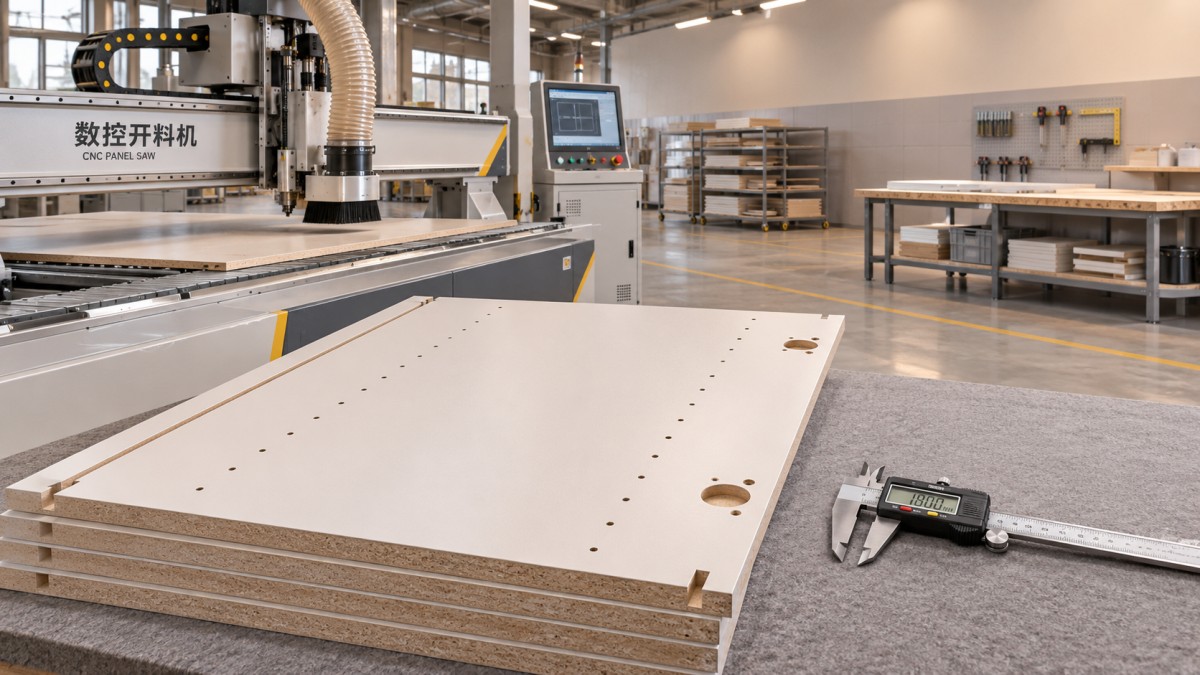
Ask for a trial using your material, thickness, and a drawing that reflects real work. A useful sample might include a cabinet side with shelf-pin holes, hinge boring, a groove, and an edge that will be visible after assembly. Measure critical features against an agreed drawing and tolerance; then assemble the part with the intended hardware. A panel can look clean and still create fitting problems when hole positions accumulate across a cabinet.
For an equipment purchase, agree in advance who supplies the material and tooling, what operating conditions apply, and how the results will be measured. Include repeated parts, not just one carefully prepared demonstration piece. Where possible, test a small or narrow component as well: holding it securely during nesting can be more demanding than cutting a full-size panel.
Do not assume that a five-axis machine is the best choice for every furniture factory. Conventional panel cabinets may be better served by a well-configured three-axis nesting router and suitable drilling or edge-banding equipment. Five-axis capability becomes more relevant when the work genuinely requires complex contours or machining at changing angles. The extra capability should justify its programming, tooling, and maintenance demands.
Follow the panel through cutting, edging, and assembly
A router rarely determines finished quality on its own. For melamine-faced particleboard, look for edge chipping, clean drilling, and consistent dimensions after cutting. MDF may be used for painted or routed profiles, where tool marks and surface preparation become more visible. Plywood and veneered panels introduce their own concerns, including face quality and grain direction.
Ask whether the supplier has processed the specific board construction and edge material you intend to use. “Works with wood panels” is too broad an answer. Confirm who approves the tooling and cutting strategy if a new material performs poorly.
Edge banding deserves the same scrutiny as cutting. Inspect the glue line, trimming, corner finish, and adhesion on production-representative samples. PUR adhesive may be appropriate where the application calls for its performance characteristics, but it also requires suitable handling and cleaning procedures. The adhesive, board, edge tape, and operating conditions must work together; no edge-banding process makes a panel waterproof or eliminates emissions by itself.
For kitchen, hospitality, or residential projects, agree on the finish standard and any moisture, emissions, or durability requirements with the customer. Request the relevant material documentation and test evidence where required, and verify which standards apply to the destination and intended use. Do not treat an equipment specification as proof of finished-product compliance.
Check the digital handover before paying for automation
Customized furniture is often won or lost between the drawing and the machine. A design change that requires someone to re-enter dimensions manually can introduce errors and slow down an otherwise fast router. Ask the supplier to demonstrate the complete path from an approved cabinet drawing to a nested cutting program, labels, drilling instructions, and assembly information.
Pay particular attention to how revisions are controlled. If a customer changes the width of a wardrobe after approval, who updates the files, and how does the workshop avoid cutting an obsolete version? For outsourced production, agree on file ownership, accepted formats, naming conventions, and the point at which a change becomes chargeable.
For a new production line, software compatibility should be demonstrated rather than assumed. Confirm whether a postprocessor is available for the actual controller, whether labels can be read at the next workstation, and whether existing design or ERP systems need an interface. Ask who will maintain that interface after an upgrade. An apparently inexpensive machine can become costly if every job requires manual programming or a separate software workaround.
PWFS follows both CNC woodworking equipment and the wider systems around flexible manufacturing. That perspective is useful here: the practical question is not whether a machine has a connectivity feature, but whether production information moves reliably between the people and equipment already involved.
Compare landed and operating costs, not just quotations
Build a comparison around the same scope and destination. Depending on the contract, the quoted price may omit freight, insurance, import charges, inland transport, unloading, installation, commissioning, or training. Confirm the named delivery point and the agreed Incoterms rule, including the edition used. The rule helps allocate delivery responsibilities, but the contract should also make payment, insurance, and risk allocation clear.
For machinery, include the costs of site preparation, electrical work, dust extraction, compressed air if needed, tooling, spare consumables, and software subscriptions. Ask how much operator and maintenance training is included, whether travel costs are covered, and what additional visits cost. For furniture components, compare material yield, edging, packing, rejected parts, and replacement freight—not only the price per panel.
Capacity claims also need context. A machine’s advertised cutting speed is not the same as completed cabinets per shift. Loading, unloading, labeling, tool changes, drilling, edge banding, and inspection all consume time. Ask suppliers to estimate output against your actual product mix and state their assumptions. If the edge bander or packing station cannot keep up, a faster router may simply create a larger queue.
For repeat orders, agree on how material price changes, exchange rates, design revisions, and minimum order quantities affect future pricing. The cheapest first batch is not necessarily the cheapest supply arrangement once custom setup and reorders are included.
Verify support where the equipment will operate
The Middle East is not a single service market. A supplier with a regional office may still depend on a technician flying in from another country. Ask who provides support at the installation site, which language the operators can use, and whether the supplier can show a realistic escalation path from remote diagnosis to an on-site visit.
Check spare-parts arrangements by part, not by promise. Critical items may include spindle components, drives, sensors, vacuum-system parts, and controller hardware, depending on the machine. Request a recommended initial stock list, prices, lead times, warranty conditions, and the location from which each item would ship. Confirm whether common tooling and consumables can be sourced locally or must come from the original supplier.
The site survey should cover the actual electrical supply, available space, floor conditions, ventilation, extraction, and environmental limits specified by the manufacturer. Dust and heat can affect equipment operation, but the appropriate controls depend on the machine and facility. Agree who is responsible for checking site readiness before the installation team arrives.
Put acceptance and delivery terms into the contract
A demonstration is most valuable when its results become part of a clear acceptance process. For equipment, define the sample parts, materials, tolerances, software functions, safety checks, and documentation required at factory and site acceptance. State what happens if a test fails, who pays for repeat testing, and when the supplier must correct the problem. Do not rely solely on a calendar date to establish that a line is ready for handover.
For finished furniture or components, specify inspection criteria, approved samples, packaging, labeling, delivery sequence, and the procedure for handling damaged or nonconforming items. A project delivered in phases also needs a rule for matching replacement parts to the correct drawing revision and finish.
Before selecting a supplier, compare the trial result, complete commercial scope, and support plan side by side. If an offer remains materially cheaper, ask what has been left out or what assumption is different. The most useful next step is often a short technical review with production and maintenance colleagues before the purchase order is issued—not another round of negotiation on the headline price.
Related News
Get weekly intelligence in your inbox.
No noise. No sponsored content. Pure intelligence.