
Choosing a Laser Edge Banding Supplier: Trials, Acceptance Tests, and Support
A showroom panel can have an almost invisible joint while production parts still develop open edges, surface damage, or inconsistent adhesion. Differences in board quality, edge-band formulation, storage conditions, and feed speed can turn an attractive demonstration into expensive rework. Choose a laser edge banding technology supplier only after it demonstrates repeatable results on your materials and accepts measurable performance obligations in the purchase contract.
The decision should rest on three linked checks: representative material trials, factory and site acceptance tests, and support commitments that match your production schedule. Compare purchase prices only after defining these requirements; otherwise, a lower quotation may simply exclude the equipment, testing, or service needed to achieve usable output.
Establish exactly what the supplier is providing
“Laser edge banding” should describe an actual laser-based activation process, not serve as a general label for every near-seamless edge. Hot-air and other activation systems can produce similar visual effects, but their material compatibility, utilities, maintenance, and process controls differ. Ask the supplier to identify the activation source and compatible edge-band constructions in writing.
In a laser system, energy activates a functional layer on suitable edging before pressure bonds it to the panel. Performance depends on matching that layer to the equipment and operating conditions. A visually tight joint does not by itself prove bond strength, moisture resistance, or suitability for a particular furniture application.
Clarify the commercial boundary as well. A complete edge bander, a retrofit activation unit, and a material-and-process package involve different responsibilities. For a retrofit, identify who guarantees integration with the existing controls, pressure section, extraction, guarding, and finishing units. Require one named party to coordinate faults spanning those interfaces.
- Included equipment: activation source, cooling, extraction requirements, tooling, software, and any conventional adhesive backup.
- Material scope: approved edging constructions, thicknesses, colors, panel types, and dimensional limits.
- Site obligations: electrical supply, compressed air, environmental conditions, layout, and installation work.
- Commercial exclusions: freight, commissioning travel, training, software access, and acceptance-test consumables.
Build the trial around difficult production parts
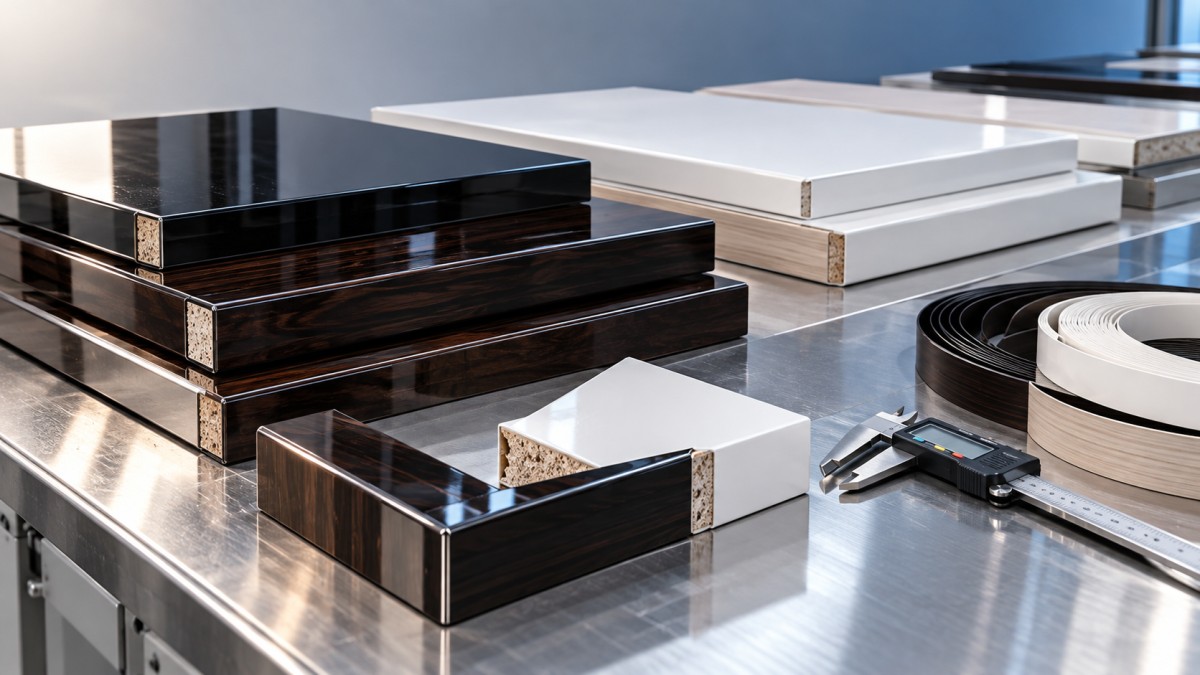
Send the same documented sample set to every shortlisted supplier. Include routine work and the combinations most likely to expose weaknesses: high-gloss or dark surfaces that reveal finishing marks, thin edging, thicker panels, short parts, and board grades with variable edge quality. Keep the selection within the capability you actually intend to purchase.
Record board grade, thickness, surface finish, edge preparation, edging specification, and material lot. Agree on conditioning and storage before testing. Uncontrolled material history makes it difficult to separate equipment limitations from moisture, contamination, or damaged stock.
Ask for trials using production-representative feed speeds and normal operator adjustments. Demonstrating each material separately at its ideal setting is useful for establishing feasibility, but it does not establish mixed-batch productivity. Include transitions between contrasting materials, an interruption and restart, and repeated samples after the equipment has been operating continuously.
Retain labeled samples and request the associated recipes, speed settings, adjustment records, and rejection reasons. An edited demonstration video is not a substitute for traceable trial evidence. Where attendance is impractical, agree on continuous recording of critical runs and have samples returned for independent inspection.
Separate appearance from adhesion
Inspect joint visibility under agreed lighting and viewing conditions, including corners and the start and end of each edge. Check for gaps, whitening, discoloration, blistering, trim marks, and damage to decorative surfaces. Use approved reference samples or an agreed defect catalogue so “acceptable appearance” does not depend on whoever happens to inspect the panel.
Evaluate adhesion separately through an agreed destructive method. Define specimen preparation, conditioning, test direction, equipment, and how results will be recorded. Record both the measured result and the failure mode: separation at the functional layer, failure within the edging, or damage within the board provide different diagnostic information. Substrate failure alone does not establish adequate bond performance.
For furniture exposed to humidity, cleaning, or heat, select conditioning tests that reflect its intended use. Specify exposure and recovery conditions before comparing results. Do not interpret an attractive seam as evidence of waterproof construction or reduced emissions; those claims require separate evidence relevant to the finished product.
Turn successful trials into a factory acceptance protocol
The factory acceptance test, or FAT, should verify the contracted machine configuration before shipment. Attach the protocol to the purchase agreement rather than negotiating it after the machine is built. Each requirement needs a test method, sampling plan, pass condition, and agreed consequence of failure.
There is no universal acceptance threshold suitable for every panel and application. Set values from product requirements, credible trial results, and the supplier’s confirmed operating envelope. The table below defines what to specify, not numerical limits to copy.
Measure accepted output over elapsed production time, not feed speed alone. A high conveyor setting has limited purchasing value if operators must slow down for difficult colors, reject startup parts, or repeatedly stop for adjustments. Define whether normal changeovers and minor stops fall within the measured period.
Record every deviation, including temporary workarounds. State whether a failed test requires adjustment and full repetition, repetition of affected portions, or another agreed remedy. Trial materials, travel, and retesting costs should have a named payer.
Use site acceptance to verify the installed process
Factory approval should authorize shipment, not automatically establish final acceptance. Transport, installation, local utilities, extraction, and upstream panel preparation can change performance. The site acceptance test, or SAT, should confirm that the installed system reproduces the agreed results under your documented operating conditions.
Before commissioning, have the supplier verify site readiness against its written requirements. During SAT, use production materials and the intended staffing arrangement. Include interaction with conveyors or return systems where these form part of the purchased scope, because handling restrictions can limit output even when the edge bander performs correctly.
Separate machine defects from site deficiencies using recorded evidence, not assumptions. Poor compressed-air quality or unstable power may require site correction; a supplied cooling system that cannot support contracted operation may require supplier action. Agree in advance how disputed causes will be investigated and how acceptance timing is affected.
For the laser equipment, require qualified verification of the installed enclosure, interlocks, emergency functions, extraction arrangements, and applicable safety documentation. Operators should not bypass protective systems to maintain throughput. Maintenance access and service procedures need their own controls, since servicing can present hazards absent during normal enclosed operation.
Compare cost per accepted part, not the machine quotation
Request cost inputs on a common production basis: the same material mix, shift pattern, utilization assumptions, and accepted output. Report both cost per accepted linear meter and, where useful, cost per finished part. Short components and frequent changes can make a theoretical linear-meter comparison misleading.
Include equipment, installation, financing, site preparation, energy, compatible edging, tooling, routine maintenance, labor, scrap, and expected service expenditure. Record measured consumption during representative runs where possible; distinguish measured values from estimates. Model ramp-up separately from steady production rather than assuming full utilization from commissioning.
Material flexibility deserves particular attention. Ask whether alternative edging sources are technically supported, what qualification they require, and whether warranty conditions restrict their use. A machine with a competitive purchase price may expose the plant to higher inventory requirements or supply interruptions if only a narrow material range is supported.
Where PUR or another existing process already meets product requirements, compare the incremental value of laser processing against its additional investment and operating constraints. Better appearance may justify a premium for some products without making laser activation the lowest-cost choice for every order. If backup adhesive processing is offered, verify its changeover, cleaning, and material requirements rather than treating it as a cost-free fallback.
Make support commitments specific enough to use
A promise of “fast service” leaves too much unresolved when production stops. Ask who answers the call, which hours are covered, what language support is available, and who can authorize escalation. Distinguish acknowledgment time, remote diagnostic availability, technician dispatch, and expected parts shipment; none is equivalent to guaranteed restoration.
Obtain a recommended spare-parts list with prices, normal lead times, stocking locations, and storage requirements. Separate routine wear items from critical components whose failure stops production. For the laser source, cooling equipment, control hardware, and specialized optics, establish whether repairs are local, exchange-based, or dependent on return to another facility.
- Training: cover recipe selection, material checks, defect diagnosis, safe cleaning, planned maintenance, and escalation boundaries.
- Remote access: define authorization, cybersecurity approval, access logging, and operation when the connection is unavailable.
- Documentation: require electrical drawings, maintenance schedules, backups, recovery instructions, and an agreed document language.
- Warranty: clarify coverage start, exclusions, travel costs, labor, consumables, and responsibility for third-party components.
Operator handover should include practical demonstration, not attendance alone. Have designated staff show that they can load an approved recipe, recognize a defective edge, perform permitted maintenance, and recover from routine interruptions without bypassing safeguards.
Resolve remaining risks before authorizing payment
Use technical acceptance as a gate before commercial scoring. A supplier that cannot demonstrate required adhesion, safe operation, or the agreed material range should not compensate for that gap through a lower price. Among technically acceptable offers, compare lifecycle cost, material flexibility, commissioning scope, and support evidence.
Tie payment milestones to documented deliverables, with any retained balance and release conditions negotiated explicitly. Maintain an open-item register identifying the owner, deadline, retest requirement, and whether each issue prevents shipment or final acceptance. Minor documentation corrections and unresolved bond failures should not receive the same treatment.
Before signing, ask for one consolidated schedule linking the quoted configuration, approved materials, FAT and SAT protocols, training, spare parts, and service terms. Conflicts between a sales proposal and a technical appendix should be resolved in the contract. The purchasing decision is ready when required performance is demonstrated, remaining risks have named owners, and the cost of keeping production running is visible.
Related News
Get weekly intelligence in your inbox.
No noise. No sponsored content. Pure intelligence.
