
Preventing Weak Laser Edge Bonds Through Functional-Layer Verification
A laser edge can look acceptable when it leaves the machine and still fail later during handling, trimming, assembly, or temperature changes. Operators often respond by increasing laser power, slowing feed speed, or raising pressure. Those adjustments can help when the process window is slightly off, but they cannot create a durable bond if the edgeband itself lacks the correct functional layer, has been loaded in the wrong orientation, or has been contaminated before processing.
For laser edge banding, the functional layer is not a minor detail hidden on the back of the tape. It is the bonding medium. The laser must activate that layer sufficiently for it to fuse with the prepared panel edge under controlled pressure. Before changing machine settings, the most productive question is usually simpler: Is this edgeband actually designed, oriented, and conditioned for laser activation?
Why weak laser bonds are often misdiagnosed
Conventional edgebanding relies on a separate adhesive system. Laser edgebanding replaces the glue line with a co-extruded or applied functional layer that becomes bondable when exposed to the machine’s energy source. This changes the troubleshooting sequence. With a hot-melt process, an operator may inspect glue temperature, glue quantity, open time, and roller pressure. With a laser process, the functional layer must be treated as a controlled production material rather than a passive backing.
A weak edge bond may appear as lifting at the leading or trailing corner, a line that opens after routing, poor adhesion around radii, or localized separation after the panel has cooled. These symptoms can be caused by machine conditions, but they can also indicate that the laser is interacting with the wrong material surface or with a layer that cannot absorb and transfer energy as expected.
Changing settings before confirming tape construction can make the diagnosis harder. Excess energy may discolor a sensitive decorative surface, distort the edge, or create a misleading bond that fails later. Excess pressure may conceal an inadequate melt during the immediate inspection while damaging the edge geometry. A repeatable process starts with material verification, then moves to machine adjustment.
What the functional layer does during laser edging
Laser-compatible edgeband is generally built from at least two material zones: the visible decorative body and the functional layer facing the board edge. The functional layer is formulated to absorb or respond to the energy delivered by the laser system, soften or melt within the available processing time, and join to the panel edge under pressure. Its behavior depends on the edgeband construction, the machine’s heating method, panel material, feed rate, and the condition of the machined edge.
That layer is not interchangeable with an ordinary backing intended for EVA or PUR hot-melt adhesive. A tape may have a surface that looks dark, textured, or similar to a laser-ready tape while still being unsuitable for direct laser activation. Likewise, some edgebands have special backing layers intended for a specific laser, hot-air, plasma, or near-infrared process. Operators should not assume that compatibility with one zero-joint method guarantees compatibility with another.
The practical implication is clear: the tape specification must identify the intended bonding technology. The production order should also identify the exact tape code, thickness, color, reel width, and orientation. Similar-looking rolls are a common source of avoidable setup errors, especially where laser-capable and glue-based edging are both used in the same facility.
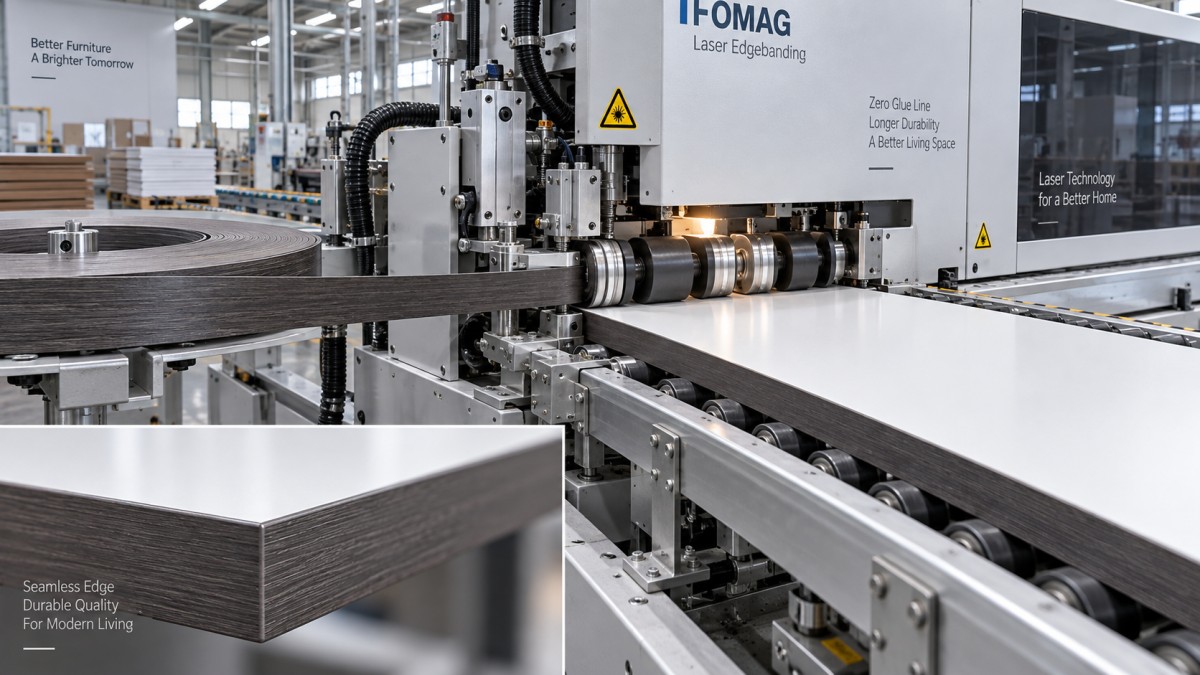
Verify the tape before touching power or feed settings
A functional-layer check does not need to be complicated, but it does need to be documented. The goal is to confirm that the reel on the machine matches the material approved for the job and that its bonding side faces the panel edge.
Check the supplier documentation and reel identification
Start with the reel label, packing record, and the edgeband supplier’s technical data sheet. The documentation should identify the material family and state whether the product is intended for laser edging or another bonding method. If the information only describes color, thickness, finish, and width, it may not be sufficient for process approval.
For controlled production, purchasing and stores personnel should avoid grouping all “laser tape” together. Separate material records are useful when tapes differ in functional-layer formulation, recommended processing direction, storage requirements, or compatibility with different board substrates. An operator cannot compensate for an unverified material substitution through machine settings alone.
Confirm orientation on the reel and through the feed path
Some materials are clearly marked, while others require visual or tactile identification of the functional side. The correct side must face the panel edge at the pressure zone. A reel loaded inside out can produce an edge that is superficially pressed into place but has little or no functional bond.
Before a production run, operators can cut a short sample from the reel and compare both faces under consistent lighting. The approved sample should be retained with the setup documentation when material orientation is not obvious. This is particularly useful after roll changes, maintenance work, or when operators work across shifts.
Inspect the functional surface for damage or contamination
Dust, release residues, oil from handling, damaged reel edges, and abrasive contact with guides can interfere with energy transfer or bonding. The inspection should include the first meters of the roll, not only the exposed edge at the machine entrance. If a reel has been dropped, stored under poor conditions, or rewound incorrectly, the functional layer may be scratched or contaminated even when the decorative face appears undamaged.
Storage practices matter because tape reels can pick up dust or deform when stacked badly. The appropriate storage conditions should follow the edgeband supplier’s handling instructions. Where no written conditions are available, the material should be kept clean, dry, protected from direct heat, and allowed to equilibrate to the production area before use.
Match the panel edge to the activated layer
A verified tape cannot overcome a poorly prepared board edge. Laser edging depends on close contact between the activated functional layer and the panel substrate. Chips, torn fibers, coarse saw marks, loose particles, and uneven milling create gaps that pressure rollers may not fully close.
The final milling cut should leave a straight, stable edge with minimal loose material. Operators should inspect the edge after pre-milling rather than relying only on the condition of panels arriving from the saw. Differences in board density, surface coatings, moisture condition, recycled-content composition, and core structure can alter how the edge behaves under heat and pressure. A setting that works on one melamine-faced particleboard may need review when switching to MDF, plywood, compact laminate, or another substrate.
Dust extraction is part of bond preparation, not just housekeeping. Fine dust left on the edge can form a physical barrier between the functional layer and the board. Inconsistent extraction can also create a confusing pattern: one panel passes, another fails, and the issue seems related to laser settings even though the real variable is edge cleanliness.
Use a disciplined process check after functional-layer approval
Once tape type, orientation, and surface condition are confirmed, machine settings can be evaluated in a logical order. The purpose is not to chase a single “perfect” power value. The process must supply adequate activation while preserving the edgeband surface and maintaining stable pressure at the selected feed speed.
When reviewing a new tape or panel combination, operators should record:
- the edgeband code, reel batch where available, thickness, and functional-layer orientation;
- panel type, thickness, surface finish, and edge-preparation condition;
- feed speed and the relevant heating or laser program selected for the job;
- pressure-unit condition, roller cleanliness, and contact alignment;
- room and material conditions if the supplier identifies them as relevant;
- the result of immediate and cooled bond checks.
The operating information required by a machine should be reviewed together with the tape supplier’s processing guidance. For example, when comparing machine capability, setup workflow, and material compatibility, the published ZD450F laser edge banding requirements can be used as a reference point for checking whether the selected production method and edgeband specification are being evaluated on the same basis.
Machine settings should be changed one controlled variable at a time. If feed speed, laser output, pressure, and trimming conditions are all changed together, it becomes difficult to identify what corrected the bond or what introduced a new defect. A short trial sequence with retained samples is more useful than a long run that produces panels with uncertain durability.
Inspect the bond after cooling, not only at the machine exit
A freshly edged panel is not the final proof of bond quality. The functional layer may still be warm and temporarily compliant. The most informative inspection occurs after the part has cooled and undergone normal handling.
Visual checks should look for edge opening, uneven contact, gloss changes, scorching, visible joint lines, and distortion at corners or radii. A careful manual check can reveal whether the edge begins to lift at the ends, where process instability often becomes visible first. Any destructive or semi-destructive bond evaluation should follow the manufacturer’s approved internal quality method and should be applied consistently across shifts.
Operators should also inspect trimmed and profiled parts. A bond that appears continuous before finishing may open when cutters remove a small amount of material or when the panel is subjected to edge stress during machining. If separation occurs only after trimming, the cause may involve insufficient activation, weak pressure contact, damaged tape, excessive cutter load, or a mismatch between tape construction and the finishing sequence.
Symptoms that point back to the functional layer
Build verification into roll changes and shift handovers
Many bonding problems begin after a routine changeover rather than during a new-machine installation. A simple roll-change checklist can prevent the most common errors: verify the reel label, inspect the functional side, confirm the correct path through guides, remove damaged leading material, clean contact surfaces, and produce a documented first-off panel.
Shift handovers should state more than the current machine program. The next operator needs to know which tape was installed, whether a reel was changed during the run, what panel material is being processed, and whether any adjustment was made after quality checks. This prevents a temporary correction from becoming an unexplained permanent setting.
When a weak bond occurs, isolate the affected production range rather than assuming all prior or later panels are identical. Traceability by reel, panel batch, machine program, and time of production makes it easier to decide whether the issue is material-specific, setup-related, or connected to panel preparation.
Keep the troubleshooting order simple
Weak laser edge bonds should not automatically be treated as a laser-power problem. The safest troubleshooting order is to verify the functional layer, confirm tape orientation and condition, inspect the prepared board edge, check pressure contact and cleanliness, and only then refine the machine program. This sequence protects operators from wasting time on settings that cannot correct an incompatible or compromised edgeband.
Laser edging can produce a clean joint only when material, panel preparation, energy input, and pressure act as one process. The functional layer is where that process begins, so it should be the first item verified whenever bond strength becomes uncertain.
Related News
Get weekly intelligence in your inbox.
No noise. No sponsored content. Pure intelligence.
