
CE Marking for Edge Banding Machines: What Documents Should Buyers Check?
For an edge banding machine destined for the EU, the CE mark on the nameplate is only the starting point. Before committing to a purchase, buyers should obtain the EU Declaration of Conformity, check the machine’s identification details, and review the operating instructions for the exact equipment and configuration being supplied.
The documents should tell a consistent story: who takes responsibility for the machine, which legal requirements were applied, and how the machine can be installed and operated safely. Gaps do not automatically prove that the equipment is non-compliant, but they are a reason to pause acceptance until the supplier provides a satisfactory explanation.
Start with the EU Declaration of Conformity
The declaration is the manufacturer’s formal statement that the machine complies with the applicable EU requirements. Ask for a copy during technical evaluation, then obtain the final signed version for the machine delivered. A declaration for a similar model can help with an early review, but it cannot settle whether the supplied machine is covered.
Check the declaration against the quotation, order and machine nameplate:
- Manufacturer identity: The legal name and address should identify the party responsible for the finished machine. A trading company’s logo alone does not establish that responsibility.
- Machine identification: The description, model and, where used, serial number should allow the declaration to be linked to the equipment supplied. Resolve any differences in model suffixes or configuration descriptions.
- Applicable legislation: The declaration should identify the relevant EU legislation. Depending on the machine and its equipment, this can include machinery and electromagnetic compatibility requirements.
- Standards: Where harmonised standards are listed, check their designations and editions. Their relevance depends on whether they cover the machine and the hazards concerned.
- Signature and date: Check that the declaration identifies the person signing for the manufacturer and includes the required signature and date information.
For machinery placed on the EU market or put into service before 20 January 2027, the Machinery Directive 2006/42/EC is generally the relevant machinery legislation. Regulation (EU) 2023/1230 applies from 20 January 2027 and replaces that directive. The applicable framework depends on the machine’s circumstances and the relevant date, so a purchase spanning the transition needs particular attention.
Do not judge the declaration by the number of directives or standards it lists. A long list can contain outdated or irrelevant references. For example, electrical safety objectives for machinery covered by the Machinery Directive are addressed through that directive; a separate reference to the Low Voltage Directive is not automatically required for the machinery itself. Ask the supplier to explain any entry that appears inconsistent with the machine or its intended market.
When standards are cited, their presence on a declaration is useful evidence of the approach taken, not proof that every requirement has been met. A harmonised standard can support a presumption of conformity only for the requirements it covers and subject to the conditions of its citation in the Official Journal of the European Union.
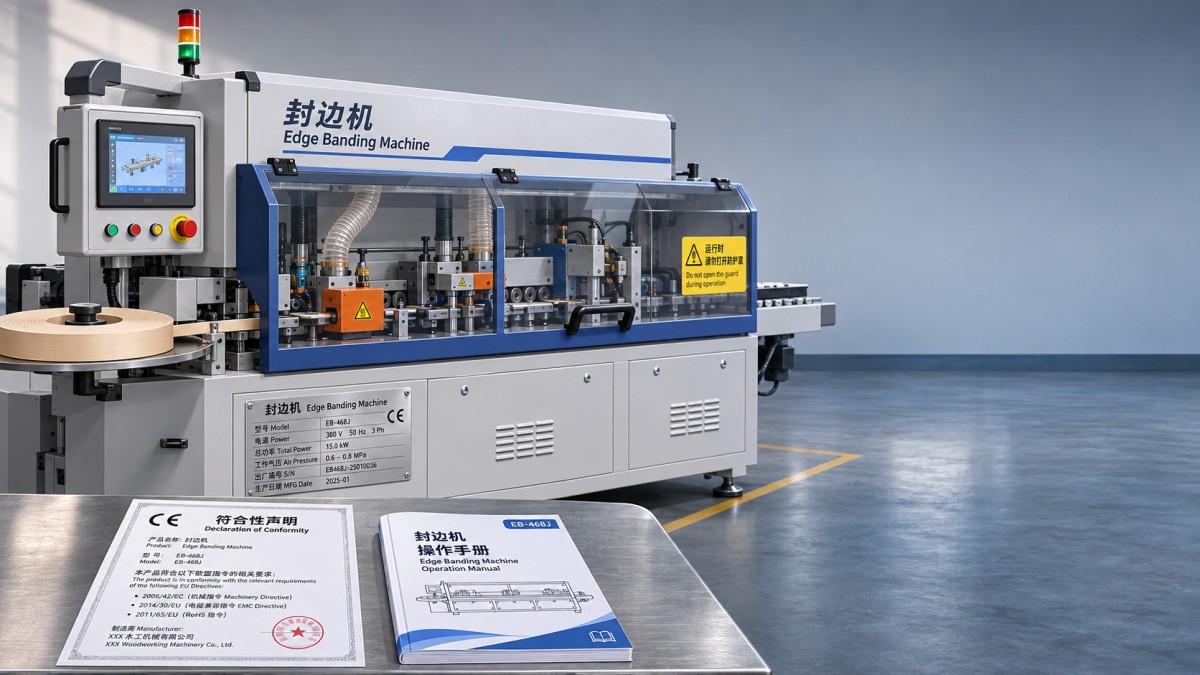
Match the paperwork to the machine being purchased
An edge bander is often ordered with a particular combination of feed system, pre-milling, glue application, end trimming, scraping and buffing units. It may also include return conveyors, loading equipment or a connection to a larger production line. A declaration for a basic machine does not necessarily answer whether the finished order, with its added equipment, has been assessed as supplied.
Ask the supplier for a configuration list that can be compared with the order and the declaration. Pay attention to options that alter access to moving parts, change operating modes or affect how material travels through the machine. If another company adds a return system or modifies guarding after delivery, establish who is responsible for assessing the resulting arrangement.
Several CE-marked machines connected together do not automatically constitute a compliant production line. Depending on how they are combined and controlled, the complete arrangement may need to be assessed as an assembly of machinery, including the interfaces between units. The purchase agreement should identify the party responsible for that assessment, any necessary protective measures and the documentation for the completed assembly.
Conversely, a supplier may deliver an item as partly completed machinery, intended to be incorporated into other machinery. In that case, the documentation and incorporation process differ from those for a complete machine. Ask whether a Declaration of Incorporation and assembly instructions apply, who will complete the machinery, and who will issue the final declaration before the completed machine is put into service. A buyer expecting a ready-to-use edge bander should resolve that distinction before ordering.
Read the instructions as an installation and safety document
The operating manual is more than a training aid. It should give the user the information needed to transport, install, operate, adjust and maintain the machine safely, including the residual risks that remain after protective measures have been applied.
Request the manual for the supplied model and its options. Check that it is available in the language or languages required by the destination EU Member State. A generic brochure, a short control-panel guide or instructions for a different configuration will leave practical questions unanswered.
For an edge bander, the most useful sections to review before purchase include:
- Installation: Electrical and pneumatic connections, space for safe access, machine stability, and any requirements for extraction and environmental conditions.
- Intended use: Permitted materials, workpiece dimensions, operating limits and foreseeable misuse. These should fit the panels and production methods specified in the order.
- Guarding and controls: Safe access to feed and machining areas, interlocks, emergency stops, operating modes and any restrictions on running with guards open.
- Adjustment and maintenance: Isolation of energy sources, safe tool changes, cleaning, jam removal and procedures for work inside guarded areas.
- Process hazards: Controls and precautions relevant to hot glue systems, heated parts, dust, noise and moving workpieces, where applicable.
Look for information specific enough to support site preparation. For example, an instruction to connect dust extraction is less useful than a clear specification of the connection points and required operating conditions. If the buyer must provide extraction, guarding at an interface or another protective measure, that obligation should be visible before the installation budget is fixed.
Also compare the manual with the machine’s stated operating modes. If the order includes automatic return handling but the instructions only describe manual unloading, ask for the missing information and a clear allocation of responsibility for the interface.
Check the nameplate and physical safety features
At delivery, inspect the machine identification and markings alongside the final declaration. The CE marking should be visible on the machine, and the manufacturer’s identification and other required information should be legible. The model and identifying details must allow the equipment to be connected to its documentation.
Then walk around the machine with the manual and configuration list. Check that guards, access doors, interlocks, emergency stop devices and warning labels described in the documentation are present. Confirm that the delivered options match the order and that access for cleaning or tool changes has not been obstructed by installation choices.
This inspection is a document-to-machine consistency check; it does not replace a technical assessment of safety functions. If a guard appears to be missing, an interlock can be bypassed easily, or the supplied equipment differs materially from the drawings, record the issue and require resolution before acceptance and use.
What supporting evidence should a buyer request?
The manufacturer must carry out the applicable conformity assessment and assemble technical documentation. Buyers can ask for information that helps them evaluate the machine, but the full technical file is not normally a document that must automatically be handed over to every customer. It must be available to the relevant authorities under the applicable rules.
A practical request is for a summary of the conformity assessment and the safety measures relevant to the ordered configuration. Depending on the equipment and the purchase terms, useful supporting material may include:
- A description of the machine’s intended use and principal safety functions.
- A summary of significant hazards and the protective measures provided.
- Information on safety-related control functions and their verification.
- Electrical and pneumatic drawings needed for installation, fault finding and maintenance.
- Noise emission information and extraction requirements in the instructions.
- Documentation for interfaces with conveyors, return systems or other equipment.
The depth of evidence needed depends on the purchase. A standalone machine with a documented standard configuration may call for fewer interface discussions than a custom cell assembled by multiple suppliers. If the machine is being modified or integrated on site, agree early on which party will provide the information needed for the combined risk assessment.
A supplier may also offer a third-party certificate or test report. Check what it actually covers: the product identity, configuration, assessment scope and legal framework. Third-party involvement is required only for certain conformity assessment routes; a certificate is not a universal substitute for the manufacturer’s declaration, instructions or responsibility. Likewise, a report for an electrical component does not establish conformity of the complete edge bander.
Resolve responsibility before the order becomes final
Buyers sourcing from outside the EU should identify the manufacturer and the EU importer, rather than assuming that the seller performing the transaction fulfils both roles. Importers have their own obligations concerning checks and identification. If an EU company places machinery on the market under its own name or trademark, or modifies it in a way that affects conformity, additional manufacturer responsibilities may arise.
Put the document requirements into the purchase specification. Require the final declaration and instructions for the delivered configuration, specify the destination country and language needs, and identify who will assess any connected equipment. For a custom machine, make receipt and review of the documents a milestone before shipment or final acceptance.
Used equipment deserves a separate question: has this particular machine already been lawfully placed on the EU market, or is it being imported into the EU from a non-EU country? The answer can change the obligations attached to its supply. Modifications can also affect the assessment, so obtain the machine’s identity, available history and details of alterations before relying on older paperwork.
The most useful final check is a simple comparison across the order, declaration, manual and delivered machine. If they identify different configurations, leave a safety interface undefined or name no clear party responsible for the finished equipment, resolve the discrepancy while the supplier and integrator can still correct it.
Related News
Get weekly intelligence in your inbox.
No noise. No sponsored content. Pure intelligence.
