
How to Compare Product Specification Sheets Across Suppliers
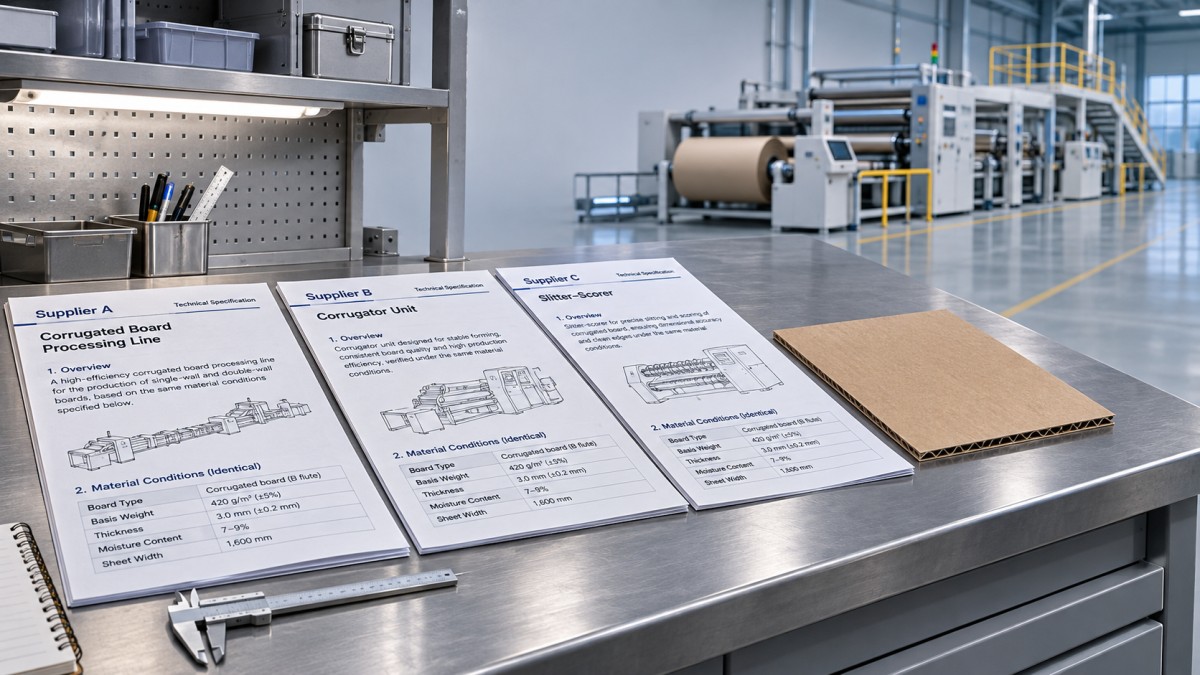
Compare supplier specification sheets by putting every claim against the same operating conditions, configuration, unit, and evidence standard. A higher headline speed or tighter accuracy figure is not necessarily better if one supplier measured it with lighter material, optional equipment, or a different test method. Separate confirmed performance from estimates and missing information before using the figures to rank machines.
This distinction matters when a corrugated board line, offset press, or CNC router must handle a defined production mix. An apparently faster machine may be rated only for its easiest job, while a lower headline figure may describe a complete line under sustained operation. The practical task is to turn unlike brochures into a comparable technical record, then ask suppliers to substantiate the differences that affect the decision.
Start with the job, not the brochure
Write a common application brief before extracting specifications. State the materials and their ranges, finished-product dimensions, required quality, expected job mix, available floor space, utilities, and interfaces to upstream and downstream equipment. Distinguish non-negotiable limits from targets: a machine that cannot accept the largest required sheet or panel should not advance simply because it scores well on speed.
Describe the production case in enough detail for all suppliers to quote against it. For a folder-gluer, that may include blank dimensions, board type, carton style, glue pattern, and delivery arrangement. For a CNC router, it may include panel material and thickness, nesting layout, tool changes, drilling operations, and edge-quality requirements. Ask each supplier to identify assumptions rather than silently selecting its most favorable operating point.
Use the same revision of the brief for every supplier. When a requirement changes, record the change and request updated responses from all affected suppliers; otherwise, later comparisons can mix answers to different questions.
Build a comparison that preserves context
Create one row per requirement and one column per supplier, but do not put a bare number in each cell. Capture the quoted value, unit, operating condition, equipment configuration, source document and revision, and evidence status. Keep the original wording alongside your normalized value so that a conversion or interpretation can be checked later.
For specification oriented articles comparison, brochures and technical articles can help identify parameters to investigate, but they should not substitute for a supplier-specific response to the application brief. Mark information as confirmed, conditional, unverified, or not stated. “Not stated” is not equivalent to zero, and an optional feature is not included merely because it appears in a product photograph.
Normalize the numbers without erasing their meaning
Convert units only after identifying what each number measures. Sheets per hour, linear meters per minute, and finished cartons per hour are not interchangeable without assumptions about sheet length, product layout, and process losses. Similarly, installed electrical power is not the same as average consumption, and connected load does not by itself establish the site’s operating energy use.
For a line rated in linear speed, a theoretical area rate can be calculated by multiplying speed by effective working width and converting the time unit. Label the result as theoretical: it assumes the stated width is actually used and does not account for stops, trim, defects, or changeovers. If suppliers use different widths in their calculations, recalculate both against the same usable width where their operating ranges permit it.
Check whether limits can occur together. A press may accept a maximum sheet size and run at a maximum rated speed, but the sheet does not necessarily run at that speed. A router’s maximum travel may not equal its usable work area after clamps, fixtures, and safety clearances are considered. Ask for a statement covering the combination of dimensions, material, quality, and speed required by the application.
Distinguish peak rate from production rate
A supplier’s maximum mechanical speed is useful for checking capability, but it is not a production forecast. Determine whether a claimed output includes acceleration, feeding, inspection, stops, setup, and the removal of nonconforming product. For a complete line, identify where output is counted: at the main machine, after a downstream operation, or at final delivery.
Request a rate for a defined representative job and a stated observation period. If the rate excludes changeovers or other losses, record those exclusions rather than applying an assumed efficiency factor. A short demonstration can establish that a machine reaches a speed under specified conditions; it does not automatically establish sustained output over a shift.
Read tolerances as measurement claims
Accuracy specifications often appear comparable because they share a unit, but the measured characteristics may differ. Positioning accuracy, repeatability, cut-to-cut variation, and finished-part dimensional accuracy describe different things. An offset press registration figure should identify the reference, measurement location, substrate, speed, and whether the value applies during stable running or through acceleration and stopping.
For CNC equipment, determine whether an accuracy claim concerns axis positioning or a machined feature. Cutting forces, tooling, workholding, material movement, and temperature can affect the finished part even when axis measurements are within specification. Ask how the supplier measures the stated tolerance, how many points or samples are involved, and whether the figure is a maximum deviation, an average, or another statistical measure.
Compare like with like: a value without a measurement method should remain unverified, not be treated as proof of a tighter result. Where the specification is important to acceptance, define the test piece, measurement instruments, environmental conditions, sampling plan, and pass criteria before ordering.
Expose configuration and boundary differences
Two quotations can describe the same machine family while including different feeding, handling, inspection, extraction, or automation packages. Make the comparison boundary explicit. A line speed measured with an automatic feeder should not be credited to a quotation that excludes that feeder unless the supplier confirms that the quoted arrangement supports the same performance.
Review the interfaces as carefully as the core machine. A high-speed die-cutter, for example, may depend on stripping, blanking, and delivery equipment to produce the desired output. A CNC router’s practical capacity may depend on vacuum zoning, extraction, tool magazine capacity, and loading arrangements. List the equipment needed to achieve the claimed result and identify who supplies each item.
Utilities and installation requirements need the same treatment. Ask for electrical supply, compressed air, extraction, cooling, steam, or other requirements as applicable, including operating conditions and the point at which each requirement is measured. Separate machine footprint from maintenance clearance, material flow, and access for installation. A compact footprint on a drawing may not represent the space needed to operate and service the equipment.
Request evidence proportionate to the risk
Not every brochure figure needs a witnessed trial. Concentrate verification on claims that determine eligibility, constrain the layout, or have a material effect on output and quality. Ask suppliers for a written response that ties each critical claim to the proposed configuration and your stated material and operating conditions.
Evidence can include a detailed technical specification, a representative test report, a demonstration, or an acceptance procedure. These are not interchangeable. A report on a different material may show how a parameter was measured but may not prove performance on your product. A demonstration should record the configuration, material, settings, duration, output count, and measurement method; otherwise, its results may be difficult to compare or repeat.
Where direct testing is not possible before selection, document the residual uncertainty and establish an agreed acceptance test in the purchasing documents. Define the responsibilities for supplying material and tooling, preparing the machine, measuring results, correcting deficiencies, and repeating a test. Treat any guarantee as valid only within its stated conditions and contractual terms.
Turn unresolved differences into a decision
Screen mandatory requirements first, then compare the remaining suppliers against weighted criteria relevant to the application. Keep technical merit separate from confidence in the evidence: a promising but unsupported claim should not receive the same status as a demonstrated result. Record the reason for each score and retain the underlying supplier response so the assessment can be reviewed.
Send a consolidated clarification list to each supplier, using identical wording where the same issue applies. Ask for a direct value, conditions, inclusions, exclusions, and the document revision supporting the answer. When a supplier cannot confirm a figure, identify whether the gap can be closed before selection, covered by an acceptance test, or accepted as a documented risk.
Before issuing the final recommendation, freeze the compared configurations and reconcile them with the quotations and drawings. A specification sheet is useful evidence only for the equipment and conditions it actually describes; the decision record should make clear where the comparison is established and where it still depends on an assumption.
Related News
Get weekly intelligence in your inbox.
No noise. No sponsored content. Pure intelligence.
