
Choosing a Flatbed Die Cutter for Corrugated Carton Production
A flatbed die cutter may look suitable on paper and still struggle on the production floor. Its maximum sheet size might accommodate the largest blank, but not the required gripper margin. Its rated speed may be impressive, yet frequent makeready and manual waste removal can erode that advantage.
Choosing equipment for corrugated carton production therefore requires more than comparing cutting force and sheets per hour. For technical evaluators responsible for industrial cutting for cartons, the more useful question is whether a machine can process the actual board mix, maintain acceptable registration, and deliver clean blanks to the next operation at a dependable cost.
Start with the cartons, not the machine catalog
Build the specification around a representative production mix. Include regular shipping cartons, retail-ready packs, die-cut trays, displays, and any laminated or preprinted products that place unusual demands on registration or waste removal. A machine selected around one large repeat order may be less convincing when it must also handle short runs and frequent design changes.
For each significant product family, document:
- Sheet dimensions, including the smallest and largest sheets expected in routine production.
- Board construction, flute profiles, thickness range, and known variation in flatness.
- Cutting, creasing, perforating, embossing, and internal waste-removal requirements.
- Print-to-cut tolerances, especially around graphics, windows, and fold features.
- Typical run length, repeat frequency, and downstream folding or gluing method.
Use actual production sheets where possible. Nominal board specifications alone do not reveal how much warp, moisture variation, or print distortion the feeder and registration system must manage. Also separate mandatory requirements from occasional work that could remain on another machine or be outsourced.
Sheet size and board handling: look beyond the maximum format
The advertised maximum sheet size is a starting point, not proof that the largest carton layout will run. Confirm the usable cutting area after allowing for gripper margins, side lays, stripping features, and any machine-specific restrictions. Check minimum sheet size as carefully: small formats may feed or register differently, particularly when they are light, curled, or unevenly stacked.
Board thickness limits also need context. A supplier may quote a broad range, but successful handling depends on flute construction, sheet stiffness, surface condition, and warp—not thickness alone. Ask how the feeder separates sheets, how skew is corrected, and whether the delivery system can stack finished blanks without damaging edges or crushing flutes.
Examine the route through the machine as a complete path: feeder, registration, platen, stripping, optional blank separation, and delivery. A sheet that feeds reliably but emerges with disturbed waste or an unstable pile can still slow the line.
Cutting force is only useful when the tooling can use it
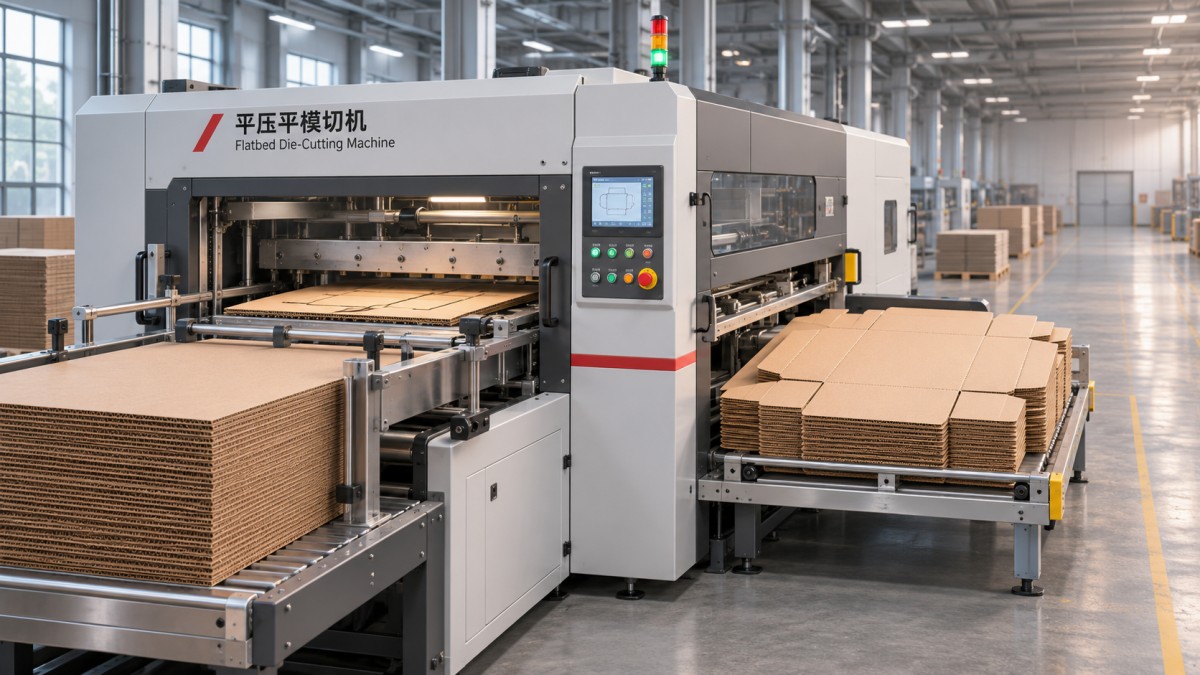
Flatbed die cutters apply pressure across a platen to cut and crease the sheet with a configured die. Compare the available cutting force with the demands of the planned layouts, but avoid treating the highest rating as an automatic advantage. Force requirements vary with total cutting-rule length, board construction, rule condition, and the amount of simultaneous creasing or other work.
Ask suppliers how their press maintains pressure distribution across the working area and how operators compensate for differences through makeready. Poorly distributed pressure can leave one section incompletely cut while another receives excessive pressure. The consequences may include inconsistent creases, accelerated tooling wear, and damaged board.
Tooling compatibility deserves its own discussion. Confirm the die format, locking arrangements, cutting plate requirements, and compatibility with existing stripping tools. If the plant already has a substantial die inventory, identify which tools can be reused, which need modification, and who will validate that conversion. A low initial machine cost can become less attractive if a large share of the tooling must be replaced.
Protect the board as well as the shape
A clean outline is not the only quality measure. Crease performance affects folding, carton geometry, and potentially the strength of the finished pack. During trials, inspect for cracked liners, crushed flutes, incomplete cuts, burrs, and variation across the sheet. Where appropriate, run samples through the intended folder-gluer or manual assembly process rather than judging them only at the die cutter.
Registration: define what accuracy means for your work
For printed corrugated packaging, registration is the relationship between the printed image and the cut or crease—not simply whether sheets align neatly at the feeder. A small shift can become visible around a printed border or make a window appear off-center. It can also affect how accurately functional features line up when a carton is folded.
Establish tolerances for representative jobs and agree on how they will be measured. Specify reference points, sample locations across the sheet, and the number of sheets to inspect over a sustained run. A single well-registered sample is not enough to show whether accuracy holds as pile condition, operating speed, and board variation change.
Compare mechanical registration with any available optical registration options in the context of the printing process. An optical system may be valuable where printed marks are reliable and image position varies relative to the sheet edge. It is not a substitute for understanding print distortion, inconsistent board, or poorly defined reference marks. Confirm which marks are required, where they must be placed, and how the system behaves when a mark is missing or difficult to read.
Stripping and blank separation can determine the real output
Two machines with similar platen speeds can produce very different quantities of usable blanks. The difference is often downstream of the cutting station. If operators must manually remove window waste, trim surrounding skeletons, or separate nested blanks, the press may wait while the pile is cleared.
Match the configuration to the work:
- Basic cutting and delivery: potentially appropriate for straightforward layouts or operations with a separate waste-removal process.
- Stripping: useful when internal cutouts and surrounding waste must be removed consistently, provided suitable tools are available.
- Blank separation: worth evaluating when individual blanks must be delivered in orderly piles for downstream handling, especially on repeat work.
Each additional station brings tooling, setup, maintenance, and space requirements. Complex or fragile designs may still need special handling, so confirm the limits with actual layouts rather than assuming every waste feature can be stripped automatically. For short-run work, compare the time saved during production with the extra time needed to prepare and set the tooling.
Convert rated speed into a production estimate
Rated speed is measured under particular conditions. Your production estimate should account for the speed that can be sustained on each board and layout, then deduct planned and unplanned interruptions. Include feeder stops, waste clearance, pile changes, quality checks, minor adjustments, and the time needed to bring the job into specification.
A practical comparison can use the same calculation for every shortlisted machine:
Good blanks per shift = good sheets produced per shift × usable blanks per sheet.
Calculate good sheets after setup and stoppages, and exclude sheets rejected for registration, cutting, creasing, or handling defects. State whether the shift includes breaks and whether operators are available throughout. The result is an estimate, not a guarantee, but it is more useful than comparing peak sheets per hour in isolation.
For example, a press with a higher running speed may be the better choice for long, stable runs. A different machine with quicker die changes, repeatable settings, and accessible stripping tools may produce more saleable cartons across a shift filled with short jobs. Model both situations if the order book contains both.
Changeover is an engineering requirement
Makeready is influenced by more than operator skill. Die loading height, tool weight, access to the platen, setting aids, pressure adjustment, and the availability of stored job parameters all affect how quickly a crew can move from one carton to another. Evaluate the complete changeover, including stripping and blanking tools, not just the time taken to mount the cutting die.
Ask for a demonstration using two materially different jobs. Record the time from the last acceptable sheet of the first job to the first acceptable sheet of the second. Note which activities can happen while the machine is running and which require it to stop. Separate normal preparation from exceptional intervention by a supplier technician.
Stored settings can reduce repeat work, but they do not eliminate variation in board, tooling condition, or print position. Check what parameters are actually saved, who can edit them, and how operators verify them before production resumes.
Evaluate integration, service, and total ownership
A flatbed die cutter should fit the plant around it. Review available floor space, maintenance access, material flow, pile transport, power and compressed-air requirements, and any extraction needs. Confirm whether upstream printing and downstream folding or packing can supply and absorb the intended output without creating queues.
For plants using production-management systems, ask what machine data is available, how it can be accessed, and whether integration requires additional hardware, licenses, or development. Useful signals may include operating state, counts, stoppage reasons, and job information. Verify the interface and responsibilities before treating connectivity as part of the project scope.
Ownership costs extend beyond the purchase price. Request a breakdown covering installation, operator training, dies and ancillary tools, wear parts, planned maintenance, software support, and expected service arrangements. Review local spare-parts availability and escalation procedures. A commercially attractive quotation is less reassuring if a critical component or specialist technician is difficult to obtain.
Use a structured trial to make the final comparison
Before committing, agree on a test protocol with each supplier. Use the same representative materials and acceptance criteria wherever possible. Include a demanding printed job, a board that reflects normal production variation, and a short-run changeover if flexibility matters to the business.
Record the board specifications, tooling condition, operating speed, staffing, and any supplier adjustments during the test. If a trial cannot reproduce a requirement, document that gap and agree on another way to verify it. The goal is not to stage a perfect demonstration; it is to understand the conditions under which the equipment performs.
The strongest choice for industrial cutting for cartons is the machine that fits the work the plant must actually deliver. Compare specifications, but give equal weight to repeatable quality, realistic throughput, tooling compatibility, and the support needed to keep production moving. Those details turn a promising press into a sound production decision.
Related News
Get weekly intelligence in your inbox.
No noise. No sponsored content. Pure intelligence.
