3-Axis vs. 5-Axis CNC Routers: Which Is Right for Solid Wood Furniture?
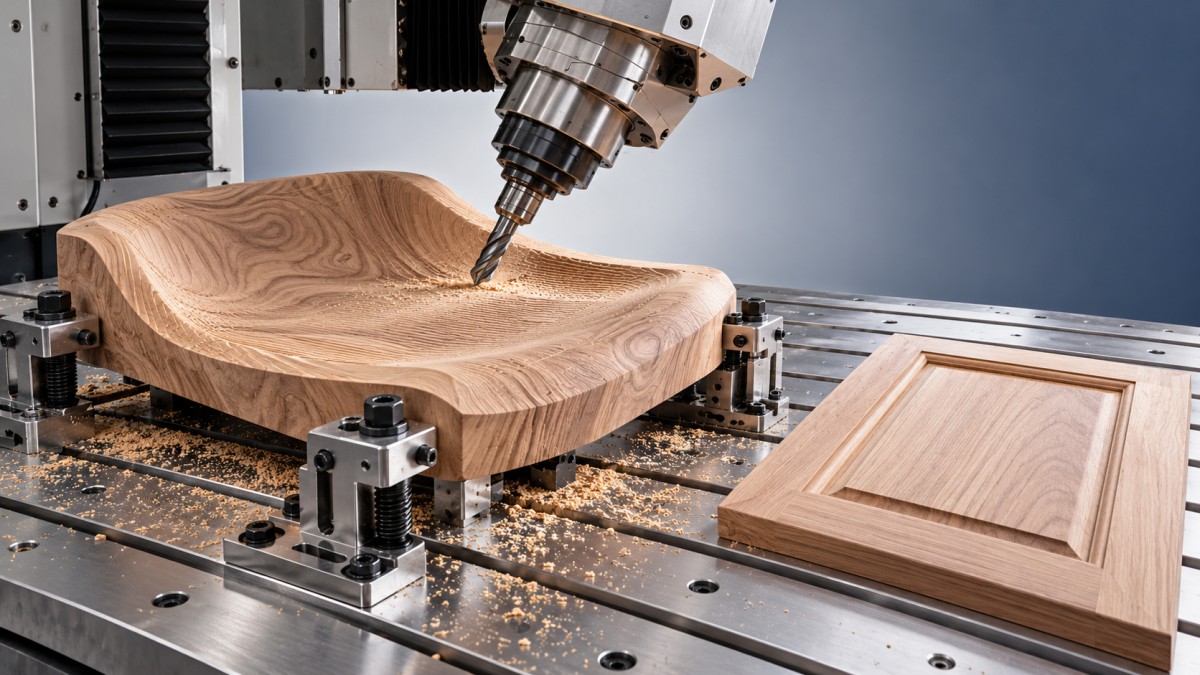
A cabinet door and a sculpted chair seat may both begin as solid wood, but they ask very different things of a CNC router. One needs reliable pocketing, profiling, and joinery from accessible faces. The other may require the cutter to approach changing curves without the spindle or toolholder colliding with the workpiece.
For technical evaluators comparing CNC woodworking equipment for solid wood, the decision starts with those differences—not with the assumption that more axes automatically mean better production. A capable 3-axis router can be the more productive investment for straightforward parts. A 5-axis machine earns its place when better tool access, fewer setups, and manageable programming demands translate into lower cost per accepted component.
Start with the features your furniture actually needs
Before reviewing machine specifications, group representative parts by geometry and machining access. Include everyday production, difficult repeat orders, and realistic future designs. A striking demonstration piece is not a useful purchasing benchmark if your factory rarely makes anything similar.
For each part, identify which operations require a vertical cutter, which need access from another direction, and which require the tool angle to change continuously during cutting. This separates three requirements that are often confused:
- Three-axis machining: The tool moves along X, Y, and Z while its orientation remains fixed. It can machine flat features and many curved surfaces, provided the cutter can reach them safely.
- Indexed five-axis machining, often called 3+2: Two rotary axes position the tool or workpiece at an angle, then remain stationary during the cutting operation.
- Simultaneous five-axis machining: Linear and rotary axes move together during cutting, continuously changing the tool’s orientation relative to the wood.
An angled mortise may need indexed positioning rather than simultaneous movement. A deeply sculpted transition may benefit from continuous orientation changes. Buying simultaneous capability for predominantly indexed work can add cost and complexity without a proportional return.
Where a 3-axis router remains the stronger choice
A 3-axis CNC router is not restricted to flat panel cutting. With appropriate CAM software, it can produce contoured seats, relief carvings, curved profiles, pockets, and many solid wood joints. Its limitation is tool orientation, not an inability to follow a three-dimensional surface.
For factories producing door components, table parts, shelving, and accessible joinery, the simpler configuration can offer a practical advantage. Programming is generally easier to standardize, fixtures are easier to understand, and operators have fewer machine movements to verify. These benefits matter when production depends on repeatable work rather than constant geometric experimentation.
However, include secondary operations in the evaluation. A part that looks inexpensive on a 3-axis machine may need several reclamping steps, manual drilling, or substantial blending afterward. Each transfer introduces handling time and another opportunity to lose the reference established in the first setup.
Before moving directly to five axes, also consider whether a horizontal drilling unit, aggregate head, dedicated angled fixture, or separate joinery machine solves the actual bottleneck. These alternatives have their own clearance, loading, and programming constraints, but can be economical when only a narrow range of features needs angled access.
What five axes change—and what they do not
The strongest argument for five-axis machining is often access. Tilting the tool can bring the cutter to an angled surface, avoid interference, or permit a shorter tool where a fixed vertical spindle would require excessive reach. Shorter reach can reduce deflection, provided the machine, toolholder, and cutting conditions support the operation.
For sculpted furniture, this may reduce the awkward handwork left between separately machined surfaces. For multi-face joinery, indexed positioning can reduce fixture changes and improve the consistency of features produced within one setup.
Yet five axes do not mean unlimited access. The spindle body, rotary head, extraction hood, toolholder, clamps, and table all occupy space. Undersides and deep recesses may still require repositioning. Rotary travel limits and machine architecture can prevent an apparently simple approach angle.
Nor does five-axis motion guarantee faster cutting. Rotary-axis acceleration, tool-center-point motion, short toolpath segments, and controller processing can constrain feed rates. On simple geometry, a 3-axis router may finish sooner because it avoids unnecessary orientation changes.
Ask suppliers to show the complete machining envelope around your parts—not merely the nominal X, Y, and Z travels. Head clearance with the intended tools and fixtures is often more revealing than the catalogue work area.
Solid wood makes the comparison less predictable
Unlike a uniform engineered board, solid wood changes across and between blanks. Grain direction, moisture condition, knots, density variation, and internal stresses influence both machining behavior and the finished part. Axis count cannot compensate for unstable stock preparation.
Grain direction and surface quality
A cutter that leaves a clean surface in one region may tear fibers as grain direction changes. Five-axis orientation can offer more options for cutter engagement, but the result still depends on tool geometry, machining direction, sharpness, chip load, and local grain. With ball-nose tools, contact near the tip also produces low effective cutting speed; suitable tilt can help in some operations.
Evaluate surfaces before sanding. Heavy sanding can disguise torn grain while increasing labor and altering profiles or joint fit. Inspect end grain, steep transitions, and reversing grain separately rather than judging the entire part from its easiest face.
Workholding and movement
Small rails, narrow legs, and irregular blanks may not offer enough sealing area for dependable vacuum holding alone. Mechanical clamps, dedicated nests, pods, or combined fixtures may be necessary. Five-axis access can make fixture design more demanding because the head needs clearance around the component.
Consider cutting forces in every planned orientation. A fixture that resists downward loading may be less secure under lateral or lifting forces. Removing material can also release internal stress, so some parts benefit from staged roughing and finishing rather than one uninterrupted cycle.
Chip evacuation and dust control
A rotating head complicates extraction close to the cut. Verify that the hood works through the required angles without striking clamps or obscuring critical clearance. Chip accumulation can affect surface quality and recutting, while inadequate dust capture creates broader workplace risks. Extraction performance belongs in the acceptance trial, not on an accessory list reviewed afterward.
Compare the production system, not just the machine
For PWFS evaluations of CNC woodworking equipment for solid wood, the useful unit of comparison is the complete production route: prepared blank, fixture, program, machining cycle, inspection, and remaining manual work.
Five-axis capability places greater demands on CAM programming and verification. The software must support the machine’s actual kinematics, and the postprocessor must produce reliable output for its controller. Tool-center-point control, rotary limits, safe retracts, and collision avoidance need practical validation rather than a check mark on a quotation.
Simulation should represent the machine, toolholders, fixtures, and stock—not only the cutter moving across the finished model. Even then, simulation does not replace controlled prove-out procedures. Incorrect tool lengths, fixture positions, or work offsets can invalidate a collision-free virtual result.
Maintenance also deserves attention. Rotary assemblies, calibration requirements, service access, spare-parts availability, and local support influence uptime. A machine that reduces handling but remains idle while waiting for specialist assistance may not deliver the expected capacity.
Build the financial case around accepted parts
Purchase price is visible. The cost of moving, checking, sanding, and occasionally scrapping a component is easier to overlook. Compare both configurations using the same production mix and quality standard.
A practical calculation is:
Cost per accepted part = total batch cost ÷ number of accepted parts.
Total batch cost should include allocated machine ownership costs, programming, setup, fixtures, machining, tooling consumption, handling, inspection, finishing labor, and rework or scrap. Use realistic productive hours when allocating ownership costs; theoretical calendar availability can make an expensive machine appear artificially economical.
Keep elapsed time and labor time separate. Eliminating a manual transfer may reduce both. A longer unattended toolpath may reduce operator involvement without shortening lead time. Those are different benefits and should not be counted twice.
Batch size can reverse the result. A complex fixture and program may pay off across repeat orders but be difficult to justify for an occasional custom component. Conversely, a standardized five-axis process can become attractive when the same family of angled parts repeatedly consumes setup labor.
Run a conservative scenario alongside the expected case. If the five-axis investment only works at immediate full utilization, with no programming delays or production variability, the proposal needs stronger evidence.
Make the supplier trial answer your purchasing questions
Use your own representative wood species, blank dimensions, and quality requirements. Include a routine part and a difficult one. Suppliers should disclose tooling, fixtures, feeds, speeds, machining allowances, and any preparation completed before the demonstration.
- Time the complete route: Include loading, referencing, tool changes, repositioning, unloading, and required secondary work.
- Inspect critical features: Check joint fit, feature relationships, surface defects, and variation across multiple blanks—not just one selected sample.
- Verify usable access: Confirm head clearance, remaining inaccessible surfaces, and extraction behavior with production fixtures installed.
- Review program ownership: Establish who supplies and maintains the postprocessor, how modifications are handled, and what training is included.
- Record acceptance criteria: Agree on measurable requirements and test conditions before ordering, including how wood condition will be controlled.
A convincing trial should expose compromises as well as strengths. If a supplier needs an unusual blank shape, extensive hand-finishing, or an impractical clamping arrangement, those conditions belong in the cost model.
The right choice follows the bottleneck
Choose a 3-axis router when most features are reachable with a fixed tool orientation, repositioning is limited, and the simpler production route meets your quality and throughput requirements. Consider indexed five-axis capability when angled features and repeated reclamping dominate the workload. Favor simultaneous five-axis machining when continuous orientation changes materially improve access or processing of complex surfaces.
For mixed production, the answer may be a combination: straightforward components on a 3-axis machine, with complex work assigned to a dedicated five-axis cell or an external specialist until demand justifies ownership.
The best investment is not the machine with the most impressive movement. It is the configuration that turns your actual solid wood parts into repeatable, accepted furniture components—with a production process your team can program, operate, maintain, and afford.
Related News
Get weekly intelligence in your inbox.
No noise. No sponsored content. Pure intelligence.
