
Sourcing Industrial Equipment in North America: A Supplier Vetting Checklist
A competitive equipment quote is useful only when the supplier can deliver a working production system, demonstrate the agreed output, and support it at your plant. For industrial equipment sourcing in North America, the strongest shortlist starts with evidence of application fit, installation readiness, and service capability. Price comparison comes after those conditions are clear.
A corrugated line, offset press, die-cutter, or CNC woodworking system can meet its catalog specifications and still miss your production targets. Material variation, changeovers, utilities, operator skills, and downstream bottlenecks all affect usable output. Use the following checklist to turn supplier claims into documented commitments before placing an order.
Define the production requirement before comparing suppliers
Give every bidder the same written application brief. Otherwise, a lower quotation may simply reflect a narrower scope, lighter construction, fewer accessories, or an easier interpretation of your requirements.
Describe the products you actually intend to manufacture, including difficult jobs that represent a meaningful share of production. Include material grades, dimensions, quality limits, batch sizes, shifts, changeover frequency, and expected connections to existing equipment.
- Corrugated board lines: Specify paper combinations, flute profiles, board widths, bonding requirements, and acceptable warp under defined production conditions.
- Offset presses: Identify substrates, sheet formats, color requirements, coating needs, and registration expectations on representative work.
- Die-cutters and folder-gluers: Include board properties, blank designs, crease requirements, glue compatibility, and difficult folds.
- CNC woodworking systems: Define panel materials, nesting patterns, hole locations, edge quality, tooling, and design-file workflows.
- Edge banders: Specify panel and edging materials, adhesive systems, finish requirements, and the range of part sizes.
Separate mandatory requirements from preferences. A machine that cannot handle a core product should leave the shortlist early. An optional automation feature can remain a commercial discussion.
Check who will actually deliver and support the equipment
Establish whether the bidder is the manufacturer, an authorized distributor, an integrator, or a used-equipment broker. Each can be a suitable partner, but their responsibilities and access to technical resources differ.
Request the legal contracting entity, manufacturing location, service locations, and written confirmation of any claimed manufacturer authorization. For integrated lines, identify who owns overall performance when components come from several companies. A collection of individual machine warranties does not establish responsibility for line throughput.
References should match your application closely enough to reveal useful problems. A supplier with successful installations in lightweight folding cartons may still need to demonstrate its suitability for demanding corrugated work.
Ask reference sites about installation delays, recurring faults, spare-parts availability, and how disputes were resolved. If a visit is possible, observe ordinary production and a changeover. A prepared demonstration alone provides limited evidence of daily operating demands.
Resolve site and compliance requirements before shipment
“North American compliant” is too broad to accept as a complete answer. Requirements depend on the installation country, local jurisdiction, equipment configuration, and processes involved. A machine intended for one destination may need changes before installation elsewhere in the region.
Have plant engineering and safety personnel review the proposed configuration before the order is released. Where electrical approval or field evaluation applies, establish the acceptance path with the relevant inspection body and assign the cost of any required modifications.
For woodworking equipment, coordinate dust collection and fire-risk controls with the actual materials and machining process. For corrugated lines, establish the boundary between machine supply and steam-system work. Printing and gluing operations may require ventilation and chemical-handling provisions that are absent from the base quotation.
Keep equipment acceptance separate from finished-product claims. A press alone cannot establish food-contact suitability, which also depends on substrates, inks, coatings, and production controls. Likewise, an edge bander cannot by itself establish the emissions performance of finished furniture.
Make the supplier prove performance on your work
Maximum rated speed rarely provides a reliable basis for comparing production economics. What matters is acceptable output over an agreed operating period, with defined materials, staffing, quality checks, and downtime accounting.
Build a representative test set that includes routine jobs and demanding applications. Supply your own material where practical, or document any substitute and its limitations. A demonstration using unusually flat board or a simple cutting pattern can conceal problems that appear on your normal workload.
Write the acceptance criteria before signing the contract:
- Output: Count saleable pieces, sheets, or panels, and define how rejects are recorded.
- Quality: Agree measurable limits for registration, dimensions, bonding, cutting, folding, or surface finish.
- Changeover: Define the start and finish points, including adjustment and first acceptable production.
- Operating conditions: Record staffing, utilities, tooling, consumables, and material specifications.
- Interruptions: State how jams, adjustments, cleaning, and equipment faults affect the result.
A CNC router, for example, may cut quickly while loading, labeling, or tool changes constrain the complete cycle. A folder-gluer may achieve high speed on simple blanks but struggle with a frequently ordered complex carton. Test the production sequence that determines shipment capacity.
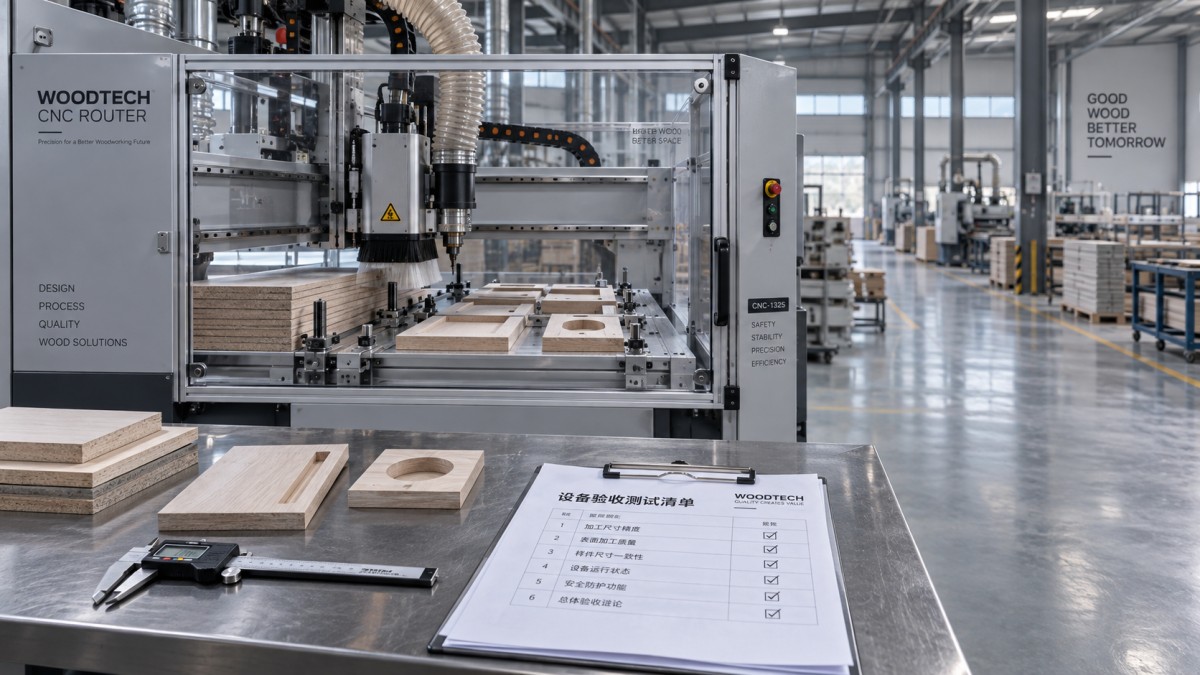
Use a factory acceptance test to establish readiness before shipment, followed by a site acceptance test under your installed conditions. Define who supplies test materials, who records results, how failures are corrected, and when retesting occurs. Connect payment milestones to documented deliverables, with meaningful value remaining until the agreed acceptance obligations are met.
Test the local service promise
A local sales office does not establish local technical support. Ask where qualified technicians are based, which machine models they support, and whether they are employees or subcontractors. Clarify support hours, travel charges, escalation procedures, and the distinction between acknowledging a request and restoring production.
Request a critical-spares list with stock locations and replenishment arrangements. Separate commonly available components from proprietary assemblies, custom boards, and specialized mechanical parts. A familiar component brand helps only if the replacement has the correct configuration and can be commissioned.
Software support deserves equal attention. Establish who holds backups, passwords, licenses, and machine parameters. Define remote-access permissions, cybersecurity responsibilities, and what happens if a subscription or distributor relationship ends. For CNC equipment, verify compatibility among design software, post-processors, machine controls, and production-management systems using representative files.
Training should cover operation, setup, troubleshooting, maintenance, and safe recovery from interrupted cycles. Tie it to the roles and shifts that will run the machine. If production depends on one visiting specialist completing every changeover, the handover is incomplete.
Compare the cost of installed, productive capacity
Normalize quotations into a shared cost model. The relevant comparison is the cost of reaching and sustaining the required output, including the work needed around the machine.
Separate purchase costs, installation costs, and recurring operating costs. Include tooling, dies, glue systems, extraction, compressors, software, freight, insurance, unloading, rigging, foundations, electrical work, commissioning, training, and startup materials where applicable.
For cross-border purchases, identify the importer of record and responsibility for customs classification, brokerage, duties, taxes, and documentation. Preferential tariff treatment depends on applicable origin rules and supporting records; a seller’s address alone does not establish eligibility. State the delivery term, named place, and responsibility for unloading explicitly.
Estimate recurring expenses using your product mix. Ink, adhesive, cutting tools, maintenance parts, energy, service travel, and software can affect machine types differently. Include the cost of waste and the labor required to achieve acceptable production.
Compare cost per saleable unit under realistic utilization assumptions. Test how the result changes with lower demand, longer changeovers, or delayed ramp-up. A highly automated line may justify its premium with stable volume and suitable upstream processes. Short runs and frequent product changes can make flexibility and setup efficiency more valuable than peak speed.
Put integration and commercial responsibilities in writing
Many disputes begin in the gap between “machine supplied” and “production ready.” Attach a responsibility schedule to the contract covering layout approval, utility connections, rigging, installation, integration, trial production, and training. Name the owner of each task.
For connected lines, document product-transfer conditions, control interfaces, fault handling, and emergency-stop coordination. Establish what happens when an upstream machine keeps producing while a downstream machine stops. Physical compatibility does not guarantee coordinated operation.
Review warranty language against the commissioning plan. If coverage starts at shipment, transport and installation can consume part of the useful support period. State the trigger, covered labor and travel, exclusions, wear-part treatment, and process for unresolved defects.
Delivery commitments should distinguish factory completion, shipment, site arrival, and readiness for production. Define the consequences of missed milestones and failed acceptance tests, including correction periods and available remedies. Ensure that negotiated promises appear in the signed documents.
Apply extra scrutiny to used and refurbished machinery
Used equipment can suit a proven process when the purchase savings exceed refurbishment and support risks. It becomes less attractive when essential controls are obsolete, documentation is incomplete, or missing tooling prevents economical production.
Request serial numbers, ownership history, maintenance records, refurbishment scope, and a list of replaced components. “Refurbished” should describe identifiable work. Inspect the machine under power where possible, using representative material, and commission an independent inspection when the condition risk warrants it.
Confirm that software licenses can transfer and that the manufacturer or a capable service provider will support the specific configuration. Include dismantling, transport preparation, reassembly, alignment, and recommissioning in the comparison. A low purchase price can disappear into relocation work.
Make the award decision from documented evidence
Use mandatory pass-or-fail conditions before applying a weighted supplier score. An unresolved safety issue, inability to run a core product, or lack of a workable acceptance plan should not be offset by an attractive price.
Among qualified suppliers, compare demonstrated application performance, installed cost, service capability, delivery credibility, and contractual accountability. Weight them according to the plant’s needs: a remote location may place greater value on maintainability and stocked spares, while a tightly connected line needs clear integration ownership.
Before authorizing the order, close every material gap between the application brief, quotation, test plan, and contract. The selected supplier should be able to explain what the equipment will produce, under which conditions, how success will be measured, and who will resolve problems after installation.
Related News
Get weekly intelligence in your inbox.
No noise. No sponsored content. Pure intelligence.
