
High-Speed Carton Gluing: How to Prevent Weak Bonds as Line Speeds Increase
A carton leaves the compression section looking square and secure. A few metres downstream, the side seam lifts. Operators add glue, increase pressure, and try again—only to find that the problem returns when the folder-gluer reaches its target speed.
Reliable high speed gluing for cartons depends on matching adhesive delivery, board condition, folding accuracy, and compression time to the production pace. More adhesive is not automatically a stronger bond. Sometimes it creates a thicker, wetter joint that takes longer to develop handling strength.
The fastest route to a stable seam is to identify where the bond is failing, then change one controlled variable at a time. These checks help operators separate adhesive problems from mechanical and substrate issues without turning an entire production run into an experiment.
Read the failed seam before changing the machine
Collect cartons from a known-good speed and from the speed where failures begin. Mark their speed, collection time, and position in the run. Compare samples after the same conditioning interval; a freshly glued seam and one that has rested for several minutes are not equivalent.
Open the joints carefully and examine both mating surfaces. The failure pattern provides a useful starting point, although no single pattern proves the cause on its own.
Fibre tear can indicate that the bond exceeds the local strength of the board. However, it is not a universal acceptance criterion: coated materials, board constructions, and customer requirements differ. Use the agreed test method rather than judging every carton by appearance alone.
The speed increase changes two different clocks
Two timing windows matter: the time between adhesive application and flap contact, and the time the closed seam remains supported under compression. Increasing line speed shortens both. That can improve one condition while making the other worse.
For a fixed machine path:
Travel time in seconds = distance in metres ÷ actual blank speed in metres per second.
For example, a seam travelling through 3 metres of effective compression at 150 metres per minute receives approximately 1.2 seconds of support. At 300 metres per minute, that falls to approximately 0.6 seconds. These figures illustrate the relationship; they are not recommended settings.
Use the actual blank transport speed and the length over which the seam receives useful pressure—not simply the machine’s overall compression-section length. Unsupported entry zones, slipping belts, and poor contact reduce effective dwell.
Cartons per minute is useful for output reporting, but it does not fully describe bonding conditions. Different blank lengths and feed gaps can produce different transport speeds at the same carton count.
Water-based and hot-melt adhesives respond differently
With water-based carton adhesives, initial tack must hold the joint while water leaves the glue line through absorption and drying. A heavy deposit or a resistant coating can delay strength development. Faster closure may help wet transfer, but shorter compression can still leave the seam vulnerable.
Hot melt must reach the opposing surface while it can still wet it, then cool sufficiently to resist flap springback. Too much cooling before contact can prevent transfer; too little setting before release can allow opening. Raising temperature indiscriminately is not a reliable fix and may exceed the adhesive’s operating limits.
Confirm the adhesive supplier’s application range, open-time characteristics, and suitability for the board. Do not assume a product that runs well slowly has enough timing margin at the higher speed.
Check the glue track where it actually lands
A clean bead on a stationary test piece does not prove correct application during production. At speed, valve response, blank tracking, pressure recovery, and adhesive rheology can shift or distort the deposit.
Using the machine’s approved sampling procedure, examine blanks from both stable-speed operation and acceleration. Check the start and end positions, continuity, width, and distance from the flap edge. Look for glue outside the overlap, not just glue that is missing.
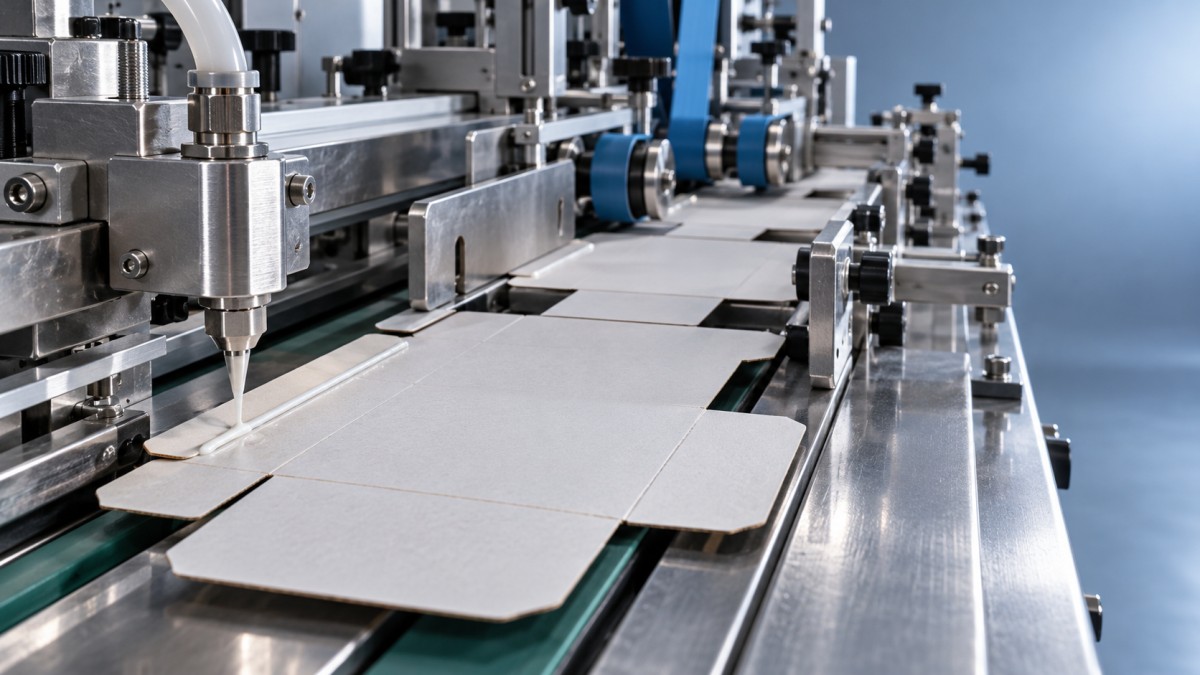
The adhesive belongs inside the intended bonding area after folding. A correctly positioned track on a flat blank may still miss its mating surface if the fold is skewed or the overlap varies.
- For nozzle systems: check filters, nozzle cleanliness, valve condition, supply stability, and encoder-based triggering. Confirm that timing compensation remains accurate as speed changes.
- For wheel applicators: inspect wheel condition, metering, contact consistency, and blank support. A bouncing flap can interrupt transfer even when the glue supply is steady.
- For either system: measure adhesive consumption against an approved baseline. Visual bead size alone can conceal deposit variation.
A constant nozzle flow does not produce the same deposit per unit length when transport speed increases. Many systems compensate automatically, but operators should verify the result rather than assume the control setting guarantees it.
Before cleaning, clearing blockages, or adjusting guarded components, follow the machine’s isolation procedure. Hot adhesive and pressurised systems require their specified depressurising and protective measures.
Do not let the board escape the investigation
When only certain batches fail, examine the substrate before rewriting the machine recipe. Changes in coating, moisture, storage temperature, recycled fibre content, or surface contamination can alter bonding behaviour.
Check whether the glue flap is genuinely available for bonding. Varnish, film lamination, UV coating, anti-scuff treatment, or print overspray may occupy an area intended to remain uncoated. An adhesive may bond to the coating while the coating itself releases from the board.
Compare suspect stock with a retained, previously successful batch under the same settings. Where possible, inspect converting records and confirm whether the glue-flap treatment changed. A simple wetting observation can flag differences, but it does not replace a bond test or establish adhesive compatibility.
Cold stock and large temperature differences can also change application behaviour. Condition materials according to supplier guidance and monitor the production environment. For water-based adhesive, uncontrolled dilution can change solids, viscosity, and tack; use only the supplier-approved adjustment procedure.
If abrasion, a coating knockout, or another surface treatment is proposed, validate it with the packaging specification owner. Removing material indiscriminately can damage the flap, create dust, or compromise the package.
Compression should restrain the joint, not crush it
Once glue placement and substrate suitability are confirmed, follow the carton through folding and compression. The seam needs consistent contact while the adhesive develops enough handling strength to resist the board’s opening force.
That opening force is easily overlooked. Poor crease quality, stiff board, inaccurate pre-breaking, or folding that leaves the flap under tension can make a workable adhesive appear inadequate.
Check these mechanical conditions together:
- The flap folds on the intended crease rather than alongside it.
- Pre-breaking is appropriate for the carton design and board.
- Guides maintain overlap without dragging or twisting the blank.
- Compression belts are clean, aligned, and transporting cartons consistently.
- Pressure reaches the seam evenly despite thickness changes or folded features.
More pressure is not always better. Excessive loading can squeeze adhesive away from the interface, mark printed surfaces, crush corrugated flutes, or distort the carton. Pressure should establish intimate contact within the machine and board limits.
If the seam is satisfactory after extended support but opens immediately at discharge, insufficient early strength or effective compression dwell becomes a strong suspect. Possible remedies include approved adjustments to compression arrangement, reduced flap springback, or an adhesive with suitable faster strength development. Raising speed further will not resolve that mismatch.
A controlled speed trial for high speed gluing for cartons
Once obvious defects are corrected, establish a repeatable operating window. Avoid changing temperature, deposit, pressure, and speed simultaneously: even if the seam improves, the team will not know which change mattered.
- Establish a baseline. Run at a speed that produces acceptable cartons. Record board identification, adhesive grade and batch, application settings, relevant temperatures, compression setup, and ambient conditions.
- Increase speed in controlled steps. Allow the line and adhesive delivery to stabilise at each step. Collect labelled samples using a safe, consistent procedure.
- Test at defined intervals. Assess early handling strength and the conditioned bond separately. Use the same opening method and acceptance criteria for every group.
- Find the first repeatable failure. Compare its glue track, overlap, and failure surface with the preceding acceptable group.
- Change the most likely variable. Make a documented adjustment within approved limits, then repeat the comparison.
- Validate normal disturbances. Include acceleration, stop-start recovery, and downstream handling before releasing the recipe.
A carton that survives a gentle bench check may still fail under counter-ejector pressure, packing, or downstream conveying. Evaluate the actual handling sequence, including the point where the first seam openings appear.
If adhesive presence sensors or camera inspection are available, use them to detect missing or misplaced deposits and confirm reject operation. Their limits matter: detecting glue is not proof of a strong bond. Physical seam tests remain necessary.
Make the stable setting repeatable across shifts
The useful output of troubleshooting is not simply a higher speed reading. It is a documented process window that another operator can reproduce.
Save the validated recipe by carton design, board specification, and adhesive grade. Include glue position, measured deposit or consumption reference, application settings, compression configuration, test timing, and acceptance criteria. Record the conditions under which the recipe was approved, not just the final machine setpoints.
Escalate to the adhesive supplier or equipment technician when acceptable bonding requires settings outside approved limits, delivery remains unstable, or the substrate’s bonding surface is uncertain. Provide labelled failure samples and speed-trial records; they are more useful than reporting that the glue is “not strong enough.”
Secure seams at higher speed come from controlling contact, timing, and material compatibility together. Read the failed joint, verify delivery under real running conditions, and protect enough compression time for handling strength to develop. That approach gives operators a defensible route to higher throughput without passing hidden seam failures downstream.
Related News
Get weekly intelligence in your inbox.
No noise. No sponsored content. Pure intelligence.