Choosing Wood Cutting and Drilling Equipment for Cabinet Panel Production
For cabinet panel production, a panel saw paired with a drilling center is a strong starting point when rectangular parts and repeat orders dominate. A CNC nesting router becomes more attractive when production involves frequent design changes, shaped components, and face machining within the same sheet layout. Neither arrangement automatically delivers the lowest cost per finished cabinet: the result depends on how parts move through cutting, edge banding, drilling, and assembly.
Choosing wood cutting and drilling equipment therefore starts with the production route. Technical evaluators need to establish which operations each machine will complete, which parts require another setup, and where dimensional references may change. A fast cutting machine can still leave a factory short of assembly-ready panels if drilling, sorting, or material handling cannot keep pace.
Match the machine arrangement to the parts you actually make
Build the evaluation around a representative mix of cabinet sides, shelves, backs, doors, drawer components, and narrow rails. Include the materials, thicknesses, finishes, and hardware preparations used in normal production. Average panel dimensions alone will hide difficult components, especially small pieces that are hard to hold, long panels that need additional support, and parts with holes on several faces.
Order structure matters just as much as geometry. Repeated rectangular components create opportunities for stack cutting and standardized drilling programs. Individual kitchens with changing dimensions create more programming, labeling, and sorting work. A machine arrangement that performs well on a large repeat order may lose its advantage when every sheet contains parts for several different cabinets.
Panel saws favor rectangular work with repeatable cutting patterns
A beam saw can be a practical choice when cutting demand centers on straight, rectangular parts. Where materials and quality requirements permit stack cutting, several panels can follow the same cutting pattern. This can increase cutting output, but the benefit depends on repeat quantities, stack stability, and the ability to handle the resulting parts.
The saw does not eliminate subsequent machining. Hinge cups, connector holes, grooves, and edge drilling still need suitable equipment. Evaluate the saw and drilling center as a combined route, including unloading, part identification, buffer space, and transfers through edge banding.
Check cutting-pattern restrictions against actual orders. Grain direction, decorative matching, trim allowances, and remnant handling can reduce the material yield predicted by a simple optimization exercise. Stack height also needs validation on the intended board: a nominal cutting capacity does not establish acceptable finish throughout a stack.
Nesting routers favor varied layouts and combined face operations
A nesting router can cut panel outlines and perform accessible face drilling or routing while the sheet remains on the table. This suits varied dimensions, shaped components, cutouts, and mixed layouts. Combining operations can reduce transfers and keep some features within one machining reference.
However, a flatbed nesting configuration may leave horizontal edge holes or underside features for another machine. Check the exact access provided by its drilling unit, aggregates, and workholding arrangement. The term “complete machining” should be translated into a list of operations completed on each representative part.
Small components deserve particular attention. As a sheet is divided, the available vacuum holding area changes. Narrow rails and small panels can move during the final cutting passes, particularly when the spoilboard condition or material permeability reduces holding effectiveness. Cutting sequence, vacuum zoning, tooling, and any retained material must be demonstrated together.
Dedicated drilling becomes valuable when hole patterns drive the workload
A drilling center can complement either cutting route. Multiple drilling spindles may process suitable hole patterns efficiently, while machines with access to several faces can reduce manual repositioning. Their suitability depends on spindle layout, supported panel dimensions, clamping positions, and the required hardware patterns.
Compare those details with the factory’s component library. A drilling head that handles shelf-pin rows efficiently may still need additional cycles for connector holes, hinge preparations, or unusual spacing. Small-part handling and machining near clamps can impose restrictions that are easy to miss in a specification sheet.
For mostly flat cabinet panels, additional axes should be justified by specific features. More complex motion is useful when the geometry requires it, but axis count alone does not establish better cabinet production performance.
Verify quality across cutting, drilling, and assembly
Machine positioning accuracy is only one contributor to finished-part quality. Panel condition, tool wear, clamping, reference selection, and material movement all affect the result. Define acceptance criteria for dimensions, squareness, edge finish, hole position, hole depth, and assembly fit before comparing demonstrations.
Use the same materials and comparable acceptance methods for each candidate. Include coated particleboard, MDF, plywood, or other boards only where they belong in the intended production mix. Different substrates and surface layers can require different tools and machining conditions; one clean sample does not establish performance across the range.
For a panel saw, inspect both faces of the cut and assess chipping alongside dimensions and squareness. Where a scoring blade is used, its alignment and setup influence surface quality. For a router, examine the upper and lower edges, internal corners, entry and exit marks, and finish on small components. Tool geometry and cutting strategy must suit both the substrate and the finish.
Spindle power should be assessed against the required operations. Available torque at the working speed, tool suitability, machine rigidity, and chip removal affect usable performance. A larger power rating cannot compensate for unstable workholding or a tool that damages the decorative surface.
Hole quality also extends beyond position. Check diameter, depth, breakout, and the fit of the intended hardware. A hole can be correctly located yet unsuitable for assembly if its diameter is inconsistent or its bottom contains packed chips. Through-holes need adequate support or a suitable machining strategy to control exit damage.
The datum strategy deserves explicit review. Determine whether drilling references the cut edge, the finished banded edge, or another defined surface. Edge-band thickness and trimming allowances can affect finished dimensions and hardware relationships. The software and machine programs must use a consistent interpretation of the drawing.
Consider a cabinet side that is cut, banded, and then drilled for a connector. If the drilling program assumes a different reference edge from the one used during cutting, individually acceptable operations can produce a poor assembly fit. Part rotation, mirrored components, and decorative-face orientation create similar risks.
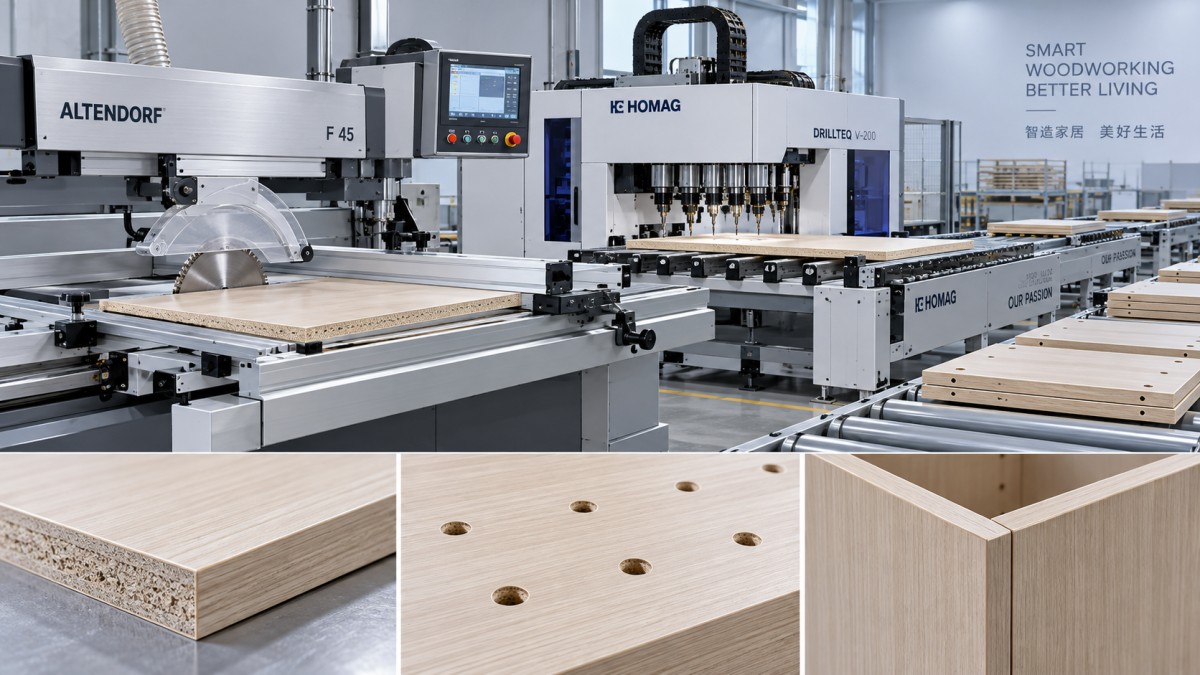
Acceptance should therefore include assembled components as well as loose-panel measurements. Representative cabinet corners, hinges, drawers, and shelf fittings help reveal whether the full tolerance chain works. This is especially useful when comparing a route that combines machining operations with one that transfers parts between machines.
Chip evacuation must be evaluated during these trials. Chips retained in holes can affect subsequent drilling or hardware insertion; recut material can degrade finish and accelerate tool wear. Check extraction at the actual cutting and drilling locations, including performance as vacuum zones, tools, and operating conditions change. Dust control and machine guarding also need to fit the proposed installation and applicable workplace requirements.
Measure the route to assembly-ready panels
Headline throughput usually describes a limited machine condition. Procurement decisions need a broader measure: acceptable, identifiable parts delivered to the next operation over a representative production period. Include loading, program selection, tool changes, unloading, sorting, interruptions, and rework.
For a nesting router, cycle time depends on cutting-path length, drilling count, tool changes, machining strategy, and loading arrangements. A layout with strong material yield can contain many small parts that take longer to machine and sort. Material utilization and output should be compared together.
For a panel saw route, cutting capacity depends on the cutting pattern, repeat quantities, stack size, and handling requirements. Faster cutting may create a queue at drilling or edge banding. Assess the capacity of those operations under the same order mix, allowing for setups and realistic staffing.
A short production trial should include a change between jobs. That exposes program handling, tooling preparation, material identification, and operator intervention that a continuous run can conceal. Where automation is proposed, include replenishment and exception handling: damaged boards, missing labels, rejected parts, and remnants all need a workable path.
Ask suppliers to distinguish cutting or machining time from total elapsed time. The difference helps explain whether improved performance comes from the machine itself, handling equipment, additional labor, or assumptions about uninterrupted production.
Installation requirements belong in this comparison. Vacuum pumps, extraction, compressed air, electrical supply, service access, and material staging can constrain the layout. Check whether the available infrastructure supports simultaneous operation of the proposed equipment. A machine’s footprint alone gives an incomplete picture of the space required.
Use cost per accepted component or completed cabinet kit as the economic reference. Include tooling, spoilboards where applicable, extraction and vacuum energy, maintenance, programming, handling labor, scrap, and rework. Savings in sheet utilization may be offset by longer machining cycles or additional transfers; faster cutting may justify higher handling costs if the downstream route can absorb the output.
Make software integration and acceptance conditions part of the purchase
Cabinet production software must carry more than panel dimensions into machining. Material identity, grain direction, edge-band assignments, decorative-face orientation, hardware rules, and machining features need to survive the transfer from design to production.
Evaluate the actual CAD/CAM connection and machine postprocessor. A machine that accepts a common file format may still require manual interpretation or program editing. Ask for representative designs to be processed through the proposed software route, then inspect the resulting machine programs and finished parts.
Pay particular attention to mirrored components and drilling on opposite faces. These can look correct on screen while producing the wrong physical orientation if conventions differ between systems. Labels should allow an operator or automated station to identify the part, its orientation, and its next operation without reconstructing the design intent.
Design revisions need a clear control process. If a cabinet changes after some parts have been produced, the system should make the affected components and replacement programs identifiable. Remakes also need consistent references and labels so that a single replacement panel fits the original kit.
Before ordering, establish an acceptance package that covers:
- The agreed material and part mix, including difficult sizes and multi-face machining.
- Dimensional, surface, hole-quality, and assembly-fit requirements.
- Measured output with defined staffing, loading, sorting, and changeover conditions.
- The full software transfer, labeling, revision, and remake process.
- Required utilities, extraction, tooling, training, maintenance access, and service support.
Give unresolved exceptions a defined route. If narrow rails require a fixture, or edge drilling requires a second machine, include that equipment, labor, and handling in the proposal. An exception that appears minor in a demonstration can become a recurring production burden when it belongs to a frequently used cabinet design.
The final choice should follow the dominant workload and its most costly constraints. Rectangular repeat production can support a saw-and-drilling route; varied layouts and combined face operations can favor nesting. A dedicated drilling center becomes compelling when secondary machining limits output or requires too much repositioning. Commit when the proposed route has demonstrated acceptable parts, manageable transfers, and dependable assembly fit under the order mix the factory intends to run.
Related News
Get weekly intelligence in your inbox.
No noise. No sponsored content. Pure intelligence.
