
Profile Geometry and Tooling Checks for Soft-Forming Edge Banders
When a “Good” Edge Band Still Looks Wrong
A soft-forming edgebander can apply a clean strip of material and still produce a part that fails visual inspection. The usual symptoms are familiar to operators: a flat spot at the crown, a visible glue line near the return, whitening on a tight curve, an edge that feels uneven when rubbed by hand, or a profile that changes from one panel batch to the next.
These defects are often blamed on glue temperature or feed speed. Both matter, but the root cause is frequently earlier in the process: the intended profile geometry does not match the cutter set, pressure rollers, band thickness, or trimming path. Soft forming is not simply straight edging with rounded corners. The machine is creating a continuous shaped edge, and every station needs to follow the same theoretical contour.
For operators, the practical task is to read the profile as a chain of surfaces and transitions. Where does the flat face end? Where does the radius begin? Is there a return underneath the panel? Does the profile have one continuous curve, two changing radii, or a reverse curve? Those questions determine whether the workpiece can pass through the edgebanding, trimming, scraping, and buffing stations without distortion.
Read the Drawing Before Adjusting the Machine
The profile drawing should be treated as the production reference, not as a general appearance guide. A small difference between the drawing and the machined panel can alter the way the edging material is compressed and trimmed. Operators should confirm the panel thickness, finished profile height, radii, tangent points, intended edge material, and any undercut or return before setting the machine.
Three profile names are frequently used in soft-forming work: J, C, and X. The names are useful shorthand, but they are not universally standardized. One supplier’s “J” may differ from another’s in radius, lip depth, or starting point. The actual cross-section drawing, preferably with dimensions and tolerances from the panel or tooling specification, should control setup decisions.
J profiles: one visible curve with a return
A J profile usually has a rounded outer face that transitions into a return or lower lip, creating the visual impression of the letter J. It may be used where a softened top edge is required while the lower section wraps back toward the panel. The return area is often where setup problems appear first because the band must follow the curve and then continue into a more restricted path.
If the pressure system does not support the material through that transition, the edging can bridge across the return rather than seating fully. The outer surface may look acceptable at first, while the lower edge shows incomplete bonding, excess glue, or a narrow gap after trimming. A J profile also requires careful cutter clearance. A trimming cutter that follows the visible crown but cannot reach the return consistently may leave a sharp feather, a step, or a partially untrimmed edge.
C profiles: a continuous rounded wrap
A C profile is generally a more continuous curved wrap around the panel edge. Its appearance is smoother than a simple chamfer or quarter-round, but the apparent simplicity can hide a tooling issue: the band must remain supported around the full arc. A roller that contacts only the high points can flatten the crown or leave insufficient pressure at the shoulders.
On a C profile, operators should look closely at the tangent points where the curved area meets flatter panel surfaces. A hard witness line at either transition usually indicates that the panel has been cut with an incorrect radius, the profile cutter is worn, or the trimming and scraping path is not aligned with the finished contour. A smooth curve should feel continuous from face to edge, without a ridge that catches a fingernail.
X profiles: changing direction requires closer control
An X profile commonly refers to a section with opposing or changing curves, often creating a more complex visual form than J or C profiles. The exact shape varies, which is why a drawing matters more than the letter designation. The key operating issue is a reversal in direction or a narrow transition zone. Material entering that area may be pulled, stretched, or insufficiently pressed if the roller sequence was designed for a simpler convex contour.
These profiles place greater demands on consistency. Variation in panel machining, even when it is modest, can move the contact point between the workpiece and a shaped pressure roller. The result may be inconsistent compression along the edge rather than a uniform defect across every part.
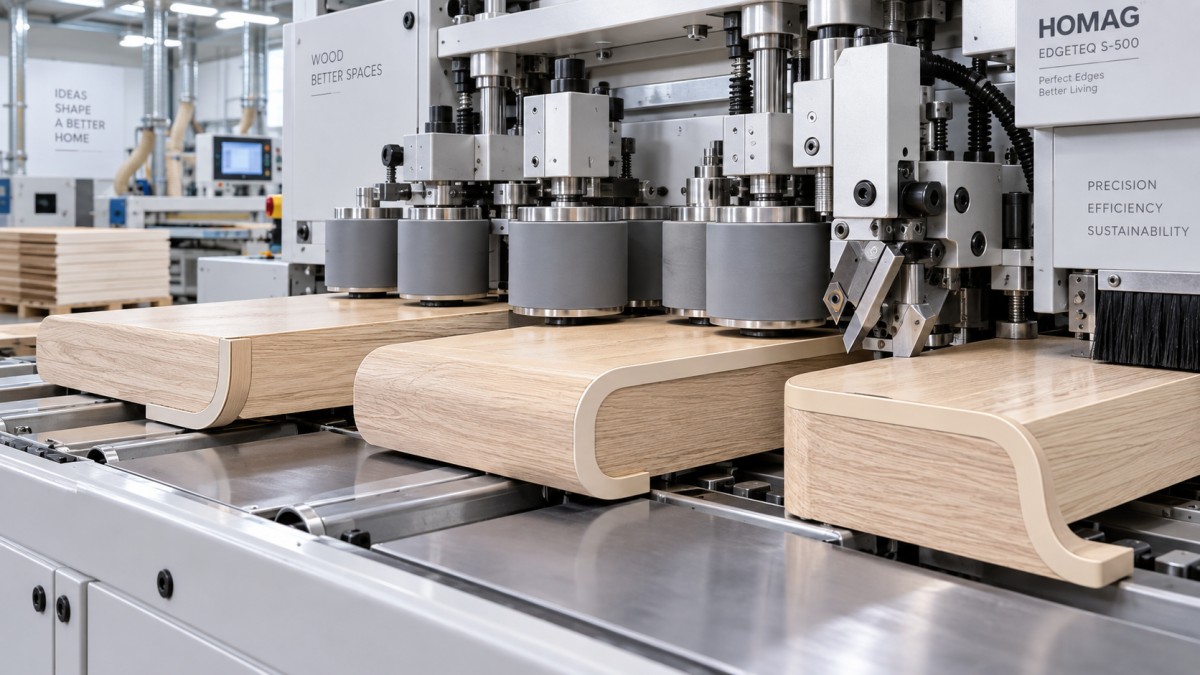
Geometry Is a System, Not Just a Cutter Shape
Successful soft forming depends on agreement among four elements: the pre-machined panel profile, the edge band material, the pressure system, and the finishing tools. Correcting only one component often shifts the defect downstream.
Consider a panel whose radius is slightly smaller than the intended tooling radius. A shaped pressure roller may contact near the center of the curve but lose support at the shoulders. Increasing roller pressure may force the band tighter at the contact point, yet it can also flatten the profile or squeeze adhesive toward an exposed edge. Replacing the roller without checking the panel profile can produce the same result.
The same logic applies to trimming. A router cutter follows a fixed path relative to the machine reference. If the panel is not sitting consistently against guides, or if the profile height changes because of upstream machining variation, the cutter may remove more material on one side of the contour than the other. Scrapers and buffing wheels can disguise a light imperfection, but they cannot correct a badly positioned trim line without changing the intended geometry.
Before making production adjustments, compare a rejected panel with an approved reference or a dimensioned profile sample. Check the panel in several locations, not only at the leading end. A profile that changes along the panel length points to upstream machining, workpiece support, or panel movement. A repeatable defect at the same location around the contour more often points to roller shape, cutter position, or a tool condition issue.
Tooling Checks That Should Happen Before a Long Run
Operators do not need to dismantle the entire machine for every changeover, but a short, disciplined inspection prevents many avoidable rejects. The following checks are most useful when a new profile, band thickness, panel material, or production batch is introduced.
- Verify the actual panel contour. Use the approved drawing, template, gauge, or sample to confirm radius locations and return depth. Do not assume that a cutter marked with a profile name produces the same shape after sharpening or replacement.
- Inspect cutter condition. Look for resin buildup, chipped cutting edges, uneven wear, and signs of heat discoloration. A dull tool can compress or tear surface material rather than cut a clean contour, especially on coated board, MDF, and veneered panels.
- Confirm cutter runout and mounting cleanliness. Chips, dust, or adhesive residue behind a cutter body can affect concentricity. In shaped work, even slight eccentric movement may create a repeating ridge or inconsistent radius.
- Match rollers to the current geometry. Shaped rollers should contact the intended profile in a controlled way rather than only touching the crown. Examine roller surfaces for cuts, hardened adhesive, flat spots, and loss of elasticity.
- Check the band path. The edging should enter the pressure zone without twisting or being pulled sideways. A narrow strip that tracks poorly may appear acceptable on a straight edge but wander across a curved profile.
- Set finishing tools after confirming the bonded band. Trimming, scraping, and buffing should refine a fully seated edge. If the band is not properly conformed before trimming, later stations may create an attractive but weak edge.
A useful practice is to keep a retained first-off sample for each profile and material combination. The sample gives the operator a physical reference for crown shape, return coverage, trim location, and surface finish. It is more reliable than judging only from a machine setting number, particularly after tooling maintenance.
Pressure Settings: More Force Is Rarely the Whole Answer
Insufficient pressure can leave adhesive gaps, poor contact at the shoulders, and lifted areas near a return. Excess pressure can be equally damaging. It may flatten a soft radius, mark a delicate surface, distort a thermoplastic edging strip, or force adhesive beyond the edge where it becomes difficult to clean.
The correct setting depends on the band material, thickness, flexibility, profile radius, adhesive system, panel surface, and feed conditions. A thin and flexible band may conform readily but show telegraphing from an imperfect substrate. A thicker band can produce a more substantial finished edge, yet it needs enough controlled support to follow a tight profile without stress. When material is changed, operators should avoid carrying over pressure settings without trial pieces.
Rather than making a large adjustment immediately, inspect where the defect begins. If the middle of a convex curve bonds well but both shoulders are weak, the issue may be roller contact geometry rather than total pressure. If bonding is inconsistent only at the leading and trailing ends, panel support, cut-in timing, or workpiece handling may be more relevant than the shaped roller itself.
Tracing Common Defects Back to Their Likely Source
Use Machine Information as a Setup Aid, Not a Substitute for Inspection
Machine documentation can help operators understand which profile concepts, stations, and adjustment ranges are relevant to a particular soft-forming configuration. For example, the available ZD880S soft forming profile details can be reviewed alongside the actual workpiece drawing when preparing a profile changeover. The important point is to compare documented capability with the panel’s real cross-section, edging material, and finishing requirement rather than relying on a profile name alone.
When reviewing machine information, focus on questions that affect the shop floor: Which stations shape the panel and which stations finish the applied band? Are shaped pressure rollers required for the intended contour? Is there enough clearance for the return on a J-like profile? Can the trimming path access the lower section without damaging the panel face? These are process questions, not merely specification questions.
Preventing Repeat Defects Through Setup Records
Soft-forming quality is easier to stabilize when setup knowledge is recorded in a usable format. A practical record can include the panel material, finished thickness, profile drawing revision, band type, roller set identification, cutter identification, observed feed condition, and photos of an accepted cross-section. It does not need to be complicated. Its purpose is to prevent an operator from rebuilding the process from memory after a tool change or a repeat order months later.
Records are particularly helpful where multiple profiles look similar from the front but differ in return depth or radius location. A C profile with a broad shoulder may use a different pressure contact pattern from one with a tighter crown. An X profile may require a different finishing sequence even if the visible edge material is the same. Treating them as interchangeable can create defects that only become visible after assembly, handling, or customer inspection.
The most reliable soft-forming runs begin with a correctly machined panel, a band capable of following the intended contour, and tools that reproduce the drawing rather than merely approximate it. When a defect appears, trace it through the geometry and station sequence before changing several settings at once. That approach preserves useful evidence, shortens troubleshooting, and makes J, C, and X profiles far more predictable in daily production.
Related News
Get weekly intelligence in your inbox.
No noise. No sponsored content. Pure intelligence.
