UV Curing System Market Outlook: Demand Drivers, Costs, and Adoption Risks
On a modern packaging or furniture line, curing is no longer a quiet finishing step at the end of production. It increasingly determines whether a job can move from printed sheet or coated panel to the next operation without waiting, rework, or surface damage. That shift is bringing the UV curing system market into sharper focus for manufacturers evaluating faster production models, more demanding decorative finishes, and tighter environmental controls.
For business evaluators, the headline attraction is easy to understand: ultraviolet curing can transform inks, coatings, adhesives, and lacquers from liquid to functional films in seconds. Yet the investment case is rarely as simple as “replace a dryer and run faster.” The value of a UV installation depends on the chemistry being cured, the material beneath it, the line speed, the energy profile, the operator workflow, and the consequences of a quality failure downstream.
Across commercial print, folding cartons, labels, corrugated packaging, decorative panels, cabinet components, and edge-finishing applications, the market is being shaped by a common production question: how can a plant produce more complex, durable, visually consistent surfaces without adding disproportionate floor space, labor, or process risk?
Why the UV curing system market is attracting strategic investment
The primary demand driver is not simply speed. It is the ability to compress the manufacturing timeline. Conventional thermal drying often requires heated air, long dwell zones, cooldown time, and careful handling before stacking or further conversion. UV curing offers an alternative route in which the coating or ink is exposed to ultraviolet energy and polymerizes almost immediately, allowing subsequent operations to begin sooner.
That benefit matters in several ways. Packaging converters can move sheets more quickly into die-cutting, folding, gluing, or inspection. Offset printers can reduce the awkward gap between printing and finishing, especially for premium cartons where scuff resistance and visual appearance are both critical. In woodworking and furniture production, UV coatings support high-throughput finishing of flat panels, doors, decorative boards, and components that need repeatable gloss, texture, abrasion resistance, or chemical resistance.
The e-commerce economy has made this pressure more visible. Corrugated and retail packaging demand continues to favor shorter lead times, more SKU variation, and stronger shelf presentation. At the same time, whole-house customization and made-to-order furniture are asking panel processors to handle more finishes and smaller batches without turning every changeover into a bottleneck. A curing system does not solve every scheduling problem, but it can remove one of the most stubborn waiting periods in surface treatment.
Another force is the rise of performance-oriented finishes. Buyers increasingly expect printed packages to survive logistics handling, cosmetic cartons to retain their visual impact, and furniture surfaces to resist household wear. UV-curable formulations can support these requirements, provided the selected lamp technology, exposure dose, coating chemistry, and substrate preparation are properly matched.
The market is also benefiting from the broader push toward compact, digitally connected production lines. Curing units can be integrated with presses, coaters, roller lines, digital print engines, and automated conveying systems. For factories pursuing MES visibility or more disciplined traceability, a UV stage can become a measurable process node rather than an opaque “drying area” managed largely by experience.
Where demand is strongest: print, packaging, panels, and precision finishing
The UV curing system market is not one uniform market. Demand patterns differ sharply by application, and procurement teams should avoid evaluating systems as though a carton printer, a corrugated converter, and a panel furniture producer face the same technical conditions.
Commercial print and high-value packaging
In offset printing, UV curing is often considered where immediate handling, vivid color, high rub resistance, or special effects matter. Premium folding cartons for cosmetics, pharmaceuticals, tobacco, electronics, and consumer goods may use UV inks or coatings to create gloss contrast, tactile effects, protective layers, or distinctive shelf appeal. Fast curing can help preserve a controlled workflow between print, die-cutting, and folder-gluer operations.
But print applications also expose one of the core disciplines behind UV investment: curing must be sufficient across the entire printed surface, not merely acceptable at first glance. Poorly cured ink may lead to odor, set-off, cracking during creasing, adhesion failures, or concerns over migration in sensitive packaging formats. For food-contact or indirect-food-contact applications, compliance evaluation must extend beyond machine output to the complete ink, varnish, substrate, barrier, and converting process.
Corrugated and e-commerce packaging
Corrugated producers face a different set of trade-offs. High-volume transit packaging often places cost discipline above decorative sophistication, while retail-ready displays and branded e-commerce boxes increasingly need stronger graphics and protective finishes. UV systems can be attractive for targeted applications, especially where rapid finishing and durable graphic surfaces justify the added complexity.
Yet corrugated board brings variable absorbency, surface roughness, flute structure, moisture behavior, and potential warp considerations. A system that performs well on coated paperboard may not automatically deliver uniform results on a lightweight or highly absorbent corrugated substrate. This is why line trials should use representative board grades, actual production graphics, and realistic downstream handling—not only laboratory samples.
Woodworking and furniture surfaces
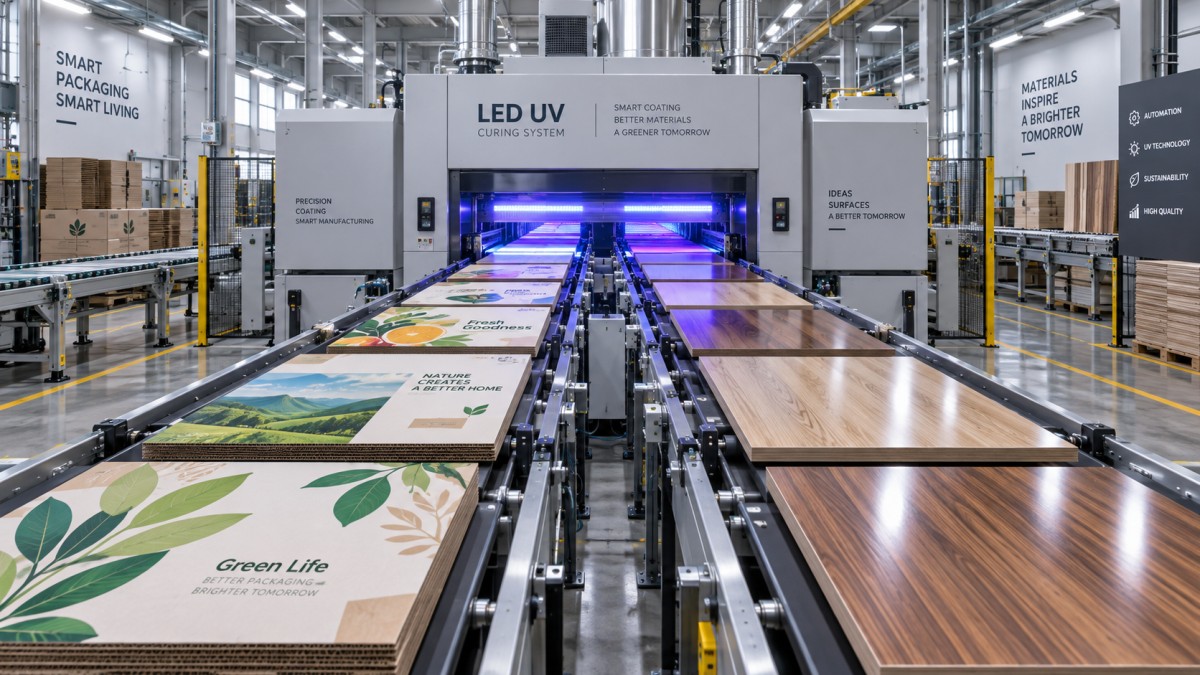
For furniture manufacturers, UV curing has become closely tied to industrial panel finishing. Cabinet doors, melamine-faced boards, veneer panels, decorative wall elements, and custom furniture components all benefit from finishes that are cured quickly and consistently. On automated lines, UV technology can support a disciplined progression from sanding and dust removal to coating, curing, inspection, and edge treatment.
The appeal is especially strong in flexible furniture manufacturing, where design variation is high but delivery expectations remain tight. A CNC router can cut a custom panel in minutes; the finishing stage cannot be allowed to reintroduce long queues. UV curing therefore fits naturally into the “digital-to-finished-part” logic of advanced panel processing.
Still, wood is not a passive substrate. Surface moisture, grain variation, resin content, sanding quality, porosity, and board temperature all influence coating behavior. Evaluators should consider whether the proposed system accommodates the actual mix of MDF, plywood, particleboard, solid wood, veneer, and engineered decorative panels used on site.
LED UV versus conventional UV: a decision with operational consequences
One of the most important developments in the UV curing system market is the expanding adoption of LED UV technology. Conventional mercury-based UV lamps remain established in many industrial applications and may offer broad spectral output suitable for familiar formulations. LED UV systems, by contrast, operate in narrower wavelength bands and generally require coatings, inks, or adhesives formulated to respond effectively at those wavelengths.
The practical attraction of LED UV includes lower heat transfer to sensitive materials, fast switching, reduced warm-up requirements, and potentially lower energy demand in suitable operating conditions. These characteristics can be meaningful for heat-sensitive films, lightweight substrates, digitally printed materials, and operations that do not run continuously for long shifts.
However, LED UV is not automatically the best answer. Existing chemistry may require reformulation, and a plant may need to qualify alternative inks, varnishes, primers, or adhesives. Some heavy-pigment, opaque, textured, or complex coatings can be more challenging to cure through depth. Conventional lamps may remain technically appropriate where formulation compatibility, line configuration, or established process knowledge favors them.
The right question is not “Which technology is newer?” It is: Which curing platform produces the required surface performance at the desired speed, with manageable operating cost and a stable supply of qualified consumables?
The real cost model extends well beyond the machine quote
A UV curing unit can look economically compelling when compared only with the footprint and apparent energy use of a thermal oven. That comparison is incomplete. A credible business case should include capital cost, installation work, electrical upgrades, extraction or ventilation needs, shielding, interlocks, conveyor modifications, controls integration, formulation changes, qualification labor, maintenance, and operator training.
In existing plants, integration is often the hidden budget line. The curing module must fit physically and functionally into a production sequence. It may affect the spacing between printing and coating stations, alter web or sheet transport, require changes to guarding, or introduce new controls logic for line stops and emergency conditions. If the line includes automated inspection, stackers, die-cutters, or robotic handling, the cure quality and material temperature must be compatible with those downstream systems.
Return on investment should therefore be measured through production economics, not energy claims alone. Useful inputs include reduced work-in-progress, faster job release, lower reject rates, less floor space devoted to drying or staging, improved finish durability, and the ability to accept work that the current process cannot handle efficiently. Conversely, if a line runs only intermittently or mostly produces low-margin work with no meaningful drying constraint, the payback logic may be weaker.
Adoption risks that deserve boardroom attention
The most expensive UV projects are often not failures of technology; they are failures of application definition. A system may be correctly built yet poorly matched to the plant’s substrate range, coating formulation, maintenance discipline, or commercial mix.
Compatibility risk sits at the top of the list. UV-curable products are part of a system, not generic liquids. Ink, coating, adhesive, primer, substrate, and curing source must work together. Switching to a different board supplier, changing pigment load, adding a matte effect, or introducing a new laminate can alter cure behavior. Procurement teams should insist on documented test conditions and acceptance criteria for each critical product family.
Heat and substrate sensitivity also require close attention. Even where UV curing is marketed as low heat, the practical thermal load depends on technology, lamp arrangement, exposure time, line speed, and material properties. Thin films, heat-sensitive boards, and moisture-variable wood composites need testing for distortion, discoloration, dimensional change, or surface defects.
Maintenance risk is frequently underestimated. Reflectors, filters, cooling systems, shutters, lamp housings, and protective glass need regular inspection and cleaning. Dust is particularly relevant in woodworking environments, where fine particles can compromise optical performance and create safety concerns if housekeeping is weak. In printing environments, ink mist and coating residues can produce similar problems over time.
Safety and regulatory risk cannot be relegated to a checklist. UV radiation exposure, ozone generation in certain lamp configurations, ventilation, fire prevention, electrical safety, and chemical handling all require engineered controls. For packaging, especially where food safety expectations apply, the curing process must be assessed alongside migration control, supplier documentation, and the final package structure. “UV cured” is not itself a compliance conclusion.
How business evaluators can make a more reliable selection
A disciplined evaluation begins with the job mix, not the vendor brochure. Map the highest-value applications by substrate, ink or coating type, target line speed, required finish properties, and downstream process. Identify where drying currently creates delays, defects, excess handling, or scheduling friction. Then distinguish between jobs that merely can run under UV and jobs that genuinely create economic value when they do.
Factory acceptance trials should include difficult work, not just ideal samples: dark or heavily pigmented designs, high-coverage coatings, matte and gloss areas, variable board lots, sharp creasing requirements, textured panels, and realistic line speeds. Evaluate adhesion, scratch resistance, odor, blocking, color consistency, gloss, cure depth, and performance after converting or assembly. In furniture applications, consider sanding and recoating behavior as well as the finished surface.
It is also wise to define ownership across functions. Production may prioritize throughput; quality teams may focus on surface performance; EHS personnel will examine shielding and ventilation; procurement will assess consumable availability; finance will ask whether utilization supports the investment. UV curing projects become more resilient when these interests are aligned before equipment specifications are frozen.
A market moving from standalone equipment to process architecture
The future of the UV curing system market will be shaped less by isolated lamp sales and more by integrated manufacturing decisions. Printers want curing systems that synchronize with high-speed offset presses and precision die-cutting. Packaging plants need stable finishes that survive folding, gluing, transport, and display. Woodworking factories are looking for surface treatment that keeps pace with CNC-driven customization and automated panel flow.
For decision-makers, the strongest opportunity lies in treating UV curing as part of a complete production architecture: material selection, color and coating control, machine kinematics, energy management, safety, maintenance, and digital workflow. The technology can shorten the distance between a creative surface concept and a shippable product. But its commercial value appears only when cure quality is repeatable, integration is thoughtful, and the operating model is built around the realities of the factory floor.
Related News
Get weekly intelligence in your inbox.
No noise. No sponsored content. Pure intelligence.
