
Commercial Web Offset Printing: When High-Volume Runs Still Outperform Digital
A purchasing decision can look straightforward on a spreadsheet: compare a digital quote with an offset quote, select the lower unit price, and move on. In practice, the choice becomes more complicated when a campaign includes millions of inserts, recurring retail catalogs, national newspaper supplements, shelf-ready packaging components, or long-lived publication programs. The apparent savings from a short-run technology can disappear once throughput, finishing, consistency, and replenishment requirements enter the discussion.
For those situations, commercial web offset printing remains more than a legacy production method. It is a disciplined industrial platform built for sustained output. When the work is stable enough to justify setup, web offset can deliver a combination that digital presses still find difficult to match at scale: low cost per finished piece, continuous production, dependable color over long runs, and integration with high-speed folding, cutting, binding, or converting.
The important word is “when.” Web offset is not automatically the right answer for every large-looking order. Procurement teams need to assess run length, artwork volatility, substrate requirements, distribution strategy, and the cost of waste—not merely compare a per-thousand price. The strongest decision is usually made before suppliers are asked to quote.
Why Long Runs Change the Economics
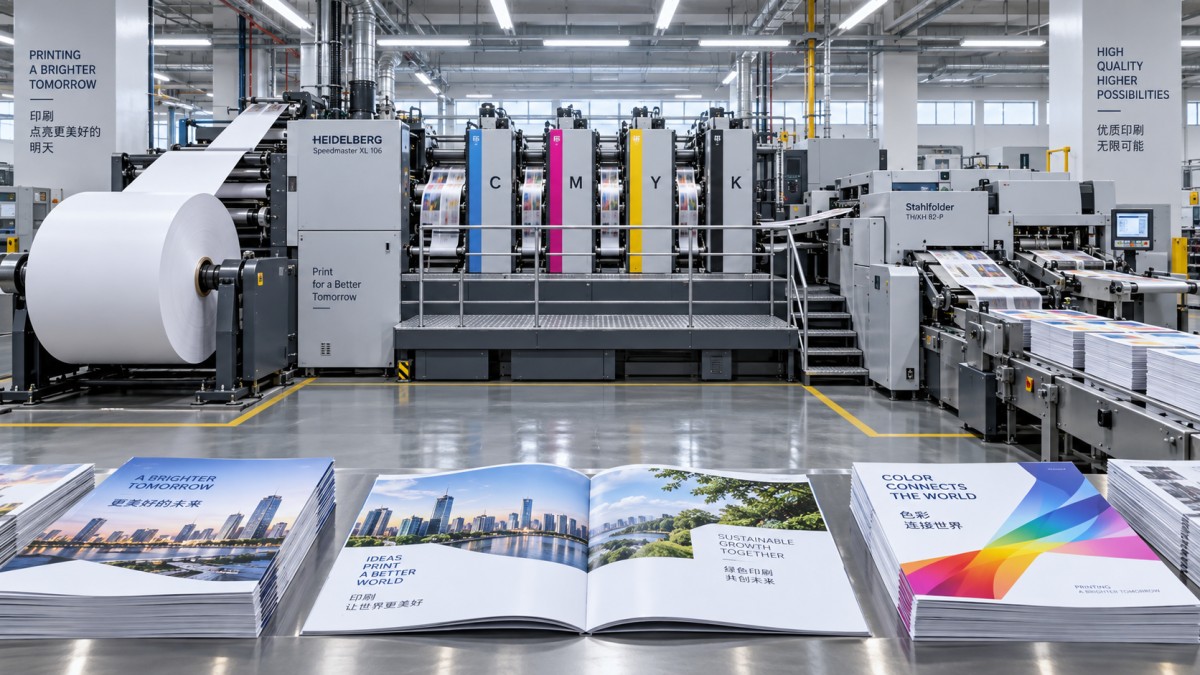
Web offset presses print on a continuous roll, or web, of paper rather than individual sheets. The process requires plates, press setup, registration adjustment, ink and dampening balance, and startup verification. These fixed preparation costs are real. They also explain why web offset can look expensive at low quantities.
Once the press is stabilized, however, the cost curve changes sharply. The same setup is spread across a very large number of impressions, while the press runs continuously and downstream equipment processes the printed web at production speed. For repeatable work, this creates a strong economic advantage. A buyer who focuses only on the first few thousand copies may miss the point: web offset is designed to make the next hundreds of thousands or millions of copies less expensive and more predictable.
That advantage is most visible where the printed item has a relatively standardized format and a consistent production rhythm. Examples include:
- High-circulation magazines, newspapers, directories, and book sections;
- Retail flyers, promotional inserts, and seasonal catalog programs;
- Large-format commercial publications with recurring editions;
- Packaging sleeves, wraps, labels, and carton components where the artwork remains stable;
- Brand campaigns requiring the same visual appearance across multiple regions or distribution waves.
In these applications, a print buyer is not purchasing isolated pages. They are purchasing a repeatable manufacturing process. The savings arise from production continuity, material utilization, and finishing integration as much as from ink placed on paper.
The Point at Which Digital Stops Being the Default
Digital printing has earned its role. It avoids plates, supports rapid changes, handles variable data, and makes short runs economically sensible. It is particularly valuable when marketing teams are still testing creative, when regional versions multiply, or when inventory risk is greater than the cost of a higher unit price.
But digital’s flexibility does not erase the value of industrial scale. When artwork is locked, personalization is unnecessary, and demand is sufficiently certain, commercial web offset printing usually becomes the stronger production candidate. The precise crossover quantity varies by page count, paper grade, color coverage, finishing complexity, delivery schedule, and local supplier capacity. A fixed “break-even number” is therefore unreliable. Buyers should request comparative estimates based on the actual finished specification rather than relying on a general industry rule.
A useful question is not, “Which technology is cheaper?” It is: Which technology produces this finished job at the lowest total operational cost with acceptable risk? That broader question often leads to a more accurate decision.
Color Consistency Is a Procurement Issue, Not Just a Prepress Detail
For consumer-facing brands, color variation can become a commercial problem. A cosmetic carton that shifts warmer between batches, a grocery insert with inconsistent product photography, or a premium furniture catalog that makes wood tones look artificial can affect perception long after the print invoice is paid.
Web offset is well suited to campaigns where color targets must remain stable over substantial quantities. Its plate-based imaging, controlled ink film, and established process-control routines support repeatable CMYK reproduction at scale. That does not mean color is automatic. Paper whiteness, ink sequence, drying conditions, image coverage, and press calibration all influence the final result. Yet a properly managed offset workflow provides a mature framework for controlling these variables.
Procurement teams should avoid accepting vague promises such as “match the proof as closely as possible.” Instead, define the approval path:
- Which proofing standard will govern the job?
- What color tolerances are acceptable for critical brand colors?
- Will the supplier provide press-pull approval or production samples?
- How will color be monitored across repeat runs and reprints?
- Are special inks, coatings, or metallic effects required—and can they be held consistently?
For brands with demanding visual systems, these questions can matter more than a small price difference. The press may be fast, but it is the discipline around registration, ink control, plate quality, and quality inspection that protects the brand.
Finishing Can Make Web Offset the More Complete Solution
A common mistake is to compare printing technologies before defining the finished product. A catalog is not merely printed pages; it may require folding, trimming, inserting, stitching, perfect binding, addressing, bundling, and distribution-ready packing. A carton component may need precise cutting, creasing, coating, or later conversion on specialized equipment.
Web-fed production often connects naturally to inline or nearline finishing. The printed web can be folded into signatures, cut, or delivered in a format optimized for the next manufacturing stage. Fewer handoffs may shorten the total production path and reduce damage, staging, and handling costs. For a procurement manager managing a launch deadline, that flow can be more valuable than a nominally lower print rate from a disconnected process.
This matters especially for packaging programs. A printed roll or sheet is only the beginning. Die-cutters, folder-gluers, inspection systems, and packing operations must all work within the tolerance established upstream. If the design contains small type, fine reverse lines, tight barcode requirements, or graphics that must register with structural features, involve the converter early. The best print technology decision is made with the full converting chain in view.
Heatset, Coldset, and the Substrate Question
“Web offset” covers more than one production environment. Buyers do not need to become press engineers, but they should know enough to ask the correct questions.
Heatset web offset uses drying systems to set ink rapidly and is widely associated with magazines, catalogs, brochures, and other coated-paper applications where strong image quality and smoother surfaces are important. It can be appropriate for premium retail communication, editorial work, and high-volume promotional pieces.
Coldset web offset relies primarily on ink absorption into the paper and is commonly associated with newsprint and uncoated stock. It is often the practical choice for newspaper-style products, circulars, and high-volume communications where economy and speed outweigh glossy reproduction.
Paper choice should not be treated as a final cosmetic decision. Basis weight, opacity, surface smoothness, moisture behavior, recycled content, and roll availability can affect print quality, show-through, postage, handling, and total cost. An ultra-light stock may reduce freight expense yet create opacity or stiffness problems. A highly coated sheet may improve photographs while increasing material cost and changing drying requirements. Ask suppliers to recommend viable alternatives, then compare the finished performance—not just the paper price.
When Web Offset Is the Wrong Choice
Clear selection also means knowing when to step away. Digital printing is generally the better route when each copy requires different content, when the campaign is still changing daily, or when only a small number of copies is needed. It can also reduce exposure when demand is uncertain and storage space is limited.
Version complexity deserves particular attention. A national campaign may seem like a high-volume web offset job until it is divided into language editions, local offers, retailer-specific covers, personalized coupons, and staggered release dates. Each version may need separate plates, setup, inventory, and approval. At some point, the supposed scale advantage breaks apart.
Likewise, a buyer should be cautious when creative files are not genuinely final. Web offset rewards planning; it does not reward late-stage indecision. Plate remakes, press interruptions, and obsolete printed stock can quickly erase the benefits of a low unit cost.
A Practical Evaluation Framework for RFQs
An effective request for quotation should give suppliers enough information to quote the entire manufacturing reality. A one-line request for “price per 10,000” encourages incomplete comparisons. Include the anticipated annual volume, release pattern, number of versions, final trim size, page count, paper options, ink coverage, special colors, finishing needs, packaging requirements, delivery destinations, and proofing expectations.
Then ask suppliers to separate fixed and variable costs. This makes the economics visible. Plate charges, setup time, makeready spoilage, paper, printing, finishing, packing, freight, and storage should not be hidden inside a single blended figure. Where possible, request prices at several quantity points and for planned call-off schedules. The result reveals whether a larger production batch is truly economical after warehousing and obsolescence risk are considered.
Look Beyond the Press: Supplier Capability Matters
Two suppliers may both offer web offset capacity, yet deliver very different outcomes. One may be optimized for fast publication work; another may have stronger color-management routines, more flexible finishing, or deeper experience with packaging substrates. Equipment alone is not the selection criterion.
During supplier evaluation, ask to understand the production control system rather than simply touring the pressroom. How are rolls inspected and conditioned? What happens when register drifts? How are defects detected, isolated, and reported? What approval is required before full production begins? How is job data retained for reprints? These details indicate whether the supplier can protect a high-volume program when normal production variables arise.
For packaging buyers, traceability and compliance may also be central. If printed materials will contact food indirectly, carry regulated information, or require responsibly sourced paper, the printer and converter must be able to document the relevant material and ink choices. Compliance should be specified at the RFQ stage, not added after the artwork is on press.
Waste, Inventory, and the More Honest Sustainability Calculation
High-volume printing often prompts questions about waste. The answer is not simply that one technology is “greener” than another. Plate production, makeready sheets, energy for drying, paper yield, transport distances, unsold inventory, and recyclability all belong in the calculation.
Web offset can be resource-efficient when volumes are accurate, press utilization is high, and production is planned around standard roll sizes and efficient impositions. It becomes less attractive when a buyer prints far beyond demand or creates multiple obsolete versions. Digital may use less setup material and support demand-led replenishment, while web offset may achieve a lower material and energy burden per copy at sustained scale. The responsible choice follows the actual program, not a slogan.
Making the Decision With Confidence
Commercial web offset printing still outperforms digital when the job combines large, reliable volume with stable artwork, controlled color requirements, and a production route that benefits from continuous finishing. It is especially compelling when every additional copy must cost less without allowing the brand appearance to drift.
For procurement teams, the decision should rest on total delivered value: finished unit cost, approval confidence, production speed, inventory exposure, compliance, and the ability to repeat the result next month or next year. That is where a carefully specified web offset program earns its place.
PWFS follows the equipment and production systems behind these decisions—from precision offset presses and color-registration control to die-cutting, folder-gluing, and automated packaging conversion. For buyers sourcing high-volume printed products, understanding how these linked operations perform together is often the difference between buying print capacity and buying a dependable manufacturing outcome.
Related News
Get weekly intelligence in your inbox.
No noise. No sponsored content. Pure intelligence.
