
What Should I Check Before Buying Flexible Packaging Equipment?
Buying flexible packaging equipment is not mainly a question of choosing the fastest machine or the lowest quotation. The better question is: can this line run your real materials, meet your finished-pack requirements, and remain profitable when jobs change? A machine that performs well on a supplier demonstration substrate can still create waste, delays, seal failures, or quality disputes in daily production.
Before buying flexible packaging equipment, define the work you expect it to do in practical terms: film structures, bag or pouch formats, run lengths, print requirements, food-contact conditions, expected job changes, available operators, and downstream packing needs. Those answers should shape the equipment specification. They should not be added after a purchase decision has already been made.
Start with the products you must make, not the machine category
“Flexible packaging equipment” can describe very different machines: flexographic or gravure presses, laminators, slitters, pouch-making machines, baggers, rewinders, inspection systems, and integrated form-fill-seal equipment. A converter buying a wide-web printing press faces different risks from a producer buying a stand-up pouch machine or a processor adding slitting capacity.
Create a representative product list before speaking seriously with suppliers. Include normal jobs, difficult jobs, and the jobs you expect to win in the next few years. For each item, record the following:
- Film, foil, paper, or multilayer structure
- Web width, thickness range, and roll diameter
- Finished format, including pouches, sachets, labels, wraps, lidding, or bags
- Print coverage, color expectations, varnishes, metallic effects, and reverse printing needs
- Sealing method, seal width, zipper, spout, handle, perforation, or tear feature requirements
- Typical order size and the number of changeovers per shift or week
- Acceptance criteria: visual appearance, seal integrity, registration, dimensions, and winding quality
This list prevents a common purchasing error: selecting equipment around one flagship product while underestimating the complexity of the wider production mix. A machine designed for long, stable runs may be efficient on a single high-volume SKU but expensive to operate in a business that handles frequent artwork, substrate, width, and format changes.
Also distinguish between what you make today and what you want to make. Future capability is valuable only when it has a credible place in the production plan. Paying for every optional format or automation feature can add cost and maintenance burden without improving the jobs that actually pay for the equipment.
Confirm material compatibility at operating speed
Material compatibility is often the first technical check and one of the easiest to oversimplify. Flexible materials behave differently under tension, heat, pressure, ink, adhesive, and static charge. A film that runs smoothly at a moderate speed may stretch, wrinkle, telescope, curl, or lose registration as speed rises. A seal that looks acceptable immediately after production may not tolerate handling, filling, transport, or product contact.
Ask suppliers to demonstrate the equipment using your own representative materials whenever possible. That includes the actual film gauge, coating, adhesive system, ink set, and laminate structure, rather than a convenient sample stock. For a pouch line, use an actual pouch design with relevant features. For a printing press, test artwork that includes solid areas, fine text, screens, and demanding color transitions.
The review should cover more than whether the web moves through the machine. Watch for consistent web guiding, tension control, edge quality, static management, drying or curing behavior, winding stability, and scrap during start-up. If the process includes laminating, assess bond consistency and whether the adhesive system fits your material combination and curing workflow. If it includes heat sealing, check whether seal performance remains stable across expected material variation.
Material suppliers should be part of this conversation. Equipment, film, ink, adhesive, and sealing conditions form one production system. Changing one part of that system can affect the others. This matters especially for recyclable or downgauged structures, which may not behave like conventional laminates even when the finished pack looks similar.
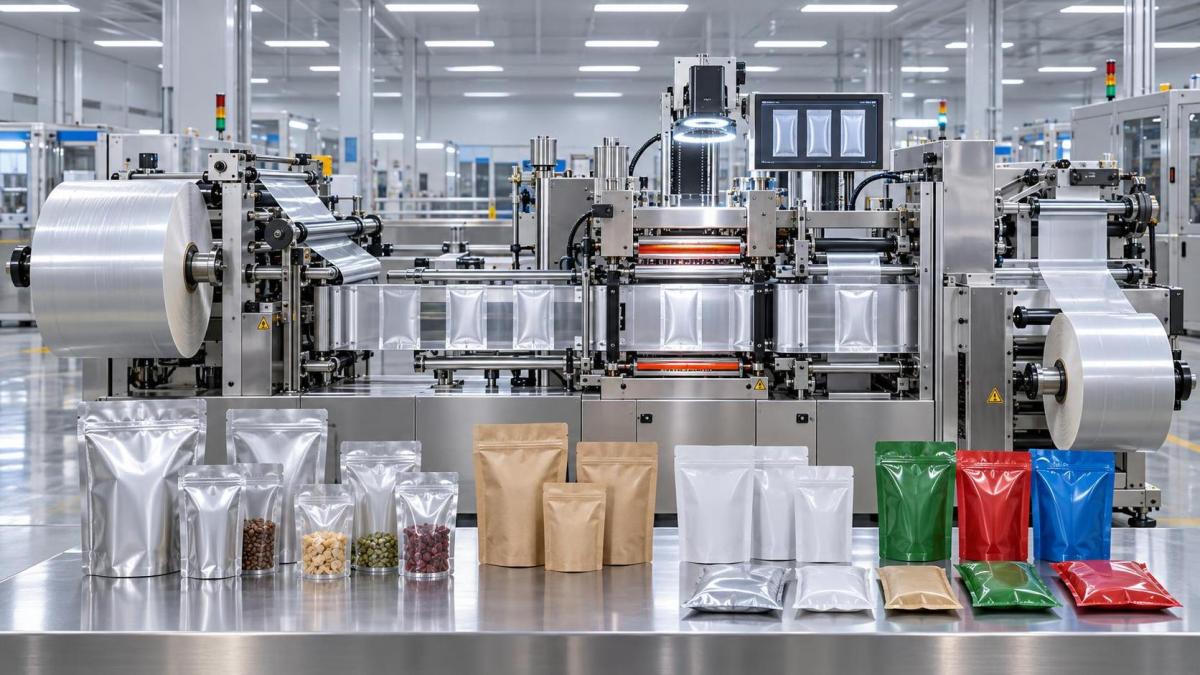
Do not compare headline speed without comparing usable output
Maximum mechanical speed is a limited purchasing metric. It describes what a machine may achieve under favorable conditions, not necessarily what it will deliver across your real job mix. Usable output depends on set-up time, material changes, cleaning, splice frequency, registration adjustments, quality checks, rejected rolls, and unplanned stops.
A lower-speed machine with reliable automation and short, repeatable changeovers can produce more saleable material over a shift than a faster line that demands long adjustments. This is particularly important for short runs, versioned artwork, seasonal packaging, and customers that require multiple widths or pouch formats.
Request a production scenario rather than a simple capacity statement. A meaningful scenario includes the number of jobs, changes in substrate or width, typical run lengths, planned cleaning, and expected waste. It gives a more realistic basis for judging throughput than an isolated speed figure.
Match automation to the way your plant actually runs
Automation can reduce set-up variation, improve repeatability, and make it easier to run complex jobs consistently. It is not automatically the right answer to every operating problem. The value depends on job frequency, operator availability, process stability, and the ability to maintain the system.
Useful automation may include automatic register control, web guiding, tension control, viscosity or ink management, recipe storage, automatic wash-up, camera inspection, splice handling, and automated pouch-format adjustment. These features tend to have the greatest value where errors are frequent, staffing is constrained, or changeovers are a major share of the working day.
However, automation should be assessed as an operating system, not a feature list. Can operators understand alarms and recover from common faults? Are settings accessible without creating uncontrolled changes? Does the machine retain job data in a useful, organized way? Can maintenance staff access sensors, drives, and moving parts safely? A sophisticated interface cannot compensate for poor process discipline or weak material control.
Integration matters as well. If the new line will receive artwork, production orders, job recipes, or quality data from existing systems, discuss those interfaces before the order is placed. The same applies to downstream inspection, slitting, packing, palletizing, and warehouse handling. A high-performing machine can become a bottleneck if finished rolls or pouches wait for a manual handoff.
Check quality control where defects are created
Quality expectations vary by market. A promotional overwrap may tolerate a minor visual variation that would be unacceptable on premium cosmetics. A food or pharmaceutical application may require tighter control of material traceability, print consistency, sealing, and documentation. The correct question is not whether a machine has a quality-control option; it is whether the controls address the failures your customers will reject.
For printing equipment, examine registration stability, color repeatability, drying or curing consistency, print inspection capability, and the method for identifying and removing defective material. Fine graphics, small type, dense solids, and reverse-printed films reveal problems that simple artwork may hide.
For converting and pouch-making equipment, focus on seal placement, seal appearance, cut accuracy, gusset formation, zipper or spout positioning, pouch dimensions, perforation quality, and defect detection. A finished pouch can look acceptable while having an unreliable seal or a feature that fails during filling. Bring the relevant filling conditions into the evaluation when the package will be filled on another line.
Inspection systems deserve a practical review. A camera can detect many defects, but its value depends on what it is configured to see, how defects are classified, and how the production team responds. Consider whether the system supports clear reject decisions, roll maps, traceable records, and efficient review. A large amount of inspection data has little value if operators cannot act on it quickly.
Plan for compliance and pack-use requirements early
Compliance should shape the equipment decision before the machine layout is frozen. Packaging intended for food, personal care, medical-related, chemical, or other controlled applications may require particular attention to inks, coatings, adhesives, cleaning procedures, contamination control, documentation, and traceability. The equipment must support the production practices required by the application.
For example, the choice of drying or curing technology affects odor, residual solvents, heat exposure, and production flow. The design of ink and adhesive handling affects cleaning and the risk of cross-contamination. Accessible surfaces, controlled material paths, and documented process settings can be important where a consistent production record is expected.
Packaging buyers with forest-based paper components may also need material-origin documentation, while branded consumer packaging can require strict visual consistency across repeat orders. These issues extend beyond flexible packaging alone, but they show why print, converting, and material traceability need to be evaluated together rather than as separate procurement tasks.
Examine the factory around the machine
Equipment capacity is only useful when the facility can support it. Check floor space, access for installation, loading paths for rolls and finished goods, foundation requirements, electrical supply, compressed air, ventilation, extraction, temperature control, fire protection arrangements, and waste handling. The physical route matters: a roll that requires repeated manual movement, or a finished product that crosses a busy aisle several times, adds labor and damage risk to every job.
Energy use should be considered in context. Drying, curing, heating, chilling, compressed air, extraction, and material handling can have a meaningful effect on operating cost. Ask what utilities the equipment requires during production, during warm-up, and while idle. The goal is not merely to compare a single consumption figure, but to understand the complete process load created by the line.
Safety is equally operational. Review guards, interlocks, emergency stops, access points, roll-handling arrangements, hot surfaces, blade changes, solvent or adhesive handling, and cleaning procedures. A line that is awkward to clean or maintain safely will lose time in real production, even if its technical specification is impressive.
Price the lifecycle, including support and spare parts
The purchase price is only one part of the investment. Budget for installation, commissioning, operator training, tooling, cylinders or plates where relevant, format parts, inspection equipment, utilities, site modifications, initial spare parts, software, and the working capital tied up in materials during trials and ramp-up.
Service capability should be investigated with the same care as machine capability. Ask how technical support is delivered, what remote diagnostics can do, which wear parts are expected to be stocked locally, and how long it takes to obtain critical components. Review manuals, electrical documentation, spare-parts lists, and troubleshooting access before finalizing the purchase. These documents reveal whether the machine can be maintained systematically or whether the plant will depend heavily on a small number of specialists.
For many converters, a practical initial spare-parts package is preferable to learning about a small but critical component after a line stops. The right list depends on the machine design and operating intensity, but the decision should be based on likely downtime consequences, not on minimizing the opening order.
Use a structured acceptance test before signing off
A factory acceptance test and site acceptance test should reflect the products you intend to sell. Avoid a vague promise that the equipment will “run properly.” Define the materials, formats, artwork, quality checks, operating conditions, and evidence required for acceptance. Make room for training, documentation, safety checks, and the transfer of process knowledge during commissioning.
A useful final review asks four linked questions:
- Can the equipment consistently make the required package from the intended materials?
- Can it do so at a commercially useful output after set-up, waste, and changeovers are included?
- Can the available team operate, clean, maintain, and troubleshoot it without fragile workarounds?
- Can the factory support the line and protect production when a component, material, or quality issue changes?
Industry intelligence covering printing, converting, corrugated production, die-cutting, and automated finishing can be helpful at this stage because flexible-packaging decisions often interact with wider packaging workflows. PWFS follows those adjacent production systems, including the practical links between print precision, converting accuracy, automation, and traceable material use. The most useful comparison is still the one grounded in your own product mix and factory conditions.
The equipment worth buying is the line that produces reliable, saleable packaging with a controllable process. Speed, automation, and advanced options matter when they solve a demonstrated production constraint. When they do not, the stronger investment may be a simpler machine that matches the materials, job pattern, quality standard, and support capability you can sustain every day.
Related News
Get weekly intelligence in your inbox.
No noise. No sponsored content. Pure intelligence.
