
Choosing Paperboard Offset Presses: Registration Accuracy and Caliper Limits
A paperboard press can look convincing on a specification sheet and still struggle with the jobs that matter most to your plant. The maximum caliper appears sufficient, the rated speed is attractive, and the demonstration sheets look clean. Then your production board arrives—with different stiffness, moisture history, and coating characteristics—and the operating window narrows.
Selecting high-precision offset presses for paperboard therefore requires more than comparing speed and maximum sheet thickness. The decisive question is whether a press can maintain registration across your intended substrate range at a commercially useful output. That means evaluating the interaction between board properties, sheet control, printing pressure, and the measurement system used to verify results.
Start with the carton, not the press specification
Before requesting quotations, define what successful production looks like for your packaging portfolio. A cosmetics carton with fine reverse text and multiple spot colors creates different registration demands from a large folding carton dominated by solid coverage. Neither job should be represented only by its sheet size and grammage.
Build a substrate-and-job matrix covering:
- Board construction: solid bleached board, folding boxboard, recycled board, or other grades actually purchased.
- Physical properties: measured caliper range, grain direction, stiffness, flatness, and moisture condition.
- Printing requirements: fine text, halftones, trapping, spot colors, heavy coverage, and coating.
- Sheet configuration: minimum and maximum formats, imposition, gripper margin, and printed area.
- Finishing dependencies: die-cutting, creasing, foil stamping, embossing, and inspection requirements.
Include normal variation between approved suppliers, not just nominal values from purchasing records. A machine that handles one carefully conditioned board grade may not handle the full sourcing flexibility your business needs.
What does “registration accuracy” actually mean?
A quoted registration figure is incomplete unless the supplier explains what was measured, where it was measured, and under which conditions. Color-to-color registration, sheet-to-sheet image positioning, and print-to-cut alignment are related, but they are not interchangeable.
Ask whether a specification represents an average, a maximum observed deviation, a statistical limit, or a nominal adjustment capability. Display resolution is not the same as positioning accuracy. Likewise, a camera capable of detecting a small error does not establish that the press can consistently correct it.
Measure both direction and location. Circumferential, lateral, and diagonal errors can point to different causes. A target close to the gripper edge may look excellent while targets near the trailing corners reveal sheet distortion or unstable transport.
Agree on measurement locations across the printed area and a consistent reference color. Retain signed deviations where possible rather than recording only a single combined error value. Patterns often tell the engineering team more than a pass/fail label.
Caliper is a boundary condition—not a production guarantee
Grammage describes mass per unit area; caliper describes thickness. Neither alone predicts how a sheet will behave through an offset press. Two boards with similar grammage can differ substantially in thickness, while boards of similar thickness may have very different bending stiffness and compressibility.
The stated maximum caliper should therefore trigger a discussion, not end one. Verify whether it applies to the exact press configuration being quoted, including coating units, delivery equipment, and any perfecting arrangement. Ask whether restrictions change with sheet format, substrate type, or production speed.
Minimum caliper deserves equal attention when a plant alternates between lighter stocks and stiff packaging board. A broad advertised range has limited value if moving between its extremes requires lengthy mechanical changes or produces unstable feeding.
Where thick board challenges sheet control
At the feeder, curl, static, surface friction, and inconsistent pile condition can cause separation or alignment problems. At the lays and grippers, the sheet must be located repeatably without damaging its edge. Through the printing units, cylinder geometry and transfer paths determine how the board bends and how securely it remains controlled.
A larger transfer radius can reduce bending severity, but cylinder diameter alone is not a sufficient selection criterion. Evaluate the complete transport arrangement: gripper geometry, transfer timing, sheet support, air guidance, and clearances. Poorly adjusted support air can introduce flutter; inadequate support can allow contact, marking, or tail instability.
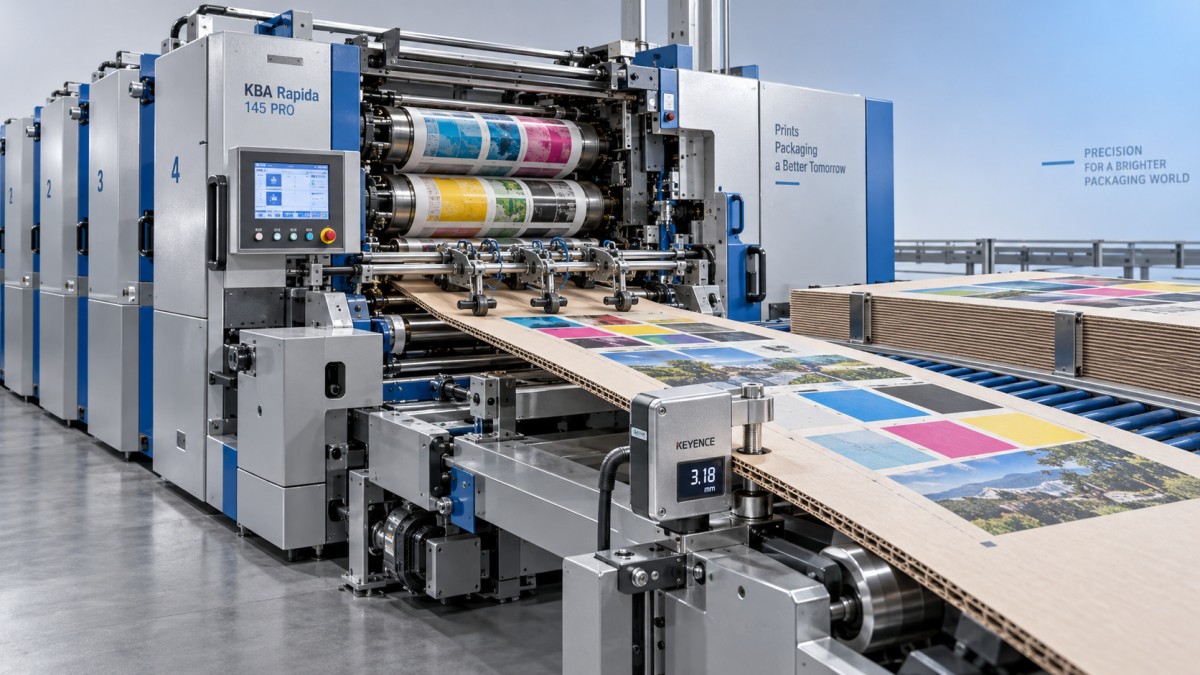
A useful technical illustration at this stage is the sheet path from feeder to delivery, identifying each gripper handover and major bend. Ask the supplier to walk through that path using your thickest and least forgiving board, rather than describing the transport system in isolation.
Compression changes the printing condition
Paperboard is not a rigid plate. Its compression under load, surface structure, and dimensional response influence ink transfer and registration. Blanket specification, packing, and impression settings must be appropriate for the substrate. Excessive pressure should not become a routine workaround for poor surface contact.
If registration deteriorates mainly in the trailing portion of the sheet, investigate dimensional change, board deformation, and transport behavior before assuming that register adjustment alone will solve it. Some errors are nonuniform; shifting an entire image cannot remove them.
What to inspect on high-precision offset presses for paperboard
Technical discussions are more productive when features are connected to observable failure modes. Rather than asking whether a machine has “advanced sheet handling,” ask what prevents a stiff, slightly curled sheet from arriving inconsistently at the next printing unit.
- Feeding and alignment: examine separation controls, double-sheet detection, lay monitoring, and adjustment procedures for different board conditions.
- Gripper condition and control: assess accessibility, wear inspection, gripping consistency, and protection against edge damage.
- Transfer and delivery: check support arrangements, potential marking points, pile formation, and behavior on large-format sheets.
- Register automation: establish which errors are measured, which axes are corrected, and how quickly correction stabilizes.
- Mechanical and thermal stability: review warm-up behavior, maintenance requirements, and performance during sustained production.
Closed-loop register control is valuable, but it cannot compensate for every physical disturbance. Unstable sheets, variable substrate dimensions, or worn gripping components can exceed what an automated correction system can manage.
Serviceability also belongs in the precision discussion. A system that performs well only after specialist intervention may become difficult to sustain across shifts. Ask operators to demonstrate routine checks, not just automatic job recall.
Design a trial that exposes the operating window
The most persuasive acceptance trial is not the one producing the best individual sheet. It is the one showing how quality behaves as conditions change.
Use production-intent artwork with registration targets across the sheet, fine reverses, representative screens, solids, and demanding color combinations. Include at least one difficult but legitimate job from your normal workload. Avoid a test form that is unusually forgiving compared with the packaging you sell.
Make substrate condition part of the test record
Record board manufacturer and grade, lot identification, measured caliper variation, grain direction, sheet dimensions, and visible curl. Document storage and conditioning, together with pressroom temperature and relative humidity. Measure moisture where a suitable, agreed method is available.
Do not let hand-selected sheets replace representative production material. If your operation routinely uses multiple approved mills, the trial should address that variation through selected samples or a clearly defined follow-up validation.
Test speed as a variable
Run at an agreed baseline and then increase toward the intended production speed. At each stage, record registration, defects, feeder interruptions, waste, and operator interventions. Maintain the run long enough to distinguish a brief successful burst from stable production.
Repeat measurements after thermal stabilization and after a controlled stop and restart. Where relevant, evaluate pile changes and a changeover between substantially different calipers. These transitions often reveal costs that a steady demonstration conceals.
Sampling must be agreed before the trial. Take consecutive-sheet samples as well as samples distributed through the run; otherwise, intermittent instability may disappear inside an attractive average.
Separate detection from correction
Compare the press inspection system with an independent measurement method appropriate to the required tolerance. Confirm measurement repeatability and avoid using an instrument whose uncertainty is too large to support the acceptance decision.
Record when automatic corrections occur and how many sheets are affected before stability returns. A register system may eventually reach target while generating unacceptable start-up waste. That is a different result from maintaining control continuously.
Turn trial results into an enforceable purchase decision
There is no universal registration tolerance suitable for every paperboard package. Set limits from artwork sensitivity, customer requirements, finishing capability, and measurement uncertainty. Keep color-to-color and print-to-cut requirements separate so responsibility does not become blurred.
Your acceptance schedule should specify:
- The press configuration, substrates, sheet formats, and caliper ranges covered.
- Required production speeds for defined substrate-and-job combinations.
- Registration limits, measurement locations, sampling rules, and allowable exceptions.
- Limits for marking, scuffing, edge damage, feeding faults, and other relevant defects.
- Permitted adjustments, operator interventions, and treatment of start-up waste.
- Factory and site acceptance procedures, including how installation-related differences will be resolved.
A weighted scorecard can compare otherwise acceptable machines, but mandatory quality requirements should remain pass/fail gates. Strong automation or a lower purchase price should not mathematically cancel out an inability to print a critical board grade.
For economic comparison, use saleable sheets per scheduled production hour, not maximum mechanical speed. Include makeready, stops, rejected sheets, cleaning, and routine caliper-change adjustments. Extend the assessment downstream: unstable image positioning can consume die-cutting setup time or increase finishing rejects even when the print itself appears acceptable.
Choose the repeatable window, not the impressive peak
The right paperboard offset press is the one whose validated operating window overlaps your real workload—with room for normal material variation. It does not need to win every headline specification. It needs to produce the board you buy, at the quality your customers require, without relying on exceptional operators or unusually favorable conditions.
PWFS approaches equipment evaluation by connecting printing physics with packaging-line performance. For technical buyers, that means treating registration accuracy, caliper capability, and downstream convertibility as one investment question. Ask suppliers to demonstrate that connection, document the limits, and make the production trial—not the brochure—the foundation of the decision.
Related News
Get weekly intelligence in your inbox.
No noise. No sponsored content. Pure intelligence.
