
Beam Saw or CNC Router: Evaluating Throughput, Material Yield, and Rework
A cutting department can appear fully automated while still creating avoidable cost in the places that matter most to a buyer: queue time, offcut inventory, damaged edges, manual handling, and parts that return for correction. The decision between a beam saw and a CNC router should therefore begin with the part mix, not with headline machine specifications.
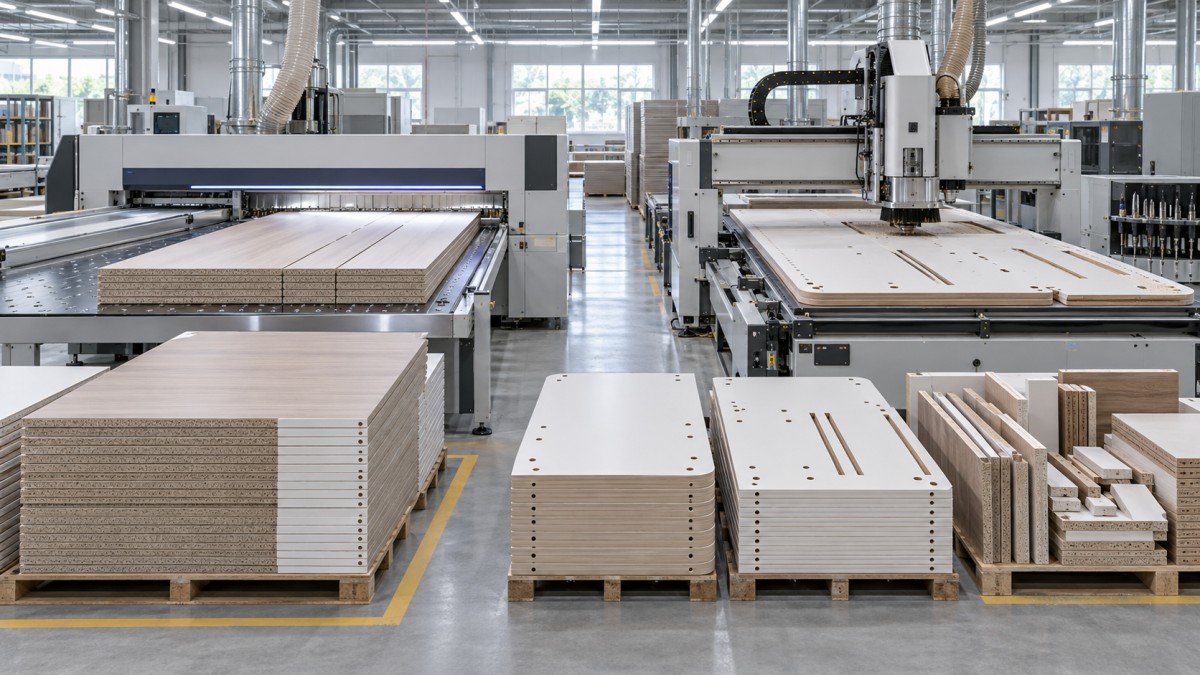
Both machines can process sheet goods, but they organize production differently. A beam saw is designed around rapid, repeatable panel breakdown. A CNC router combines cutting with contouring, drilling, pockets, grooves, and shaped geometry. Where one production order consists mainly of rectangular cabinet components, shelves, sides, backs, and doors, the beam saw often creates a simpler material flow. Where the same order includes variable shapes, machining features, cutouts, and frequent design changes, routing may remove secondary operations.
For procurement teams, the central question is not which machine is more capable in isolation. It is which process produces the required parts with the least combined burden of labor, material loss, scheduling friction, quality risk, and rework.
Start with the parts leaving the department
Machine comparisons often begin with cutting speed, spindle power, saw carriage design, or software features. Those factors matter, yet they become meaningful only after the buyer understands the parts being produced. A purchasing specification should separate the part family into at least four groups: rectangular cut-to-size components, repeated formats, shaped or nested components, and panels requiring machining after cutting.
A beam saw is generally strongest when the work consists of repeated rectangular parts cut from standard panels. The machine can optimize cut sequences, make crosscuts and rip cuts efficiently, and support a predictable flow into edge banding, drilling, or assembly. The economics tend to improve when panel volumes are high and dimensions repeat often enough for batches to be organized around material type, thickness, finish, or order family.
A CNC router becomes more relevant when panel geometry is not limited to straight rectangular cuts. Curves, internal cutouts, sink openings, appliance openings, shaped doors, grooves, dados, drilling patterns, and engraved identification features can be processed in one programmed setup. This can reduce the number of times a part is moved between departments, even if the pure panel-breakdown cycle is slower than a dedicated saw.
The same factory may need both approaches. A high-volume cabinet producer might use a beam saw to break down standard carcass components and reserve router capacity for doors, custom pieces, and parts with integrated machining. A smaller operation with highly variable output may prefer a router-centered workflow because fewer transfers and fewer dedicated stations can be easier to manage.
Throughput is a flow measurement, not a speed claim
Buyers sometimes compare a quoted saw cutting speed with a router feed rate and assume the faster figure identifies the higher-output option. This is rarely enough. Throughput should be measured from the time raw sheets enter the cutting area until correctly identified, accepted parts are ready for the next operation.
For a beam saw, throughput depends on more than the saw stroke. It includes panel loading, stack handling where applicable, cutting pattern efficiency, trim cuts, label application, offload procedures, and the time needed to sort parts into downstream batches. A saw can cut quickly but still create delays if operators must repeatedly search for parts, separate mixed stacks, or correct labels.
For a CNC router, the cycle includes sheet loading, vacuum setup, tool changes, spindle cutting, drilling operations, unloading, tab removal where used, and cleaning of smaller nested parts. Toolpath design has a major influence. A program that minimizes travel moves and avoids unnecessary tool changes may improve actual output more than a modest increase in programmed feed rate. Conversely, a complex nesting program can make a router appear productive on a utilization report while leaving operators with slow cleanup and sorting work.
Capacity planning should also account for the constraint after cutting. Installing a faster saw does not improve delivery performance if edge banding, drilling, sanding, or assembly is already the bottleneck. Similarly, moving complex work to a router may reduce pressure on several secondary stations but create a new constraint in programming, tool management, or vacuum hold-down setup.
A useful purchasing exercise is to map a representative week of work rather than select a single “typical” job. Include urgent replacements, low-volume custom orders, common production runs, and parts that are routinely remade. This exposes whether the proposed machine will be productive during normal variation, not only during an idealized batch.
Material yield requires more than a nesting percentage
Material yield is often discussed as the percentage of a sheet converted into usable parts. That figure is important, especially for expensive decorative boards, laminated panels, veneered sheet, and materials with limited availability. Yet a high nesting percentage does not automatically equal low material cost.
Routers are commonly associated with nesting because software can arrange multiple shapes across a sheet. For irregular components, this can use the sheet area effectively. The calculation must include cutter diameter, spacing between nested parts, entry and exit strategies, holding tabs if required, and any sacrificial spoilboard consumption. Small offcuts may also be difficult to reuse, even if the layout reports low waste.
Beam saw optimization works differently. It normally produces strips and rectangular remnants through guillotine-style cutting patterns. This can generate reusable offcuts when the production planner has visibility of future demand and uses disciplined remnant storage. Without that discipline, a saw may produce a growing inventory of pieces that are technically usable but operationally forgotten.
Material decisions should consider usable yield rather than theoretical yield. Buyers can ask: Can the remaining pieces be identified, stored without damage, and called back into future optimization? Are grain direction, surface protection, defect zones, and color matching constraints included in the cutting plan? Does the layout create pieces too narrow for later processing? A small nominal gain in yield has little value if it creates remnants that cannot reliably return to production.
Panel quality also changes the equation. Bowed, damaged, or inconsistent sheets can be difficult to hold flat on a router vacuum table, particularly when the final nested parts are small. A beam saw may handle such material differently, but surface condition, laminate chipping, and stack alignment remain relevant. Procurement specifications should describe the actual materials being processed, including thickness range, surface sensitivity, panel flatness expectations, and whether protective films are present.
Rework often reveals the real process cost
Rework is not limited to recutting a visibly incorrect part. It includes the labor spent investigating missing panels, reprogramming jobs, replacing chipped components, correcting mislabeled parts, cleaning router tabs, re-machining holes, and expediting replacement material. These costs can spread across cutting, edge processing, assembly, installation, and customer service.
Beam saw rework risks often arise from cut-list control, panel orientation, trimming allowances, saw blade condition, pressure settings, and part identification. A clean square cut is valuable because downstream machinery is frequently configured around accurate reference edges. If a part is incorrectly labeled or mixed into the wrong batch, the problem may not surface until edge banding or assembly.
Router rework has a different profile. Common sources include incorrect tool offsets, worn cutters, insufficient vacuum hold-down, inaccurate spoilboard surfacing, toolpath errors, poor chip evacuation, and parts moving as the final perimeter cut is completed. Some issues are immediately visible; others, such as a drilled feature in the wrong location or a shallow pocket, may travel further through production before detection.
When reviewing the beam saw and CNC router process comparison, procurement teams should focus on where each operation begins and ends, rather than treating saw cutting and routing as interchangeable methods. The most suitable process is often the one that removes a handoff or inspection point without introducing a different failure mode that the plant is not equipped to control.
Define rework in the acceptance plan
A machine acceptance plan should go beyond demonstration cuts. It should require representative parts in the materials the plant actually uses, including finished surfaces where relevant. The buyer can define inspection criteria for dimensions, squareness, edge condition, hole position, groove depth, orientation, label accuracy, and part traceability. If the equipment will feed an edgebander or drilling cell, acceptance parts should pass through those operations as well.
The test should also include a realistic changeover. A machine may perform well on a carefully prepared demonstration file but show a different result when operators switch from white melamine cabinet sides to grain-sensitive decorative panels or parts with nonstandard machining. The quality of software integration, program revision control, and operator workflow may influence the result as much as mechanical capability.
Labor, programming, and maintenance belong in the purchase model
A beam saw and a CNC router distribute labor differently. Saw operations may require strong discipline in material staging, cut-list management, part sorting, and the handoff to downstream equipment. Router operations can require more programming control, tooling knowledge, vacuum management, and attention to machine setup. Automation can reduce handling in either process, but it also increases dependence on preventive maintenance and reliable fault recovery.
Buyers should request a clear description of routine tasks: blade or cutter changes, calibration checks, spoilboard surfacing, dust extraction requirements, lubrication, cleaning, software backups, and response procedures after a damaged tool or interrupted job. A process that looks efficient on paper can become costly if routine maintenance requires specialized support that is unavailable during normal operating hours.
Dust collection deserves particular attention. Router cutting can generate substantial fine dust and chips, while saw cutting also requires effective extraction to protect cut quality, maintain visibility, and support reliable operation. The existing extraction system, electrical supply, compressed air capacity where required, floor space, panel loading route, and waste handling arrangement should be reviewed before equipment is ordered.
Build a decision around the dominant source of value
A beam saw is usually easier to justify when the plant’s dominant need is fast, accurate breakdown of repeated rectangular panels and when downstream machining is already available or unnecessary. It can support orderly batch production, predictable part dimensions, and a material flow suited to cabinet and furniture components.
A CNC router may be the stronger choice when the highest-value work involves shaped panels, integrated drilling, cutouts, grooves, and frequent variation that would otherwise create multiple setups. Its value comes from consolidating operations, provided the organization can manage nesting, tooling, dust extraction, programming, and quality verification.
Before issuing a purchase order, compare the two options using the same set of representative jobs and the same definition of finished output. Count labor touches, remnant usability, tooling and consumables, downstream queue time, inspection effort, and the likely cost of correcting an error. That approach compares parts before machines—and gives procurement teams a more reliable basis for selecting the process that fits the production system they actually operate.
Related News
Get weekly intelligence in your inbox.
No noise. No sponsored content. Pure intelligence.
