
Corrugated Industry Solutions: How to Cut Waste Across Converting and Printing
Corrugated Industry Solutions: How to Cut Waste Across Converting and Printing
Corrugated industry solutions are redefining how project leaders control waste, quality, and throughput across converting and printing operations. From board production and color registration to die-cutting, folding, and gluing, every process step can create costly material loss when equipment, production data, and daily workflows are disconnected. The difficult part is that waste rarely has one obvious cause. A board warp may begin with moisture variation, become visible during printing, and turn into registration loss or poor die-cut accuracy further downstream.
For an engineering or project lead, the practical question is not simply which machine runs faster. It is how the line behaves as a system: how paper is conditioned, how jobs are scheduled, how operators receive quality feedback, how defects are contained, and how reliably the process returns to specification after a changeover. A lean corrugated plant is built around stable interfaces between these steps, not around isolated speed records.
This matters especially as e-commerce packaging becomes more varied. Plants are expected to process shorter runs, more SKUs, changing flute combinations, demanding graphics, and box designs that use less material without sacrificing compression performance. The answer is usually not to eliminate every manual task. It is to remove avoidable variation, make exceptions visible earlier, and automate the repetitive decisions that consume paper, ink, adhesive, time, and operator attention.
Waste Begins Before the Converting Line
Most scrap is counted at the end of the process, but many of its causes enter at the corrugator. Board quality is influenced by liner and medium selection, roll storage, preheating, steam condition, adhesive preparation, web tension, and the relationship between machine speed and drying capacity. If these variables drift, the plant may still produce sheets that appear acceptable at the stacker. The problem emerges later when the board changes shape, cracks on a score, absorbs ink unevenly, or no longer feeds consistently through a converting machine.
A project should therefore define board quality in operational terms rather than relying on a vague “good sheet” judgment. Relevant measures may include caliper consistency, moisture profile, flatness, bond quality, score response, and the condition of trimmed edges. The appropriate tolerances depend on flute type, grade, print process, storage environment, and the downstream equipment involved. What is acceptable for a plain shipping case may not be stable enough for a high-graphics display carton.
The most useful intervention is often a shared quality language between corrugating and converting teams. When a folder-gluer operator reports fishtailing, open glue seams, or inconsistent fold position, the issue should not automatically be treated as a gluer adjustment. The team needs a traceable route back to board batch, production time, moisture condition, score settings, and job parameters. That is the foundation of effective corrugated industry solutions: connecting cause and effect across departmental boundaries.
Control moisture and warp as production variables
Warp is frequently managed as an inconvenient symptom, yet it is also a planning signal. A plant that sends unstable board into printing or die-cutting is effectively transferring risk into more expensive processes. Operators may compensate by slowing the feeder, increasing setup sheets, or repeatedly adjusting side guides and impression settings. Those actions keep the job moving, but they hide the root cause and make true waste difficult to measure.
Projects should review the full moisture path: incoming paper storage, warehouse temperature and humidity, web conditioning, adhesive application, drying, cooling, and the time board remains between the corrugator and conversion. A sudden change in ambient conditions can affect both board behavior and print results. The right response is not always a capital project. In some plants, clearer material staging rules, defined conditioning time, and better communication between shifts remove a large part of the variability.
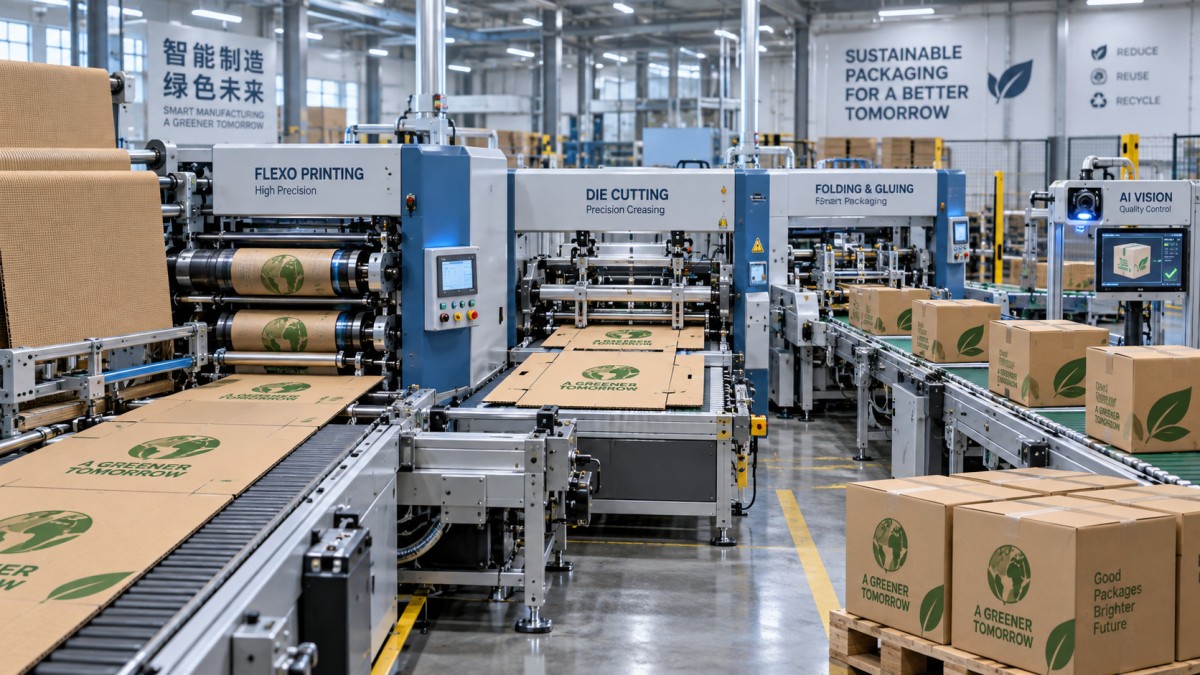
Make Printing Waste Visible, Not Inevitable
Printing loss is often concentrated around start-up, job changeover, color matching, registration correction, and defect discovery after a substantial number of sheets have already run. In flexographic corrugated printing, board surface variation and plate mounting quality can influence print consistency. In offset-related packaging workflows, precise sheet handling, ink-water balance, registration, and substrate stability become equally decisive. The printing method differs, but the operational principle is the same: detect drift before it becomes a pile of nonconforming material.
A useful project review separates three categories of waste. Setup waste is material consumed while reaching approved production conditions. Running waste comes from defects during stable production. Decision-delay waste occurs when a defect exists but is not recognized, classified, or acted on quickly enough. The third category is often underestimated because the line may continue operating while samples wait for inspection or supervisors debate an acceptable limit.
Automated inspection can support earlier detection of registration errors, print defects, missing content, or repeatable surface problems, but its value depends on how it is integrated. A camera system that only records defects after the fact is less useful than one tied to clear hold, reject, and escalation rules. Teams also need to decide which defects justify an automatic response and which require human judgment. Excessively sensitive thresholds can create unnecessary stoppages; lax thresholds can allow a quality problem to travel into die-cutting and shipment.
Color control deserves the same discipline. Brand expectations may require close color management, while food-contact or other regulated applications can introduce additional requirements for inks, coatings, migration considerations, and traceability. These requirements should be confirmed against the relevant market and product specification, not assumed from a previous job. PWFS places particular attention on the link between color-registration physics, compliance questions, and real production constraints, because a visually correct package that lacks reliable process records can still create avoidable risk.
Die-Cutting, Folding, and Gluing: Where Small Errors Become Finished-Goods Loss
Converting is where a sheet becomes a usable package, and where accumulated variation becomes impossible to ignore. Die-cut registration, crease quality, stripping performance, folding geometry, and glue application must work together. If any one condition is unstable, the line may generate blanks that look acceptable until they are erected, packed, or subjected to a customer’s automated packing equipment.
Tooling condition is a major but sometimes neglected factor. Worn rules, damaged creasing components, poorly maintained stripping elements, or incorrect packing can create ragged cuts, incomplete stripping, crushed flutes, and inconsistent folds. Operators may compensate with higher pressure, but excessive pressure can damage the board and reduce the margin for variation. A preventive tooling review should be part of job planning, particularly where design complexity, lightweight materials, or demanding fold accuracy are involved.
Folder-gluer waste is not limited to visible glue failure. Glue pattern, adhesive temperature or viscosity where applicable, compression time, board surface condition, and folding alignment all affect bond performance. A box that opens after distribution creates a much more expensive problem than a rejected blank at the line. Projects should identify the critical-to-function features for each box style: glue seam position, squareness, lock engagement, fold recovery, barcode readability, or the dimensions needed for automated filling equipment.
Rather than inspecting only at the end, place verification points where correction is still cheap. For example, confirm die-cut and score behavior before committing large quantities to folding; confirm folded geometry before full-speed gluing; and retain traceability between the finished bundle and its board, print, tooling, and adhesive conditions. The exact method will vary by plant, but the logic is universal: do not wait until finishing to discover that the material was wrong at the feeder.
Build a Data Thread That Operators Can Actually Use
Many factories have machine data but lack a usable production narrative. Speed, downtime, counts, and alarms may be available on separate interfaces, while quality notes remain on paper or in shift messages. This makes it difficult to answer basic questions: Did the problem begin after a roll change? Does a recurring defect follow a particular board grade? Is changeover loss caused by job complexity, missing tools, inaccurate setup data, or a sequence that forces repeated wash-ups?
Manufacturing execution systems, recipe management, barcode tracking, and connected inspection can help, but implementation should begin with the decisions people need to make. A project manager should avoid collecting every possible signal merely because the equipment can produce it. Start with a small number of decisions that materially affect waste: release or hold a board batch, adjust a process condition, replace tooling, stop a defect from continuing, or sequence jobs to reduce changeover material.
The data structure also needs ownership. Who enters the reason for a stop? Who validates a scrap code? Who reviews repeated faults across shifts? If nobody owns the definitions, dashboards become decorative and teams continue to make decisions from memory. Good digitalization makes a shift handover more precise; it does not turn every operator into a data clerk.
Use OEE carefully
Overall equipment effectiveness can be helpful, but it should not become the only operating target. A line can show high availability while producing excess setup sheets, carrying hidden quality risk, or consuming more energy and adhesive than planned. Pair uptime and speed metrics with material yield, approved-first-pass output, rework, and the reasons behind rejected material. This creates a more honest view of performance, especially when the business is moving toward shorter and more customized runs.
Choose Automation by Constraint, Not by Fashion
Automation is most effective when it removes a known bottleneck or stabilizes a known source of error. Automatic recipe recall can reduce setup variability when jobs repeat. Servo-controlled adjustments may be valuable where registration and dimensional repeatability are critical. Robotics can reduce manual handling where bundle flow is consistent. Automated ink, adhesive, or material management may improve control, but only if cleaning, maintenance, safety, and exception handling are designed into the project.
The wrong automation project digitizes an unstable process. Before specifying new equipment, map the current material path and record where products wait, where operators intervene, where defects are detected, and where information is re-entered. Include planned maintenance, cleaning, tool changes, and SKU transitions. A line that looks efficient during a single long run may behave very differently over a week of mixed orders.
PWFS examines corrugated board lines, precision printing, die-cutting, and folder-gluing as connected manufacturing systems rather than separate equipment categories. That perspective is useful when evaluating a modernization plan: the most valuable change may be an interface between machines, a better control strategy, or a traceability step that protects downstream quality—not necessarily the largest machine replacement.
A Practical Project Sequence for Reducing Waste
Begin with a baseline that distinguishes trim loss, setup loss, process rejects, rework, and customer-returned defects where that information is available. Then choose one or two high-frequency loss mechanisms, rather than launching a broad “zero-waste” initiative with no clear operational target. Confirm the material, machine, operator, and job conditions involved. A defect that appears similar may have different root causes on different shifts or product families.
Next, test the simplest sustainable correction. It may be a revised board specification, better pre-production checks, a tooling maintenance trigger, a documented recipe, or a clearer escalation rule. Only then should the team decide whether sensors, controls, inspection systems, or new converting capacity are required. This order prevents capital spending from becoming a substitute for process understanding.
Finally, make acceptance criteria explicit before commissioning. Specify the materials, box formats, print requirements, target operating conditions, quality checks, operator training needs, data handover, spare-parts approach, and local compliance considerations that apply to the project. For complex work, these details are more valuable than a generic promise of output speed. They define whether the system can deliver stable production after the installation team leaves.
Waste reduction in corrugated converting and printing is not achieved by one machine setting or one software layer. It comes from treating paper, board, print, tooling, glue, people, and production data as one controlled chain. When that chain is visible, project leaders can make sharper decisions about where to standardize, where to automate, and where flexibility is worth preserving.
Related News
Get weekly intelligence in your inbox.
No noise. No sponsored content. Pure intelligence.
