Why Do Corrugated Boxes Warp After Production?
Why Do Corrugated Boxes Warp After Production?
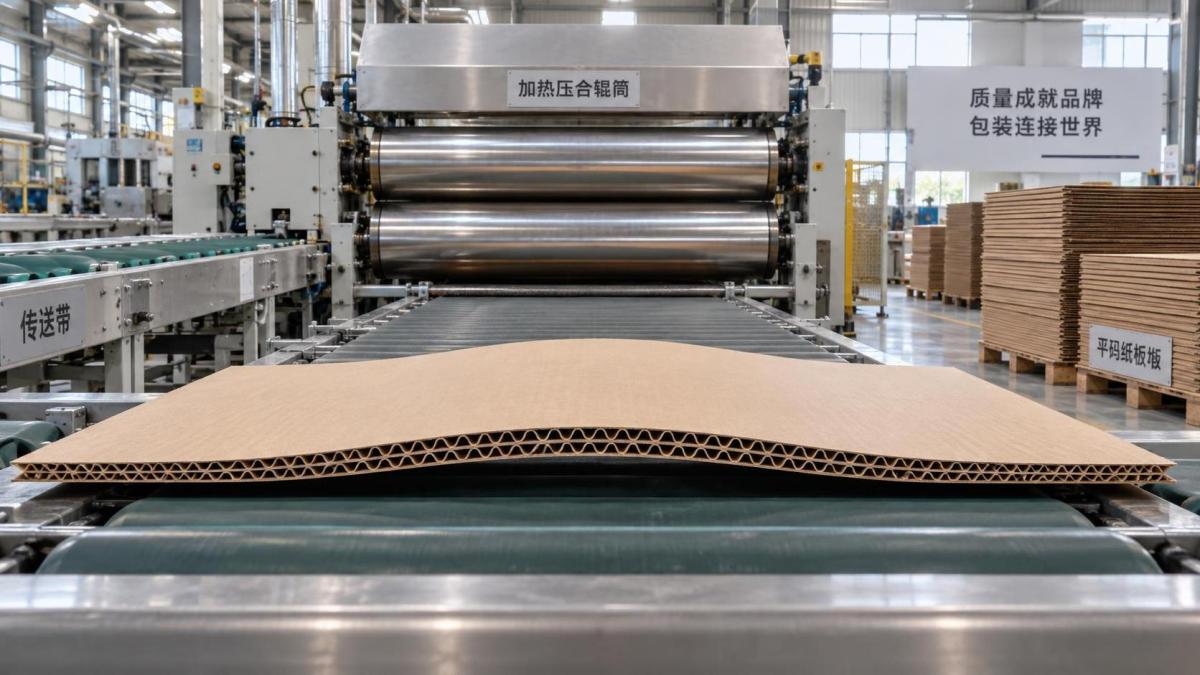
Why does a corrugated box warp after production? In most plants, the honest answer is not “because the board is wet” or “because the glue is wrong.” Warping is usually the visible result of an imbalance somewhere in a moving system: paper enters the corrugator under tension, receives steam and adhesive, passes through heat and pressure, then cools and equilibrates in a different environment. If one liner expands, shrinks, dries, or pulls more than the other, the sheet bends toward the side under greater stress.
That matters well beyond appearance. A bowed or twisted sheet can create feeding problems at the printer, unstable registration, inaccurate die-cutting, poor score quality, inconsistent glue application at the folder gluer, and lower stacking efficiency. For e-commerce shippers, it may also reduce the box’s practical compression performance because panels and flaps no longer sit where the structural design expects them to sit.
The fastest way to solve the problem is to stop treating warp as a single defect. Look at the direction of the warp, when it develops, which grades are affected, and whether the issue changes with machine speed, paper source, weather, or converting route. Those clues usually point to the part of the process that deserves attention.
The board is trying to equalize moisture and stress
Corrugated board is a composite structure. The top liner, fluted medium, and bottom liner do not behave as a single material until bonding, drying, and conditioning have been completed properly. Each paper layer has its own moisture level, basis weight, fiber orientation, stiffness, surface treatment, and response to heat. When those layers leave the process with different dimensional tendencies, the board curves.
A common pattern is a board that looks reasonably flat at the corrugator delivery but curls after several minutes in the stack. This often means the sheet was not yet in equilibrium when it left the hot section. As the board cools, moisture redistributes through the structure and paper tension relaxes unevenly. The defect may become more obvious during overnight storage, especially when the warehouse air differs sharply from the production environment.
In practical terms, warp is a balance problem between the two faces of the board. Too much moisture or excessive stretch on one face can produce a curl toward the drier, shorter side. Over-drying can create the opposite problem. But direction alone is not a complete diagnosis: flute profile, adhesive distribution, web tension, and machine-side differences can all complicate what seems like a simple moisture issue.
Read the shape of the warp before changing settings
Operators sometimes respond to any warped board by adding more heat or more steam. That can temporarily flatten one order and create a worse defect on the next one. The shape of the sheet is more useful than a general judgment that it is “curled.”
The key is repeatability. If warp appears only on one flute profile, one paper combination, one shift, or one side of the machine, that is valuable evidence. A defect that comes and goes with weather may still be a process-control problem; ambient humidity is simply exposing a line that has little operating margin.
Moisture imbalance starts before the glue station
Incoming paper condition is frequently underestimated. Rolls may arrive from different mills, have spent time in different storage areas, or be brought into production before they have acclimatized to the plant. Two liners with the same nominal grade are not automatically matched in moisture response. Recycled-content papers, heavily sized papers, white-top liners, and coated grades can react differently to steam and drying.
The preconditioner and preheater do more than “warm up” the paper. They influence flexibility, moisture movement, starch gelatinization conditions, and the web’s tendency to stretch. Too much steam on one web may make it temporarily compliant, but it can also leave that component longer or wetter than its mating liner. Too little conditioning can make the medium difficult to form cleanly, leading teams to compensate elsewhere with excessive pressure or adhesive.
A sound investigation compares the actual state of each web rather than relying only on the recipe. Check whether the liner rolls are centered and tracking correctly, whether steam valves respond consistently, and whether condensate is being removed effectively. Unstable steam supply can produce a board that appears acceptable for several sheets and then changes as the thermal balance moves.
Do not overlook storage. Paper placed directly near exterior walls, dock doors, roof heat, or unconditioned areas can develop moisture differences before it ever reaches the single facer. The machine may be blamed for a problem that was built into the roll environment days earlier.
Adhesive can pull a board out of plane
Starch adhesive brings water into the board structure, so glue control is central to flatness. Excess adhesive is not simply wasteful. It adds moisture that must be removed later, increases the chance of differential drying, and may contribute to a board that is firm at the edges but unstable through the sheet. Insufficient adhesive, however, is not a cure. Weak or intermittent bonds can release stress unevenly and create delamination or washboarding after converting.
Look for uniformity across the machine width. A poorly set metering system, worn applicator roll, contamination, or uneven doctoring can create more adhesive on one side of the web than the other. That often presents as a twist or a one-sided curl rather than a perfectly even bow. Operators may see it first as an unexplained “difficult side” at the cut-off or stacker.
Adhesive formulation should also be reviewed when raw materials or production conditions change. The right target depends on the board grade, speed, flute geometry, paper absorbency, and equipment design. It is risky to copy a setting from a different run simply because the board combination looks similar on the schedule.
Heat and pressure must be even, not merely high
The double backer is where many warp problems become visible. Board needs enough heat and contact time to dry and cure adequately, but aggressive heat can over-dry one face, particularly when the bottom liner receives a different thermal load than the top liner. Uneven hot plates, worn belts, localized pressure variation, and inconsistent steam-zone performance can make the problem appear only at certain widths or speeds.
A useful field check is to map the defect across the sheet width and then compare it with machine components. If the same side of the board repeatedly rises, inspect the corresponding steam zone, belt condition, pressure loading, and heat transfer path before changing the entire recipe. Broad adjustments often hide the evidence.
Machine speed creates another trade-off. At higher speed, there is less residence time for heat transfer and moisture removal. Slowing the line may flatten the board, but that does not automatically prove the speed is the root cause. It may reveal weak steam capacity, limited heat transfer, an unsuitable adhesive window, or conditioning that is no longer adequate for the paper combination.
Warp can be introduced after corrugating
A flat blank at corrugator delivery is not guaranteed to remain flat. Flexographic or offset-laminated packaging can take on moisture through water-based inks, coatings, lamination adhesives, or uneven drying. Die-cutting adds another possibility: aggressive stripping, poorly balanced nicks, excessive pressure, or an unstable feeding path can exaggerate an existing bow and make it look like a converting defect.
This is particularly relevant for high-graphics packaging. Tight color registration and accurate die-cutting depend on a sheet that feeds consistently. A board with variable flatness can shift under transport belts or vacuum systems, which creates downstream complaints that may be incorrectly assigned to the printing press or die-cutting section. The best quality teams trace the sheet backward, not just the last machine it touched.
Stacking and palletization deserve the same scrutiny. Warm board packed tightly can continue releasing moisture inside the stack. Conversely, unprotected pallets may absorb or lose moisture rapidly in a dry warehouse or humid loading area. Allowing a reasonable stabilization period, where the process permits it, is often more sensible than immediately wrapping board that is still thermally active.
A disciplined troubleshooting sequence saves material
When a warp issue appears, avoid changing steam, glue, heat, tension, and speed all at once. That is a quick route to an unrepeatable result. Start by retaining representative samples and recording board construction, roll identities, machine direction, warp direction, production time, speed, and settings. Compare samples taken at the corrugator, after cooling, after printing, and after storage where possible.
Then adjust one meaningful variable at a time. If the defect is clearly side-to-side, focus on cross-machine uniformity before changing overall moisture. If it is associated with a particular liner grade, examine paper condition and conditioning response before assuming the double backer is at fault. If the board only moves after printing, measure the influence of inks, coatings, drying, and stack exposure.
The objective is not to make one stack look flat for inspection. It is to produce board that stays stable through print, die-cut, folding, gluing, distribution, and use. That distinction is important for plants supplying fast-moving shipping-box demand, where a small flatness issue can disrupt several automated operations in sequence.
At PWFS, corrugated board lines are best understood as part of a connected paper-to-package system, not isolated steel equipment. The same discipline that supports precise registration on a printing press or reliable geometry at a folder gluer begins with a stable sheet. When corrugated boxes warp after production, the useful question is not “which setting should we turn up?” It is: which layer, condition, or process zone is no longer in balance—and what evidence proves it?
Related News
Get weekly intelligence in your inbox.
No noise. No sponsored content. Pure intelligence.
