
Why Corrugated Box Production Quality Fails: Common Causes of Warp, Crush, and Misalignment
Why corrugated box production quality fails in real operating conditions
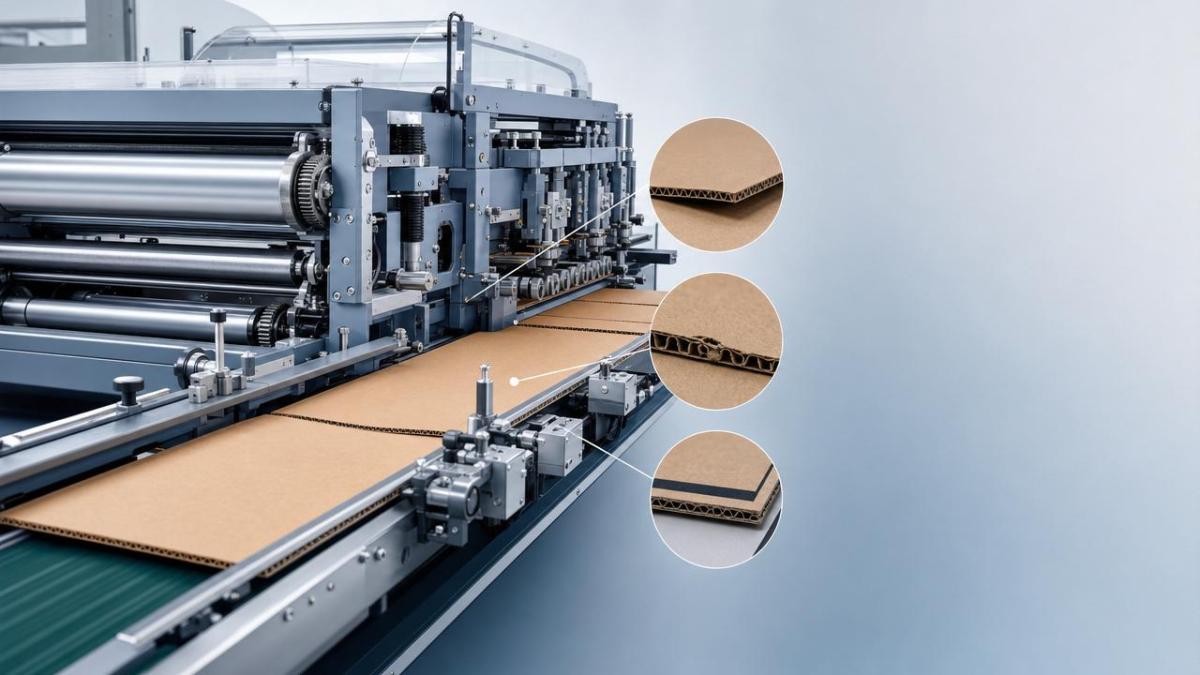
In corrugated box production, warp, crush, and misalignment are rarely isolated defects.
They usually reveal instability across paper, steam, traction, print registration, die-cutting pressure, and folder-gluer timing.
That is why quality control cannot be reduced to a single machine alarm or one operator adjustment.
In actual converting environments, the same defect can come from very different causes.
A fast e-commerce shipper, a shelf-ready retail carton, and a printed pharmaceutical box do not stress the line in the same way.
PWFS often frames corrugated box production this way: the board line builds structure, printing adds positional precision, and converting exposes every hidden weakness.
When line coordination slips, box quality fails long before final packing strength tests reveal the problem.
Different box applications create different failure patterns
The first useful judgment is not the defect itself, but the production context behind it.
In corrugated box production for high-volume shipping cartons, warp often appears when speed rises faster than moisture balance stabilizes.
On lines serving branded retail packaging, misalignment becomes more visible because graphics, scores, and cut windows must match tightly.
For heavy-duty transit packaging, crush is usually the bigger commercial risk because compression failure affects stacking safety.
This is where many teams misread the situation.
They treat similar-looking boxes as identical jobs, even when flute profile, liner grade, print coverage, and downstream handling differ sharply.
A line that runs stable for brown shipping cases may struggle on coated preprint, high-ink graphics, or tighter die-cut tolerances.
When warp starts at the board line, later stations only make it worse
Warp in corrugated box production often begins before printing or slotting starts.
Uneven paper moisture, unbalanced heating, poor glue application, or single-face tension errors create board memory.
At low speed, that memory may look manageable.
At high speed, it turns into feeding instability, score drift, and poor stack formation.
A common mistake is correcting warp only at the dry end or slitter-scorer.
That may flatten appearance temporarily, but it does not remove the moisture imbalance inside the sheet.
In facilities tracking full-line intelligence, the better practice is linking steam pressure, wrap angle, bonding condition, and reel variation as one system.
Crush problems usually appear where pressure control seems “good enough”
Crush rarely comes from one dramatic setup error.
More often, it develops from accumulated overpressure across preheater contact, nip settings, printing impression, die-cutting, and bundling.
In corrugated box production for long logistics routes, slight flute damage can remove critical stacking margin.
In short distribution cycles, the same damage may pass unnoticed until customer complaints surface.
That difference matters.
Production settings should reflect handling intensity, not just visual acceptance at the machine exit.
This is also where PWFS intelligence around die-cutter kinematics becomes relevant.
Mechanical balance at high throughput influences whether pressure is cleanly transferred or destructively concentrated.
Misalignment is often a coordination issue, not only a print issue
Misalignment in corrugated box production is easy to blame on printing units.
In reality, registration loss often starts with sheet shape, pull consistency, side guide behavior, or score position drift.
On offset-laminated or high-graphic jobs, micron-level expectations expose tiny transport errors quickly.
On plain transport boxes, those same errors may stay hidden until folding gaps appear.
More demanding applications need tighter relationships between print, die-cut, fold, and glue than many plants expect.
If the die-cut blank enters the folder-gluer slightly off, the final skew may be blamed on gluing.
The real cause, however, can sit upstream in pull roll wear, vacuum inconsistency, or board curl after printing.
Where judgment changes from one production scene to another
The table below shows why the same defect demands different checks under different operating conditions.
What gets overlooked when lines run faster and product mixes widen
Corrugated box production has become more sensitive as order structures change.
Shorter runs, more graphics, lighter papers, and tighter delivery windows reduce the margin for hidden variation.
In practice, several blind spots appear repeatedly:
- Paper grades are approved by specification, but not by behavior after heating and bonding.
- Print registration is monitored, while score-to-print and cut-to-fold relationships are ignored.
- Pressure settings are optimized per machine, not across the entire converting path.
- Operators correct symptoms manually, but no one traces recurring defects to recipe logic.
- Maintenance focuses on breakdowns, while guide wear and roll surface drift remain untreated.
These issues become more expensive on integrated lines.
A modern plant may combine board lines, flexo or offset print sections, die-cutters, and folder-gluers with digital monitoring.
When one section silently drifts, downstream equipment only magnifies the defect with more speed and less recovery time.
Why similar defects should not trigger identical fixes
A warped blank from humid storage does not require the same response as a warped blank from poor steam balance.
A crushed flute from die-cut overpressure differs from crush caused by stacking clamps or bundle compression.
Misalignment after high-coverage printing may relate to sheet stretch, while misalignment on plain board may point to transport mechanics.
In other words, defect names are not enough.
Useful diagnosis in corrugated box production depends on where the defect first becomes irreversible.
How to build a more reliable corrugated box production response
The most effective response starts with line-level logic rather than isolated troubleshooting.
That approach fits the broader PWFS view of paper and wood manufacturing: precision is created by coordinated systems, not individual machines alone.
For corrugated box production, a workable improvement path usually includes the following actions:
- Map each defect to the earliest measurable process change, not the final visible symptom.
- Separate jobs by board structure, print load, speed range, and downstream handling intensity.
- Create setup windows for steam, tension, pressure, and registration by application type.
- Track repeat defects against reel source, shift pattern, maintenance history, and recipe changes.
- Verify box strength and geometry after converting, not only at the board exit.
This is also the point where digitalization matters.
MES links, quality records, and machine trend data help distinguish random variation from systematic weakness.
Without that visibility, corrugated box production often remains stuck in repeated manual correction.
A practical next step before defects become routine losses
Warp, crush, and misalignment are not just shop-floor nuisances.
They affect compression safety, brand appearance, packing efficiency, and the credibility of the whole converting chain.
The better next step is to review corrugated box production by application group, then compare defect patterns across board making, printing, die-cutting, and folding.
That makes it easier to define realistic control windows, identify weak transfer points, and avoid treating every box as the same manufacturing problem.
Where process complexity is rising, a structured intelligence view can help connect material behavior, machine physics, and final package performance before waste becomes the normal cost of speed.
Related News
Get weekly intelligence in your inbox.
No noise. No sponsored content. Pure intelligence.
