
How to Evaluate Corrugated Box Production Lines for Capacity, Board Grades, and Plant Layout
Evaluating corrugated box production lines starts with a simple correction: rated speed is never the whole story. A line that looks impressive on paper can still underperform when board grades shift, order sizes shrink, or the building itself creates handling delays.
That is why capacity, paper mix, utilities, and plant layout need to be reviewed together. In today’s packaging environment, where e-commerce volumes rise and box styles diversify, corrugated box production lines must support both throughput and control.
This matters across the broader converting landscape that PWFS tracks, from corrugated board lines to offset presses and downstream folder-gluers. The same lesson appears everywhere: productivity comes from system balance, not from one headline specification.
What a production line evaluation really needs to capture
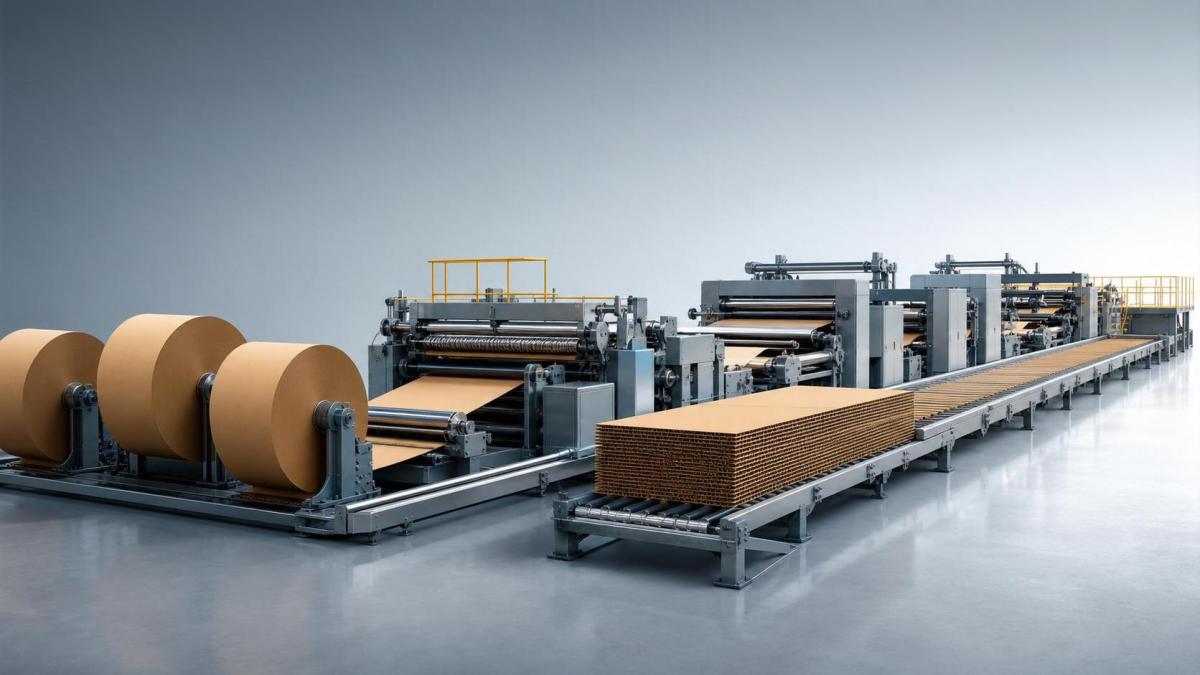
At a practical level, corrugated box production lines combine paper handling, corrugating, bonding, drying, slitting, scoring, cutoff, stacking, and transfer. Each section can become the real pace setter.
For that reason, line evaluation should focus on effective output. Effective output means sellable board and boxes per shift, under the actual product mix, with realistic stoppages included.
A useful review asks three connected questions. How much can the line truly make, which board structures can it run well, and how efficiently can material move through the plant around it?
When those answers align, corrugated box production lines become scalable assets. When they do not, plants often inherit hidden waste in changeovers, paper damage, steam instability, queueing, or finished goods congestion.
Capacity should be measured beyond nominal speed
Nominal line speed is still relevant, but only as a starting point. The better metric is sustained output across a representative production week.
A technical review usually becomes clearer when capacity is split into operating layers.
Rated capacity versus usable capacity
Suppliers may quote top speed under stable paper, limited flute changes, and favorable sheet sizes. Real plants deal with order sequencing, adhesive adjustments, startup loss, and operator response time.
Usable capacity should factor in:
- average order length and run frequency
- number of flute or board profile changes
- scheduled maintenance windows
- waste during startup and splice events
- speed reductions for heavier or moisture-sensitive papers
The bottleneck is often downstream
Many corrugated box production lines are limited less by the corrugator than by printing, die-cutting, stacking, bundling, or internal logistics. A fast wet end does not help if converting lines cannot absorb the board flow.
This is where PWFS-style system thinking is useful. The same discipline used to analyze offset registration or folder-gluer rhythm also applies here: every transfer point affects total yield.
Questions that sharpen a capacity review
Board grades are not a detail, they define line fitness
A line that performs well on standard single-wall shipping boxes may struggle when the plant adds heavier double-wall formats, high graphics sheets, or lighter recycled papers with variable moisture behavior.
That is why corrugated box production lines should be matched to the board grade portfolio first, then to the speed target.
Paper and flute combinations affect everything
Board grades shape bonding temperature, warp control, crush resistance, slit quality, and stack stability. Liner and medium quality also influence how much process window the line actually has.
A strong assessment reviews the expected range of:
- single-wall, double-wall, or specialty board structures
- lightweight versus heavy basis weights
- kraft, testliner, recycled, or moisture-variable papers
- flute profiles tied to compression, printability, or cushioning
Quality risk rises when board mix broadens
Broader product portfolios often look attractive commercially. Yet they demand tighter process control on heat, glue application, web tension, and alignment.
For plants feeding high-precision printing or premium retail packaging, flatness and caliper consistency matter as much as volume. That links corrugated performance directly to downstream print quality and die-cut accuracy.
In other words, board grade compatibility is not only a corrugator question. It is a full converting question, especially when visual packaging standards are rising.
Plant layout can unlock or erase line value
Long corrugated box production lines demand more than floor space. They need logical flow, safe access, service room, and clean links to raw paper storage and converting zones.
A layout review should trace material movement from reel receipt to finished bundle dispatch. When that map is missing, hidden inefficiencies usually appear later as forklift traffic, staging overflow, or awkward manual intervention.
Space planning should include operating reality
The machine footprint is only one layer. Reel loading, waste extraction, preheater access, spare roll staging, maintenance clearance, and board accumulation areas all consume real space.
Common layout pressure points include:
- insufficient aisle width for paper roll handling
- poor adjacency between corrugator and converting cells
- inadequate utility routing for steam and condensate recovery
- limited room for future stackers or automated transfer systems
Expansion potential is part of the decision
A layout that fits today but blocks tomorrow’s automation can become expensive fast. Space for AGVs, pallet flow, MES visibility points, or extra converting capacity should be reviewed early.
PWFS often frames industrial equipment as connected production ecosystems. That perspective is useful here because a board line rarely succeeds in isolation. It succeeds when data, material, and labor movement stay synchronized.
How to compare line configurations in a structured way
Side-by-side equipment comparison works best when the criteria reflect the plant’s actual order pattern. A broad specification sheet is helpful, but a weighted decision matrix is usually more revealing.
Useful comparison categories include capacity, board range, uptime support, energy use, automation depth, digital integration, maintenance access, and building fit.
It also helps to separate must-have requirements from optimization features. For some plants, double-wall stability or steam efficiency is decisive. For others, rapid order scheduling and low-touch transfer matter more.
When reviewing corrugated box production lines, three evidence sources deserve priority: reference plant performance, trial data under comparable grades, and realistic layout drawings with utility loads.
A practical next step for line selection
The clearest path is to build the evaluation around the plant’s own production mix. Start with actual box formats, monthly grade split, shift model, and downstream converting rhythm.
Then test each option against sustained output, board quality window, utility readiness, and layout constraints. This turns corrugated box production lines from catalog choices into operational decisions.
Where uncertainty remains, the next useful move is not a broader specification list. It is a tighter requirement sheet, supported by sample jobs, plant flow mapping, and a comparison of bottlenecks across the full packaging system.
That approach usually leads to better results: a line sized for real demand, compatible with the intended board grades, and positioned to support efficient, scalable box manufacturing over time.
Related News
Get weekly intelligence in your inbox.
No noise. No sponsored content. Pure intelligence.
