
Furniture Production Systems Price Breakdown: What Drives Cost from Standalone Machines to Full Lines
Furniture Production Systems Price: Why the Number Changes So Much
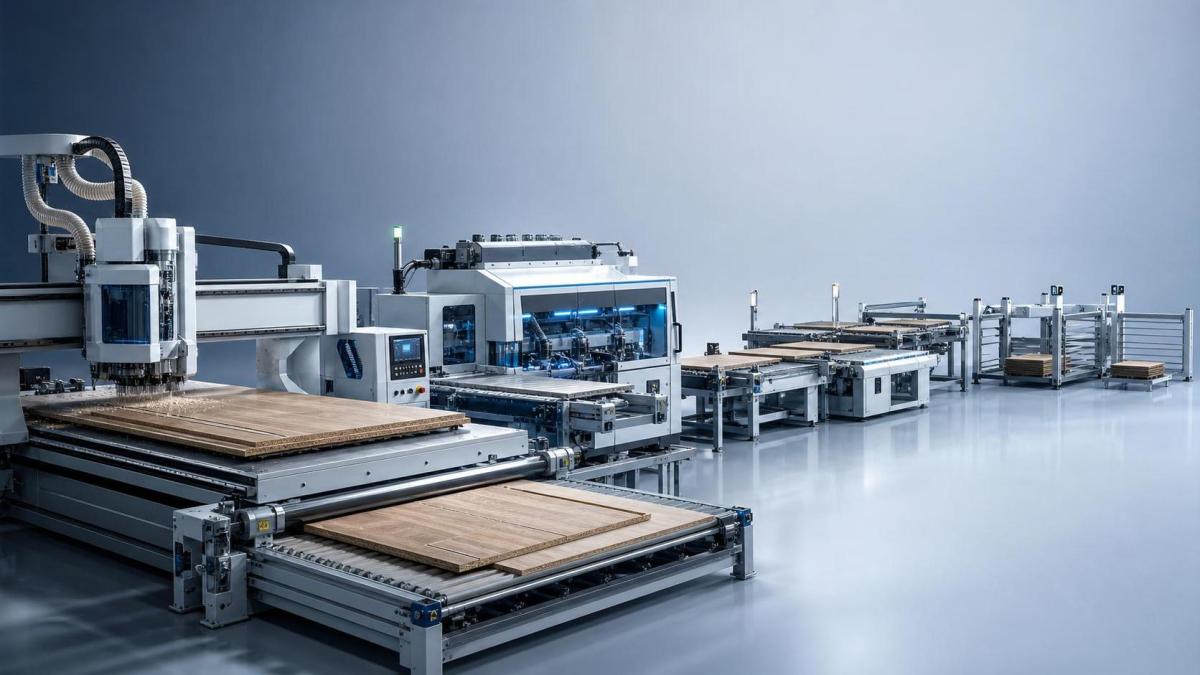
Understanding furniture production systems price starts with one simple fact: buyers are rarely comparing like with like.
A standalone CNC router, an edge bander cell, and a full digital furniture line may all process panels, yet their cost logic is completely different.
That is why headline machine quotes often mislead internal budgeting.
In practice, furniture production systems price is shaped by throughput targets, automation depth, software links, installation scope, and the cost of keeping output stable.
The useful question is not just, “How much does the machine cost?”
A better question is, “What production model is this investment buying over five to ten years?”
Within PWFS coverage, that distinction matters across both furniture and adjacent converting industries.
The same capital logic appears in corrugated lines, offset presses, die-cutting systems, and CNC woodworking equipment: precision, speed, integration, and uptime cost real money.
What does furniture production systems price usually include, and what gets left out?
Many quotations cover only the visible hardware.
That may include the CNC nesting machine, drilling unit, edge bander, conveyor sections, and basic operator terminals.
But total furniture production systems price usually extends far beyond that initial list.
Common hidden items include electrical work, compressed air preparation, dust extraction upgrades, software licenses, barcode stations, commissioning, and training.
If layout changes are needed, civil work can also become material.
This is especially true when moving from a single machine to an integrated line.
More connected systems need more interfaces.
They also need more testing before stable production begins.
A quick comparison table helps separate quote price from real project cost.
This is where many budgets go wrong.
The approved amount reflects machine price, while the actual furniture production systems price reflects project execution.
Is a standalone machine cheaper in the long run, or only cheaper on paper?
It depends on demand stability and process bottlenecks.
A standalone machine is often the rational choice when order mix is moderate, labor is available, and one process is clearly limiting output.
For example, replacing an old edgebander can remove rework and improve finish quality without redesigning the factory.
That keeps capital exposure lower.
However, a lower purchase price does not automatically mean a lower lifecycle cost.
If manual transfers, relabeling, queue buildup, and repeated handling remain in the process, labor and error costs stay embedded.
The more custom the product mix becomes, the more expensive those invisible frictions get.
Whole-house customization is a good example.
Short runs, varied part geometry, and sequence sensitivity punish disconnected production islands.
That is why furniture production systems price should be judged against labor dependency, not only asset value.
PWFS often tracks the same pattern in printing and packaging lines.
A cheaper press or die-cutter can lose its advantage quickly when makeready time, waste rates, and operator reliance stay high.
Which factors push furniture production systems price sharply upward?
Not every upgrade affects cost equally.
Some options add convenience.
Others fundamentally change the economics of the line.
- Automation architecture: loading, sorting, buffering, return conveyors, and robotic handling quickly increase system value.
- Software depth: CAD/CAM integration, MES connectivity, production scheduling, barcode tracing, and remote diagnostics raise both capability and cost.
- Precision requirements: tighter drilling tolerance, cleaner edges, and lower defect tolerance require better mechanics and controls.
- Output target: higher daily panel volume usually means stronger spindles, faster changeover, and more balanced downstream equipment.
- Material flexibility: systems handling MDF, particle board, plywood, lacquered panels, and mixed thicknesses need more robust process control.
- Compliance and sustainability: dust control, energy monitoring, and adhesive technology can materially influence total project value.
A useful way to read furniture production systems price is to ask which costs are buying speed, which are buying quality, and which are buying resilience.
Those three categories do not create the same return profile.
For instance, laser or PUR edge banding may cost more upfront, yet it can support premium product positioning and lower callback risk.
That matters when moisture resistance and indoor emission standards influence sales acceptance.
When does a full line make financial sense?
A full line usually makes sense when order variability is high, labor consistency is low, and growth depends on faster flow rather than isolated machine speed.
In other words, integration pays when coordination becomes the real bottleneck.
This is common in panel furniture factories handling many SKUs, frequent design changes, and compressed delivery windows.
More connected systems can also improve data visibility.
That matters because the strongest ROI case often comes from reduced exceptions, not just higher nominal output.
A balanced line can cut panel misrouting, label errors, work-in-progress congestion, and emergency overtime.
Those savings are easy to ignore during quotation review, yet they materially affect payback.
The same logic appears across PWFS-tracked sectors.
High-precision offset presses and automated folder-gluers are expensive because they compress labor, stabilize quality, and protect throughput under pressure.
Furniture production systems price follows a similar pattern.
The capital jump is justified when integration removes recurring operational leakage.
A practical screening test
Before approving a full line, check whether at least three of these conditions are already visible.
- Orders are growing, but output stays flat because flow breaks between processes.
- Labor cost is rising faster than gross margin.
- Rework and sorting consume more time than actual cutting or edging.
- Delivery promises depend on overtime or highly experienced operators.
- Management lacks clean production data for scheduling and traceability.
What are the most common mistakes when comparing quotes?
The biggest mistake is comparing hardware lists without comparing production assumptions.
Two suppliers may both quote a nesting cell, yet one assumes manual unload and the other assumes automated sorting with barcode logic.
The prices will look far apart because the operating model is far apart.
Another mistake is treating software as an optional extra.
For short-run furniture manufacturing, software often determines whether the line behaves like a system or a collection of machines.
There is also a timing error that appears often.
Some budgets ignore the ramp-up period and assume full efficiency immediately after installation.
That assumption usually weakens the ROI model.
A shorter checklist helps keep quote evaluation grounded.
How should the next decision be framed?
The most reliable way to evaluate furniture production systems price is to connect price with process design, labor model, and future order structure.
A cheaper asset can be expensive to run.
A more expensive line can be conservative if it removes chronic instability.
That is the real decision point.
In practical terms, start by mapping the current bottleneck, then quantify labor touchpoints, rework cost, queue time, and expected SKU complexity over the next three years.
After that, compare quotations against one common production scenario.
Without that discipline, furniture production systems price remains a list of disconnected numbers.
With it, the cost picture becomes clearer: which investment buys capacity, which buys control, and which simply shifts expenses elsewhere.
For teams following PWFS intelligence across woodworking, packaging, and print, that wider lens is usually the most valuable one.
The smartest next step is not chasing the lowest quote.
It is building one decision sheet that aligns project scope, full furniture production systems price, ramp-up risk, and expected return under real operating conditions.
Related News
Get weekly intelligence in your inbox.
No noise. No sponsored content. Pure intelligence.
