
High-Speed Folder Gluers for Pharma Cartons: What Specs Matter for Clean, Accurate Folding?
In pharmaceutical packaging, speed only matters when every carton still folds square, seals cleanly, and arrives audit-ready. That is why high-speed folder gluers for pharma cartons are judged less by headline throughput and more by repeatable accuracy, glue discipline, and hygienic line control. In a market shaped by serialization, tighter documentation, and rising packaging complexity, the machine specification has become a quality decision as much as a production one.
Why folder gluer specs now carry more weight
Pharma cartons look simple, but they operate under stricter tolerances than many consumer packs. A minor flap drift can affect leaflet insertion, tamper-evidence, coding visibility, or downstream cartoning.
PWFS tracks this part of the converting chain closely because folder gluers sit where print precision, die-cut geometry, adhesive behavior, and line automation meet. At that junction, small mechanical weaknesses become visible product risk.
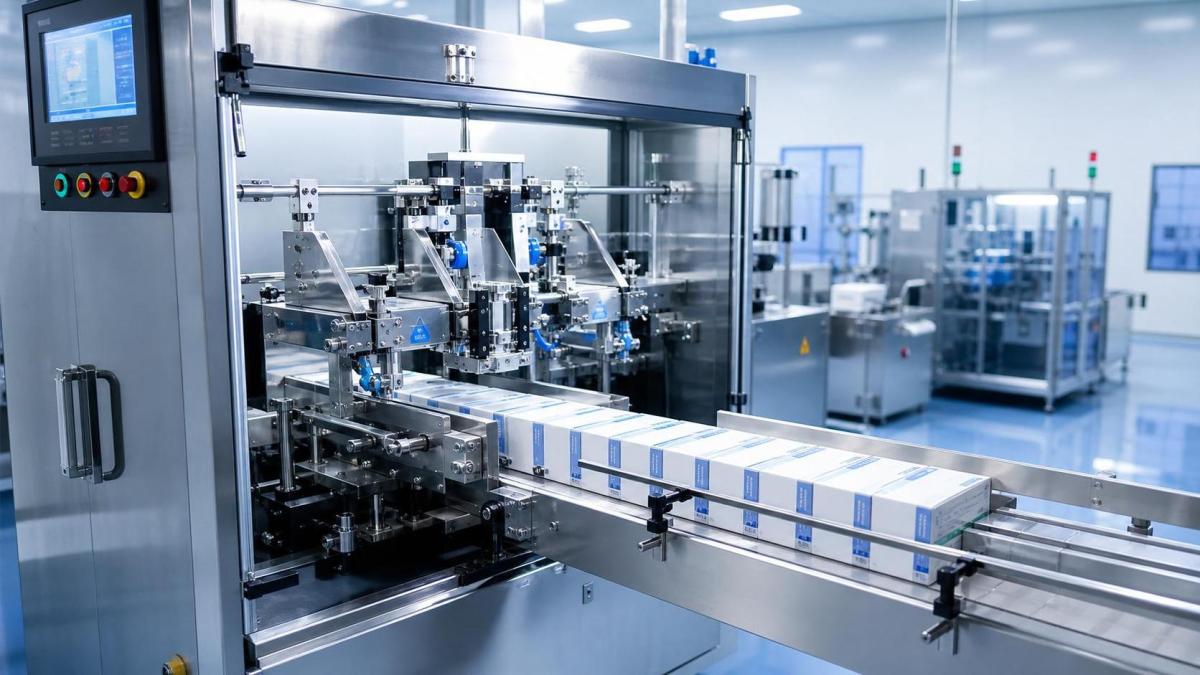
For folding cartons used in medicines, the target is not merely “running fast.” It is holding crease alignment, minimizing fiber cracking, and keeping glue placement consistent while the line accelerates.
What “clean, accurate folding” actually means
Clean folding starts with controlled board handling. Cartons should enter the prefolding and final folding sections without skew, bounce, or drag that disturbs crease memory.
Accurate folding means more than dimensionally correct blanks. It also includes panel squareness, stable flap overlap, consistent compression at the glue joint, and low variability across long production runs.
For high-speed folder gluers for pharma cartons, this definition expands further. The machine must preserve carton integrity while supporting traceability systems, fast changeovers, and validation-friendly monitoring.
Core specifications that influence carton quality
Some specifications look impressive in brochures but contribute little to real packaging control. Others directly affect reject rate, contamination risk, and compliance performance.
Feeder stability and blank transport
A stable feeder is the first quality gate. Look for controlled suction, accurate side alignment, anti-static management, and transport systems that prevent micro-shifts at high speed.
At pharma line speeds, even slight board wander can misplace glue, distort folds, or affect code-reading windows. That is why transport precision matters as much as nominal speed.
Prefolding geometry and crease management
Cartons with lock bottoms, reverse tucks, or narrow side seams need reliable prefolding angles and repeatable rail settings. Poor geometry increases spring-back and causes inconsistent carton shape.
Machines with fine adjustment capability, stable carrier rails, and strong memory recipes are easier to control across repeat jobs. That reduces setup drift between shifts.
Glue application precision
Glue system quality is central for high-speed folder gluers for pharma cartons. Adhesive placement should be narrow, repeatable, and stable under changing viscosity and ambient conditions.
Cold glue systems remain common for many carton styles, but the real question is application control. Nozzle response, pattern consistency, easy cleaning, and glue monitoring should all be assessed.
Excess glue is not a harmless margin of safety. It can squeeze into product areas, mark printed surfaces, interfere with coding, or create hygiene concerns during packing.
Compression section performance
The compression conveyor determines whether adhesive contact becomes a durable bond. Adjustable dwell time, belt tracking, and pressure uniformity are more useful than raw conveyor length alone.
If cartons exit under-compressed, bond strength becomes variable. If over-compressed, panels may deform and cosmetic quality can fall, especially on coated or lightweight boards.
The specs that matter most for quality and safety review
A practical review benefits from mapping each machine parameter to a likely packaging risk. The table below keeps that discussion focused on real outcomes.
Operational details that often decide real performance
On paper, several machines may appear similar. In practice, the better platform is usually the one that remains predictable after eight hours, not the one with the highest headline speed.
Changeover time and repeatability
Pharma packaging often involves shorter runs and frequent SKU changes. Tool-free adjustments, digital position indicators, and stored setup recipes reduce restart losses and operator dependence.
Dust control and accessible cleaning points
Paper dust is not trivial in medicine carton production. It affects sensors, glue quality, print appearance, and housekeeping discipline around the line.
High-speed folder gluers for pharma cartons should allow fast access to belts, rails, nozzles, and waste zones. Cleanability is a performance feature, not only a maintenance issue.
Integration with inspection and data systems
PWFS consistently highlights the value of digital connectivity across converting equipment. In folding-gluing, that means reliable interfaces for vision inspection, reject confirmation, batch records, and MES reporting.
A machine that can log speed, alarm history, and setup parameters makes deviation review much easier. That is especially useful when a defect appears intermittently.
Typical carton scenarios and the specs behind them
Different carton styles place different stress on the gluing line. Selection should match actual packaging geometry rather than a generic speed target.
- Straight-line cartons: prioritize feeder consistency, glue line accuracy, and compression stability for long, repeatable runs.
- Crash-lock bottom cartons: focus on prefolding precision, synchronized folding hooks, and bond strength under high acceleration.
- Small-format medicine boxes: pay attention to registration stability, narrow glue bead control, and low-vibration transport.
- Printed cartons with coding windows: confirm accurate fold position so variable data remains readable and correctly placed.
These differences explain why comparing high-speed folder gluers for pharma cartons by meters per minute alone rarely leads to the right decision.
A practical evaluation framework before approval
A useful machine review usually combines mechanical checks, sample testing, and line documentation. The goal is to understand how the equipment behaves under normal variation.
- Run real board grades, not only ideal test stock.
- Measure glue placement consistency at multiple speeds.
- Check fold squareness after warm-up and after extended production.
- Review accessible cleaning points and residue-prone zones.
- Verify data outputs for inspection, alarms, and batch traceability.
- Assess restart stability after stoppages, not only continuous running.
This type of review aligns well with the broader PWFS view of converting technology: precision is not isolated at one station. It is created by the interaction between print, die-cutting, folding, gluing, and digital control.
Where the next decision should focus
The best high-speed folder gluers for pharma cartons are usually the ones that make quality performance more visible and more repeatable. That means stable transport, precise folding geometry, disciplined glue application, easy cleaning, and useful production data.
Before comparing suppliers, it helps to define the carton styles, board range, adhesive conditions, inspection needs, and acceptable reject thresholds. With those criteria in place, machine specifications become easier to judge against actual packaging risk rather than brochure language.
A structured side-by-side trial, supported by measurable fold and glue checkpoints, is often the clearest next step. It turns a fast machine comparison into a sound packaging control decision.
Related News
Get weekly intelligence in your inbox.
No noise. No sponsored content. Pure intelligence.
