Automated Woodworking Solutions for Wardrobes: Machine Layouts and Workflow Basics
Why are automated woodworking solutions for wardrobes getting so much attention?
Wardrobe production has changed from batch carpentry to digital, mixed-model manufacturing. That shift makes layout logic just as important as machine selection.
Automated woodworking solutions for wardrobes matter because they connect design data, cutting, drilling, edge treatment, and handling into one controlled flow.
In practical terms, that means fewer manual handoffs, less panel damage, and a more predictable delivery rhythm for custom orders.
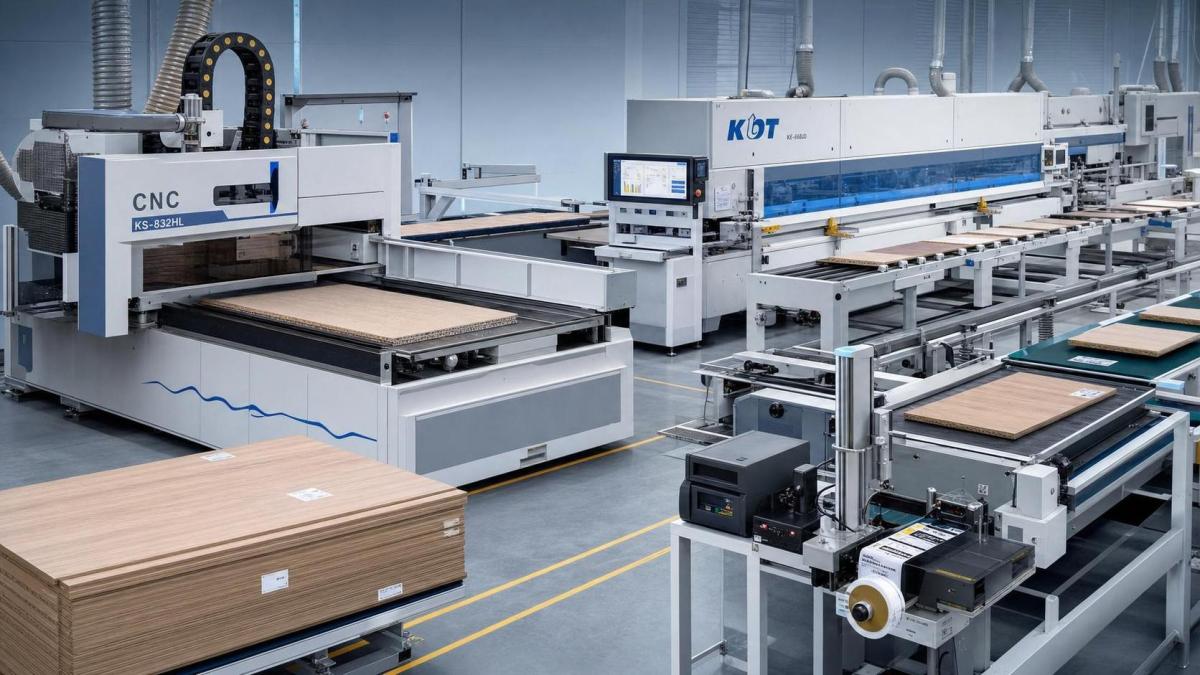
The core equipment is familiar: CNC nesting routers, beam saws, drilling centers, edge banders, conveyors, labeling systems, and sorting stations.
What changes performance is not only machine speed. It is the sequence, buffer design, software connection, and material movement between stations.
That is why intelligence platforms such as PWFS pay close attention to woodworking lines alongside corrugated, printing, and die-cutting systems.
Across these industries, the same rule keeps appearing: automation succeeds when digital instructions, mechanical precision, and shop-floor flow stay tightly aligned.
For wardrobes, the goal is not simply faster cutting. The goal is stable output across many cabinet sizes, finishes, hole patterns, and delivery dates.
What does a basic wardrobe production workflow usually look like?
Most automated woodworking solutions for wardrobes follow a simple logic: data in, panels processed, parts identified, edges sealed, and kits prepared for assembly.
The exact route depends on product mix, but the workflow usually includes these steps.
- Order import from CAD, ERP, or MES with part dimensions, materials, and machining rules.
- Panel optimization, nesting, or saw cutting to reduce waste and balance output.
- Labeling so every part carries identity before downstream processing becomes complex.
- CNC routing or drilling for grooves, connectors, hinges, cams, and shelf support holes.
- Edge banding with EVA, PUR, or laser-compatible technology, depending on quality targets.
- Buffering, sorting, and kitting so matching components move together toward assembly.
- Final inspection, packaging, and transfer to installation or delivery staging.
A common mistake is treating each machine as a separate island. That often creates hidden delays between fast cutting and slower edge processing.
A better view is to treat the line as one production organism. Capacity is set by the slowest stable process, not the fastest advertised machine.
In wardrobe factories with high SKU variation, identification and sorting can be as critical as machining accuracy.
How should machine layouts be planned before buying equipment?
Layout planning starts with flow direction, not with brand catalogs. The line must support clean movement of raw boards, semi-finished parts, and completed kits.
For most plants, one-way material flow is easier to control than loops or cross-traffic.
The first layout question is whether the line is saw-based, nesting-based, or hybrid. Each model changes space, labor, dust control, and throughput balance.
Buffer zones deserve more attention than they usually get. Without them, one machine stop can block the entire line within minutes.
It also helps to separate dusty cutting zones from edge banding and labeling areas. That improves quality and simplifies maintenance discipline.
PWFS often frames this as a systems problem. The same thinking used in precision print and die-cutting lines applies here: motion, tolerance, and data timing must match.
Where do bottlenecks usually appear in automated woodworking solutions for wardrobes?
Bottlenecks rarely appear where people first expect them. They are often created by variation, rework, or unstable information rather than by headline machine speed.
Edge banding is a frequent constraint. Wardrobe parts may require multiple edge types, colors, and thicknesses in one shift.
When changeovers are slow, the line loses rhythm. When adhesive control is weak, rework grows quickly.
Drilling can also become a choke point, especially if connector standards vary across projects or imported design data lacks machining consistency.
Another weak point is label integrity. If labels are printed late, damaged by dust, or mismatched with part orientation, downstream sorting becomes unreliable.
The table below captures common warning signs and what they usually mean.
In other words, automated woodworking solutions for wardrobes succeed when line balance is measured across the entire order journey, not only in machining minutes.
How do you judge whether a line is right for custom wardrobes or still overbuilt?
The best judgment is not based on maximum speed alone. It depends on order mix, board materials, finish expectations, and how often designs change.
A line can be overbuilt when automation is added to unstable processes. That usually produces expensive waiting, not real efficiency.
A more reliable evaluation uses a few grounded questions.
- How many orders are single-piece flow, and how many are repeatable modules?
- What percentage of panels need special drilling, grooves, or visible premium edges?
- Can the software stack pass accurate data from design through machining without manual repair?
- Is the packaging and sorting area ready for mixed custom kits?
- How long can the line keep running when one station pauses?
This is where cross-industry intelligence becomes useful. PWFS follows not only woodworking equipment, but also print and converting automation.
That wider lens helps explain why data discipline, traceability, and controlled handoff points often create more value than one additional high-speed machine.
For wardrobe projects, fit is usually better than excess. The right line should absorb variation without turning every nonstandard order into an exception.
What should be confirmed before implementation starts?
Before installation, confirm three layers together: process rules, facility conditions, and digital readiness. Problems in any one of them can delay the full line.
Process rules include board specifications, connector standards, edge quality targets, remake criteria, and kitting logic for installation sequences.
Facility conditions include dust extraction, compressed air, power stability, forklift paths, maintenance access, and safe panel storage around each machine.
Digital readiness is often underestimated. CAD libraries, machining post-processors, barcode standards, and MES handshakes should be tested before live orders arrive.
It is also wise to define success metrics early. Typical measures include first-pass yield, order lead time, edge defect rate, and buffer occupancy.
When automated woodworking solutions for wardrobes are introduced with clear operating standards, startup becomes faster and line learning is less painful.
So what is the practical next step?
Start by mapping the current wardrobe workflow from order entry to final package. That simple exercise usually reveals avoidable loops and missing data points.
Then compare layout options against actual product mix, not ideal production assumptions. A smaller, balanced line often outperforms a larger, fragmented one.
Automated woodworking solutions for wardrobes create real value when machine layout, software logic, and material handling are planned as one system.
That is the basic workflow lesson behind modern furniture automation, and it is consistent with how PWFS reads industrial equipment across paper, print, and wood.
The most useful next move is to build a decision checklist around flow, bottlenecks, traceability, and implementation risk before locking the line design.
Related News
Get weekly intelligence in your inbox.
No noise. No sponsored content. Pure intelligence.
