
Precision Die Cutting for Packaging: Which Materials, Tolerances, and Jobs Is It Best For?
Precision die cutting for packaging sits at the point where print quality, material behavior, and production economics meet. When carton shapes must register with graphics, fold cleanly, and run fast through downstream equipment, cutting accuracy becomes more than a finishing detail. It affects waste, glue performance, stackability, and even how a package performs in logistics. That is why precision die cutting for packaging remains a priority in corrugated, folding carton, label, and specialty converting lines.
Why this process matters more now
Packaging formats are becoming more varied, while run structures are becoming less predictable. E-commerce requires durable ship-ready packs. Premium retail formats demand cleaner edges and tighter visual alignment. Shorter campaigns also leave less room for setup loss.
In that environment, precision die cutting for packaging supports both output quality and line stability. It helps converters hold shape consistency across long runs, while still managing frequent changeovers, mixed substrates, and demanding customer tolerances.
For a platform such as PWFS, this topic also connects directly with the larger production chain. Corrugated board quality, offset registration, die-cutter dynamics, folder-gluer speed, and MES-driven process control all influence the final cut result.
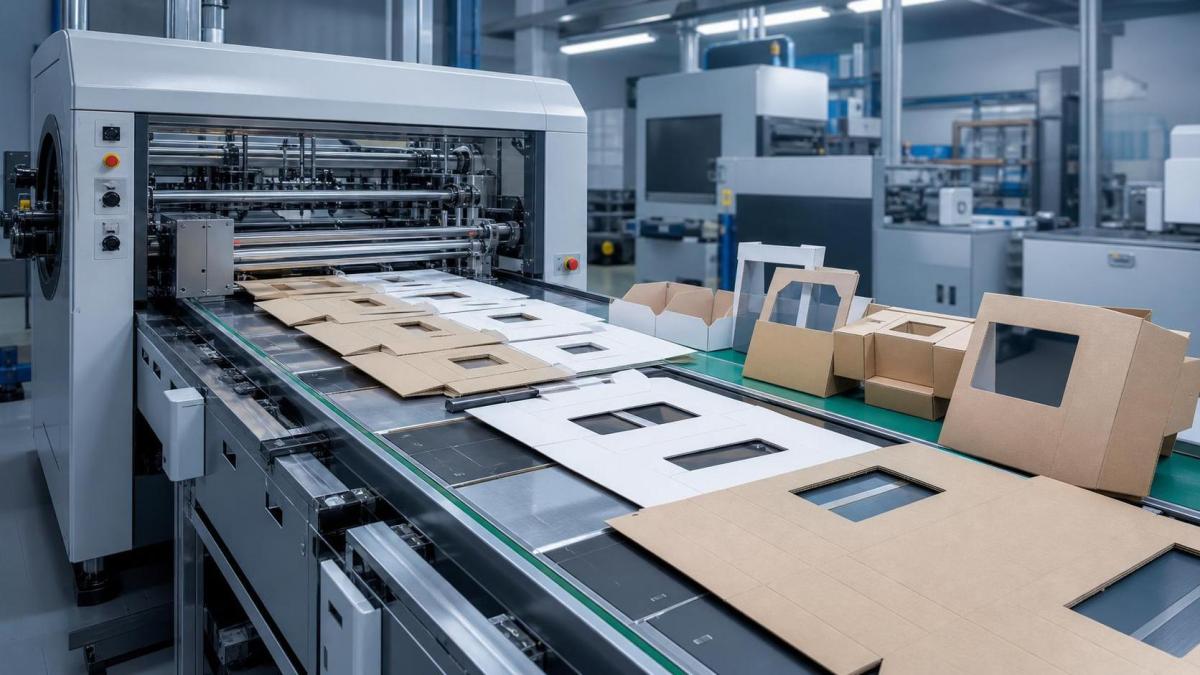
A die-cut part may look simple on a sample table. In production, it is the visible outcome of pressure control, board flatness, rule condition, sheet transport, and downstream handling discipline.
What precision die cutting for packaging actually means
At its core, the process uses a custom tool to cut, crease, score, perforate, or emboss packaging material into a repeatable shape. The word precision matters because the target is not just cutting through material. The target is controlled geometry.
That geometry includes blank size, slot position, hole location, corner sharpness, crease depth, and relationship to printed artwork. In many jobs, tolerance performance matters as much as cut quality.
A technically sound evaluation usually looks at four linked results:
- Dimensional repeatability across the run
- Edge cleanliness without tearing, feathering, or dust
- Crease integrity that supports folding without cracking
- Stable throughput with acceptable setup and make-ready loss
When one of these fails, the cost often appears later. Misaligned gluing, carton pop-open, poor shelf appearance, and stacking issues are common symptoms.
Materials that respond best to precision die cutting
Not every substrate benefits in the same way. Precision die cutting for packaging creates the most value where material variation can be controlled and where shape accuracy affects later operations.
Paperboard and folding carton grades
SBS, FBB, and coated cartonboard are among the strongest candidates. They support high graphic value, precise crease formation, and tight registration with printed elements.
This matters in pharmaceuticals, cosmetics, tobacco, consumer electronics, and premium food packaging. Small panel differences can quickly affect lock-bottom fit, tuck closure behavior, and shelf presentation.
Corrugated board
Corrugated applications are more demanding because flute profile, moisture, and board warp influence cutting response. Even so, precision die cutting for packaging is highly effective for retail-ready trays, inserts, point-of-sale units, and e-commerce protective structures.
The better the upstream board line controls thickness and bonding consistency, the more predictable the die-cut result becomes. PWFS often treats this as a chain issue, not a single-machine issue.
Labels, laminates, and specialty sheets
Pressure-sensitive constructions, thin films, and composite materials also benefit, especially when kiss-cut depth and matrix stripping need close control. These jobs usually demand finer tooling, sharper setup discipline, and tighter waste management.
Materials that need caution
Recycled grades with unstable caliper, heavily textured boards, and moisture-sensitive substrates can still be processed well. They simply require more attention to pressure balancing, rule selection, and environmental control.
How tolerance should be judged in real jobs
Tolerance is often discussed too broadly. A tight number on paper means little without linking it to substrate behavior, print registration needs, and downstream assembly requirements.
For practical evaluation, it helps to separate three levels of tolerance demand.
Usually, the highest risk is not absolute dimension alone. It is variation over time. A line that starts in tolerance but drifts during the shift can create larger hidden losses than a slower line with stable control.
That is why technical reviews should check tooling wear, pressure repeatability, sheet travel stability, stripping performance, and blank collection quality together.
Jobs where precision die cutting delivers the strongest value
The best applications share one feature: package geometry directly influences commercial performance or process efficiency.
High-graphic folding cartons
For premium cartons, even slight drift between artwork and cut line can damage brand perception. Clean nicks, accurate windows, and controlled creasing are essential when visual quality is part of the product value.
Automation-ready box blanks
When cartons feed into high-speed folder-gluers or packing lines, shape consistency matters more than sample appearance. Precision die cutting for packaging reduces jams, glue misses, and folding asymmetry.
E-commerce inserts and protective components
This segment rewards precision because fit drives protection and pack-out efficiency. Overcut or undercut inserts create product movement, slower assembly, and unnecessary material use.
Complex promotional and display formats
Retail displays often combine multiple folds, tabs, and locking points. The more interaction points a design has, the more valuable precision die cutting becomes.
Evaluation points that deserve closer attention
A strong review should move beyond headline speed and nominal pressure. The more useful questions sit inside process behavior.
- How stable is cut quality across substrate changes?
- How well does the machine maintain registration at production speed?
- How quickly can operators balance pressure after tooling change?
- How much waste appears during setup, stripping, and delivery?
- How well does the output feed folder-gluers or packing cells?
- How visible is process data for diagnostics and continuous improvement?
This is where PWFS-style intelligence becomes useful. Die-cutting performance is easier to judge when linked with board formation quality, offset color registration, servo control, and digital production feedback.
In other words, precision die cutting for packaging should be read as part of an integrated converting system, not as an isolated station.
How to apply this understanding in a sourcing or upgrade review
A practical next step is to classify current and future jobs by substrate, graphic sensitivity, structural complexity, and downstream automation requirement. That usually reveals where precision die cutting for packaging will return the most value.
Then compare three things together: the real tolerance needed, the materials actually used, and the line conditions upstream and downstream. Many problems blamed on tooling are really board, print, or handling issues.
Where the review shows repeated waste, unstable folding, or registration drift, the decision should not focus only on machine specification sheets. It should include process capability, maintenance discipline, and data visibility across the converting chain.
That approach creates a clearer basis for tooling trials, line audits, and supplier comparison. It also makes later investment decisions more defensible, especially when packaging demand is shifting toward faster changeovers and tighter quality expectations.
Precision die cutting for packaging is best understood as a capability match. The strongest results appear when material behavior, tolerance targets, and job design are aligned early, then verified against real production conditions.
Related News
Get weekly intelligence in your inbox.
No noise. No sponsored content. Pure intelligence.
