
How to Evaluate a Flexible Packaging Technology Manufacturer for Quality and Fit
Start with the production reality, not the brochure
When procurement teams evaluate a flexible packaging technology manufacturer, the first mistake is treating all suppliers as if they are selling the same thing with different logos. They are not. One supplier may be strong in high-speed output but weak in changeover discipline. Another may look impressive on print quality samples yet struggle when the job mix includes short runs, frequent SKU changes, or stricter material controls.
A workable evaluation starts with your own operating conditions: film structures, pouch formats, run lengths, target waste levels, registration tolerance expectations, downstream sealing performance, food-contact requirements, and the level of automation your plant can actually absorb. Without that baseline, it is easy to reward polished presentations and miss practical fit.
If you want a reliable shortlist, assess the manufacturer in the same order your operation will feel the consequences: application fit, process capability, quality control, compliance handling, service depth, and lifecycle economics.
Check whether they understand your packaging application
This sounds obvious, but it is where weak matches usually begin. Ask the flexible packaging technology manufacturer to walk through your actual product mix, not a generic category slide. Stand-up pouches, sachets, lidding, rollstock, retort structures, recyclable mono-material formats, and high-barrier laminates do not place the same demands on printing, laminating, slitting, curing, or sealing.
What you are looking for is not just “yes, we can do it.” You want to hear where the process becomes sensitive. For example:
- Which substrates are stable at your target speeds and which ones create tension or registration issues?
- How does the line handle frequent design changes and small-batch work?
- What part of the process most often drives defects: ink transfer, adhesive application, drying, slitting accuracy, or pouch conversion?
- What is their normal approach when seal integrity and print appearance start competing with each other?
A manufacturer that has done this kind of work before will answer with constraints, tradeoffs, and process controls. A weak one stays at the level of selling points.
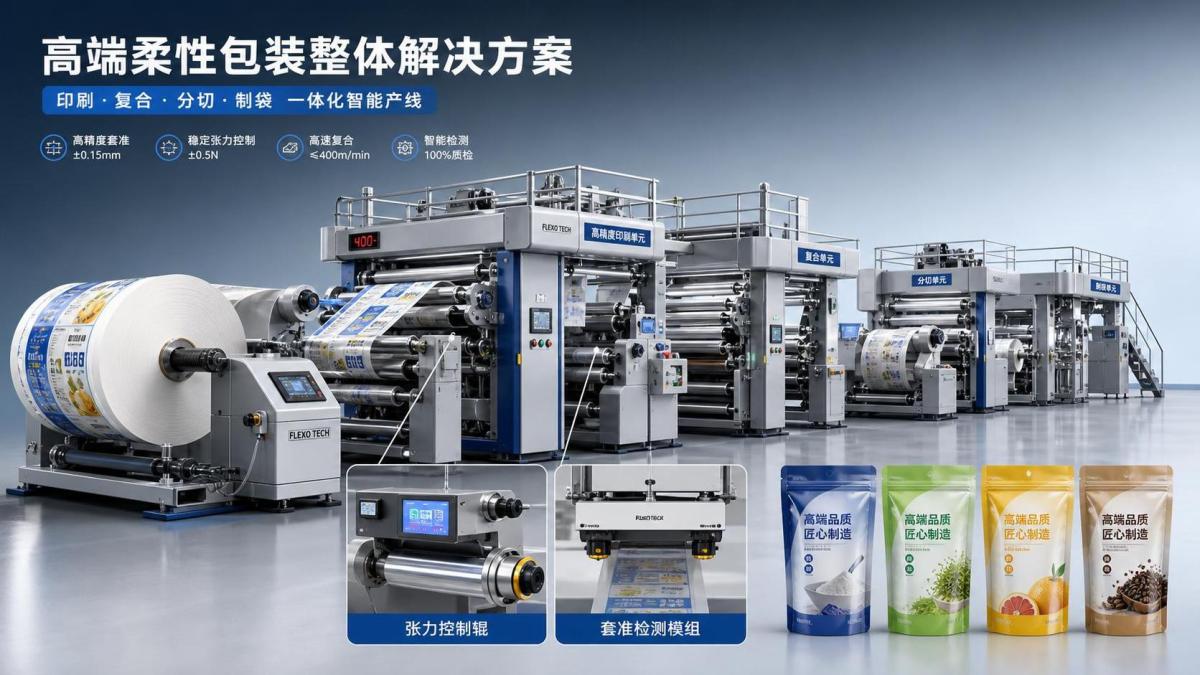
Look past machine specs and test process capability
Headline speed is one of the least useful numbers in supplier evaluation unless it is tied to stable output on your material set. Procurement teams get more value from a process capability discussion than from a spec-sheet comparison.
Ask for a structured review of how the equipment maintains consistency during long runs and during changeovers. In flexible packaging, many quality losses happen in the transitions: color adjustment, tension reset, adhesive ratio drift, curing setup, knife positioning, pouch size change, sealing jaw tuning.
A practical checklist here includes:
- Registration control method and how operators detect drift before scrap climbs
- Tension control architecture across unwind, print, laminate, slit, and convert stages
- Changeover steps that are manual versus automated
- Repeatability of settings for recurring SKUs
- How startup waste is reduced after recipe changes
If possible, ask for a trial based on a representative structure and design complexity. A simple sample job proves very little. A better trial includes challenging elements: fine text, solid coverage, multiple colors, thin films, and at least one changeover event.
Audit quality control at the point defects actually occur
A polished QA manual is useful, but it should not be the center of the conversation. What matters is where quality is measured, how often, and whether the manufacturer can stop a drift condition before it turns into a full lot problem.
For flexible packaging equipment, ask how they monitor the issues that hurt converters and brand owners most: registration variation, color inconsistency, coating or adhesive uniformity, slitting edge quality, seal-window stability, pouch dimensional variation, and defect detection at speed.
One useful way to compare suppliers is this:
Do not just ask whether inspection systems exist. Ask what happens when they detect a trend.
Separate compliance knowledge from marketing language
Compliance becomes messy when buyers assume it is covered because a supplier says the line is “food packaging ready” or “export compliant.” Those phrases are too loose to use in a decision.
The real question is whether the manufacturer can support the documentation and process controls your market requires. That depends on what you are packing, where it will be sold, and how the package is built. Food contact applications, pharmaceutical packaging, and personal care formats do not create the same document trail or process sensitivity.
Ask to review the exact documents and control points they normally support, such as material traceability records, ink and adhesive handling procedures, cleaning procedures where relevant, and the technical file structure used during validation or qualification. If your target market requires supplier declarations, migration-related support from material partners, or batch traceability through print and conversion stages, verify how that information is captured and handed over. A capable manufacturer can explain the workflow document by document.
This is also where you find out whether their engineering choices align with your regulatory burden. A line designed for easier cleaning, tighter process repeatability, and stronger data capture usually reduces validation pain later.
Judge integration readiness before you judge automation level
A lot of procurement trouble comes from buying “advanced” equipment that the plant cannot integrate cleanly. Automation only pays back when it connects to prepress, job setup, maintenance planning, quality records, and production reporting without constant manual workarounds.
Ask the manufacturer how job data moves through the system. Can recurring SKUs be recalled reliably? Can process parameters be logged by job? Can alarms, downtime reasons, and consumption data be exported into your MES or plant reporting layer? If your business runs mixed packaging formats with frequent order changes, recipe management matters more than flashy automation language.
A common miss is buying a line that runs well in isolation but creates manual data re-entry everywhere around it. That usually shows up later as scheduling friction, inconsistent quality records, and slow root-cause work when complaints appear.
Test the service model the same way you test the equipment
Many buyers spend weeks comparing machine configuration and very little time stress-testing after-sales support. In practice, response quality often decides whether the investment performs in year three the way it did during acceptance.
Check service depth in concrete terms:
- Commissioning scope: who owns startup tuning, qualification support, and operator ramp-up?
- Remote diagnostics: what can be accessed remotely, and what still requires a field visit?
- Spare parts logic: which wear parts should be held locally, and what are the normal replenishment paths?
- Training format: one-time classroom delivery is rarely enough for multi-shift operations
- Escalation path: when output drifts, who picks up the problem and how fast?
A supplier that can only talk about installation is still selling hardware. A supplier that can explain stability after six months is closer to being a real operating partner.
Compare total operating fit, not just capital cost
Low purchase price can hide expensive operating behavior. With flexible packaging equipment, the real cost picture usually sits in waste at startup, labor intensity during changeovers, spare-part dependence, downtime diagnosis, adhesive or ink inefficiency, and the number of good saleable units produced under normal shop-floor conditions.
Ask each manufacturer to discuss cost drivers under your production pattern, especially if you run many SKUs or short to medium batches. A line optimized for long, stable runs may look efficient on paper and disappoint badly in a business with constant artwork revisions and frequent format shifts.
This is also the stage to challenge hidden assumptions in the proposal. Are utility needs realistic for your site? Does the quoted performance depend on a narrower substrate window than your sales mix requires? Does the labor model assume operators with a higher skill level than you can staff consistently?
Use a short decision table before the final round
Before awarding the project, reduce the discussion to a few decision questions that expose risk fast:
- Can this manufacturer run our real packaging mix with stable quality, not just ideal samples?
- Where is the process most likely to drift, and do we trust their control strategy there?
- Will the line fit our plant systems, staffing model, and changeover rhythm?
- Can they support the documentation and traceability burden of our target market?
- If output drops after handover, do we have a credible recovery path with this supplier?
That final pass usually clarifies the difference between a supplier that looks capable and one that actually fits.
What a solid procurement sequence looks like
In practice, the cleanest selection process is simple. Define your application conditions first. Narrow the field by substrate and format fit. Review process controls around registration, tension, changeover, and defect response. Check how compliance records and traceability are handled for your end market. Then pressure-test service, spare parts, training, and data integration before comparing commercial terms.
That order matters. A flexible packaging technology manufacturer should be chosen because it can hold quality under your operating reality and support the business after startup, not because the proposal looked strong in isolation. Procurement gets better outcomes when the decision is built around repeatability, evidence, and operational fit rather than headline specs alone.
Related News
Get weekly intelligence in your inbox.
No noise. No sponsored content. Pure intelligence.
