
How to Evaluate Automated Packaging Lines for Throughput, Flexibility, and ROI
How to Evaluate Automated Packaging Lines for Throughput, Flexibility, and ROI
For enterprise decision-makers, evaluating automated packaging lines means looking beyond speed claims to the full picture of throughput, flexibility, and long-term ROI. From corrugated production and printing to die-cutting, folding, and gluing, the right line can reduce labor dependency, improve consistency, and support fast-changing market demands. This guide outlines the key factors that matter when comparing systems built for scalable, profitable industrial performance.
The first mistake I see in automated packaging lines evaluations is buying headline speed. A supplier quotes a very high output number, everyone focuses on it, and six months later the real bottleneck turns out to be changeovers, material stability, curing time, upstream feeding, or downstream packing. If you are comparing lines for cartons, corrugated formats, printed boxes, or folding-gluing work, the question is not “What is the top speed?” It is “What sustained output can this line hold on our actual mix?”
Start with the production mix, not the machine brochure
Before looking at vendors, write down what really runs through your plant. Not the ideal jobs. The real ones.
- Board grades, flute profiles, paper weights, sheet sizes, and box styles
- Average batch size and the share of short runs versus repeat runs
- Print complexity, registration tolerance, glue patterns, and finishing requirements
- Seasonal peaks, SKU proliferation, and customer lead-time expectations
- How much rework, manual sorting, or offline correction happens today
If a vendor cannot map its proposed line to this mix in a concrete way, the conversation is still too early. Good suppliers will ask for job data, waste records, and line history. Weak ones go straight to generic promises.
For decision-making, I would keep one internal sheet that separates your work into three buckets: volume runners, margin-sensitive specialty jobs, and disruptive small-lot orders. That single view usually tells you whether the line should be optimized for raw throughput, fast changeover, or balanced flexibility.
Throughput: measure the line as a system
Real throughput is governed by the weakest part of the process chain. In packaging plants, that may be sheet feeding, stack change, die-cut stripping, folding stability, glue application, bundle discharge, palletizing, or even barcode verification. A fast section surrounded by slow handling is still a slow line.
Ask vendors to discuss output under normal production conditions, including:
- Ramp-up time after start and after job change
- Stable running speed on your common substrates
- Expected scrap rate during setup and during long runs
- Stop frequency caused by misfeeds, skew, glue faults, registration drift, or downstream jams
- Labor needed to keep the line at target speed across a full shift
What matters is net good output per hour, not theoretical cycles. If you can, request a factory acceptance test built around representative jobs, or at least recorded production evidence from comparable applications. If the reference jobs are all large, clean, repeat orders and your business is short-run mixed SKU work, treat the performance claim carefully.
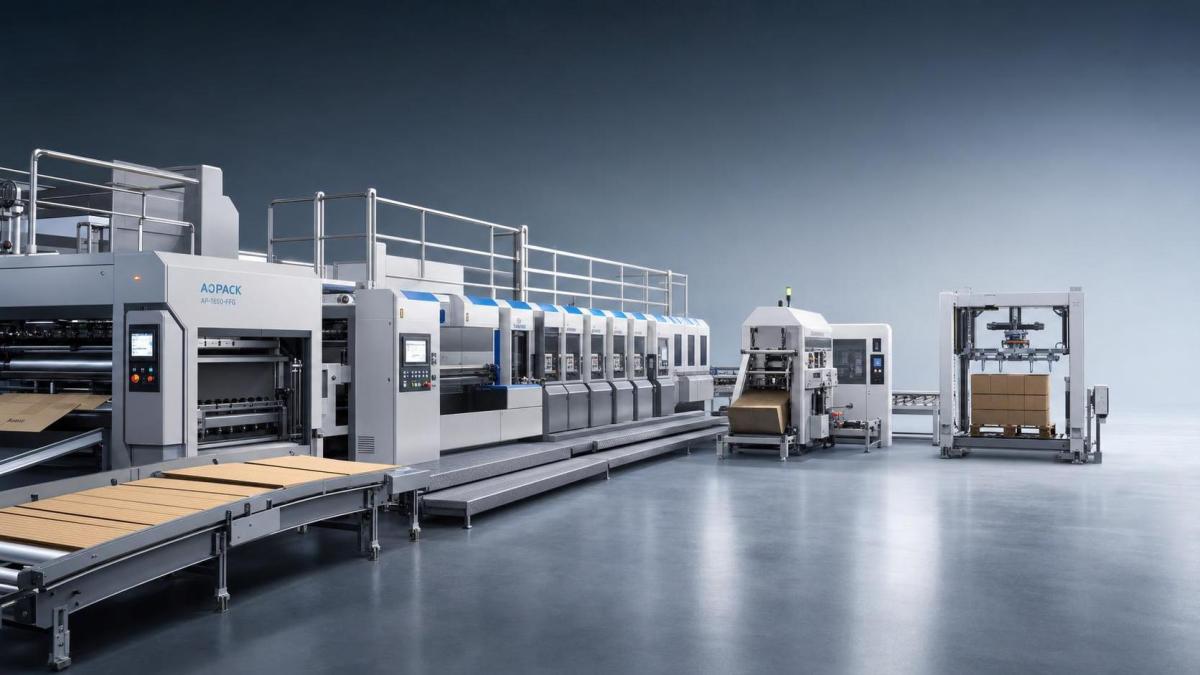
A useful internal question is simple: when the line is supposed to run for eight hours, how many sellable units actually leave the end of the line, packed in the way the customer needs them? That answer is much closer to truth than any catalog speed.
Flexibility is usually where the investment either works or fails
Many companies buy for today’s hero product and regret it when the sales mix shifts. E-commerce has pushed more SKU variation, more versioning, and more demand for faster replenishment. In furniture and custom panel-related packaging, the same issue appears when dimensions and presentation requirements keep changing with order mix.
When you assess flexibility, get specific. Can the line move cleanly between different formats without a long mechanical reset? Are recipe storage, servo positioning, and guided changeover built in? How many settings still depend on the skill of one experienced operator? If that person is absent, do results hold?
This is where some highly automated packaging lines underperform in practice. They are automated, but only within a narrow process window. Once substrate variation, humidity, print coverage, glue behavior, or box geometry shifts, the machine becomes operator-dependent again.
Do not treat automation as labor reduction alone
Labor savings are real, but they are not the whole story. The stronger case is usually labor stability plus process consistency. If your output depends on a few operators who know how to “listen” to a folder-gluer or manually correct alignment drift on difficult jobs, you have operational fragility. Automated lines can reduce that fragility, but only if the controls, sensing, and diagnostics are mature enough to support less intervention.
Ask to see alarm logic, fault history categories, and operator guidance screens. Better HMIs do more than display errors. They help isolate root cause fast: feeder issue, registration issue, adhesive issue, stack issue, or downstream accumulation issue. That matters at 2:00 a.m. on a peak-season shift.
ROI gets distorted when hidden costs stay off the spreadsheet
A serious ROI review for automated packaging lines should include more than purchase price and labor substitution. Keep the model grounded in items you can verify internally:
- Waste reduction from better setup repeatability and tighter process control
- Uptime improvement versus the current line or manual workflow
- Reduced overtime and lower dependence on scarce skilled labor
- Floor space impact, especially if the new line changes material flow
- Utilities, compressed air, extraction, steam, adhesive systems, and maintenance consumables
- Tooling, spare parts strategy, and software licensing or support contracts
- Integration cost with MES, ERP, prepress, barcode systems, inspection, or warehouse automation
One practical rule: if the ROI only works under perfect utilization, it probably does not work. Run the numbers using a realistic ramp period, conservative scrap assumptions, and partial staffing overlap during commissioning.
Integration is where many good machines become disappointing projects
A packaging line rarely lives alone. It sits inside a chain of scheduling, file preparation, feeding, handling, inspection, and dispatch. If you are investing at enterprise scale, ask early how job data will flow into the line and how production data will flow back out.
For plants already using MES or planning digital scheduling, recipe download, job traceability, downtime coding, and OEE reporting are not side topics. They affect whether the line becomes manageable across shifts and sites. Suppliers should be able to explain available interfaces and data granularity. If they answer only in marketing language, push harder.
This point is especially relevant in corrugated and carton operations where upstream print accuracy, downstream folding quality, and delivery timing all have to stay coordinated. A machine that cannot communicate clearly with the rest of the factory often creates manual patches that erase part of the automation gain.
Check maintainability before you check appearance
Shiny guarding and a modern interface are easy to sell. Maintenance access is harder to fake, and much more important. Look at how quickly crews can reach wear parts, clean glue stations, replace belts, inspect sensors, or service vacuum systems. Ask what preventive maintenance is expected by shift, week, and month.
Then ask a less comfortable question: what breaks most often? A credible supplier will answer without drama. No line is failure-free. What you want is transparency about failure modes, spare part lead times, and remote support capability.
If the equipment is crossing borders, include service coverage, local technician availability, electrical standards compatibility, and documentation quality in your evaluation. Compliance requirements can vary by market, and machine safety obligations should be reviewed against the destination region’s applicable rules and plant requirements. Specific certifications and legal acceptance points should be checked case by case rather than assumed.
Use site visits well, or skip them
A reference visit is useful only if you go with a checklist and ask uncomfortable operational questions. Do not spend the whole visit watching a clean demo job. Ask the host plant what happened during the first three months, what jobs still cause trouble, how often they stop for adjustments, and whether the promised staffing model held up.
Pay attention to what the operators touch repeatedly. Repeated manual correction is a signal. So is the presence of workarounds around feeding, alignment, stack handling, or quality checks.
A short decision checklist for the final round
- Can the line sustain target output on your actual product mix, not just on ideal jobs?
- Does changeover time fit your future SKU complexity, not only today’s volume model?
- Is process stability built into the machine, or still dependent on expert operators?
- Have integration costs, support terms, utilities, and maintenance realities been included in the ROI?
- Can the supplier prove support capability in your market after commissioning?
- Have you tested the proposal against the jobs that usually create waste, delays, or customer complaints?
That last point matters more than people expect. Difficult jobs reveal the truth. Easy jobs flatter every machine.
If you are selecting automated packaging lines for a serious capacity step, keep the discussion tied to net sellable output, repeatability across job changes, and the total cost of keeping the line productive over time. The best investment is usually not the fastest machine in the room. It is the one that keeps making good product, across shifts and changing order patterns, without needing heroics to stay there.
Related News
Get weekly intelligence in your inbox.
No noise. No sponsored content. Pure intelligence.
