
How Can Factories Achieve Zero-Waste Emissions Without Disrupting Operations?
For manufacturers under pressure to improve sustainability without risking uptime, zero-waste emissions for factory operations is no longer a distant ideal but a practical strategy. From corrugated lines and offset presses to CNC woodworking and edge banding systems, the right mix of process intelligence, automation, and material recovery can cut waste at the source while protecting output, quality, and profitability. This article explores how factory leaders can move toward cleaner production with minimal disruption.
In practice, the phrase “zero-waste emissions” often creates confusion. Many factory teams hear it as a promise of instant elimination: no scrap, no wastewater, no volatile emissions, no dust, no landfill, no compliance risk. That is not how real industrial transitions work. For decision-makers, the useful interpretation is more operational: reduce waste generation at source, maximize reuse and internal recovery, minimize uncontrolled emissions, and redesign production so environmental performance improves without destabilizing throughput.
That distinction matters because the biggest reason sustainability programs stall is not technical impossibility. It is operational fear. Plant leaders worry that environmental upgrades will slow the line, increase changeover complexity, create quality instability, or consume capex better reserved for output expansion. In sectors like packaging converting, printing, and panel furniture, those concerns are justified. A corrugated board line cannot afford glue inconsistency. An offset press cannot tolerate contamination that affects registration or color repeatability. A CNC woodworking cell cannot sacrifice extraction performance and still maintain cut quality, tool life, and fire safety.
The good news is that the most effective zero-waste emissions strategy rarely starts with end-of-pipe equipment alone. It starts with process discipline.
Where factories usually get the transition wrong
A common mistake is treating waste as a disposal problem rather than a process signal. When management focuses only on what leaves the site—sludge, trim, solvent vapor, overspray, dust, rejected sheets—it often invests in collection and treatment before understanding why those losses are being created. That approach can improve compliance, but it rarely produces the strongest business case.
In industrial packaging and woodworking environments, waste is usually generated in five predictable zones:
- Raw material variation that forces overcompensation in setup or process parameters
- Startup and changeover losses
- Process instability during steady-state production
- Quality rejects detected too late
- Poor segregation that turns recoverable by-products into mixed waste
Executives looking for minimal disruption should therefore prioritize interventions that remove waste before it becomes a treatment burden. This is particularly important when energy prices, labor availability, landfill fees, and buyer scrutiny are all moving in the same direction.
The lowest-disruption path begins with a waste map, not a technology catalog
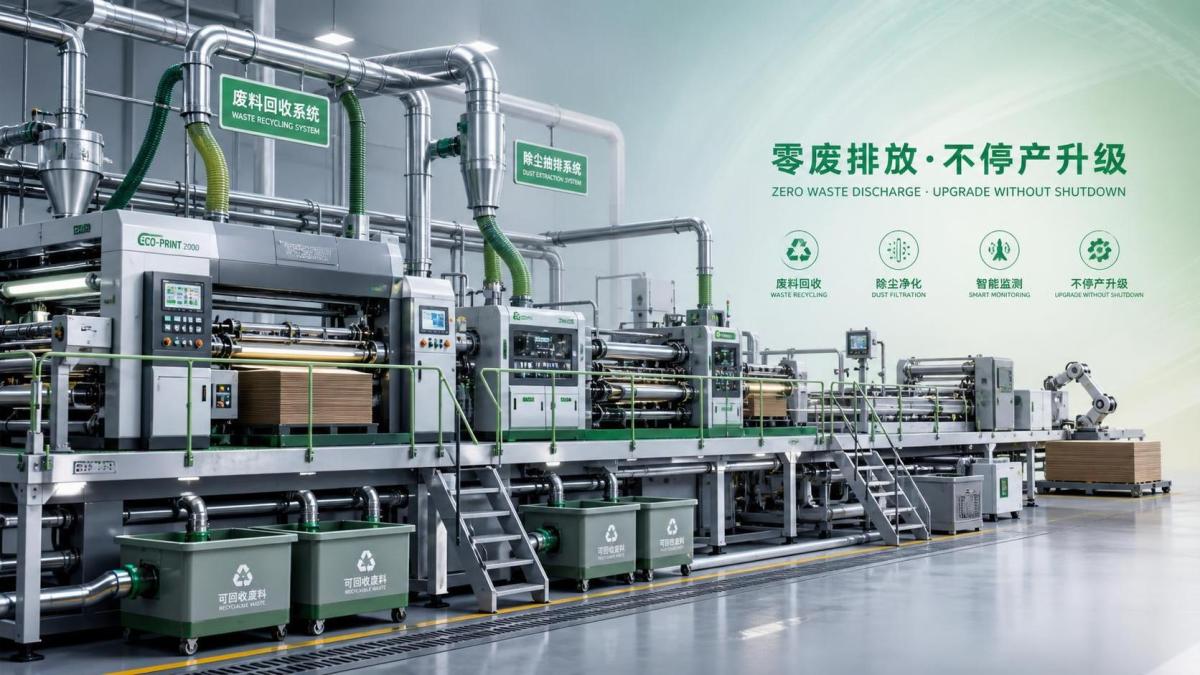
Before evaluating dryers, oxidizers, filtration units, water treatment systems, or briquetting equipment, factories need a line-level waste map. Not a sustainability report. A production map tied to actual losses by machine, material, and shift.
That means measuring:
- Board trim by order profile and flute change on corrugators
- Startup sheets and wash-up losses on offset presses
- Glue waste and carton rejects on folder gluers
- Dust generation, offcut ratios, and damaged panels in CNC nesting cells
- Edge band adhesive consumption, purge losses, and rework rates
- Compressed air leakage, steam loss, and extraction inefficiency across utilities
Without that baseline, zero-waste programs become symbolic. With it, management can rank opportunities by two variables that matter most: waste intensity and operational sensitivity. The ideal first projects are those with high waste intensity and low production disruption.
Source reduction delivers the fastest returns
For most factories, the first 30% to 50% of waste reduction does not come from advanced environmental hardware. It comes from tighter process control.
On corrugated board lines, waste is heavily influenced by paper quality consistency, starch preparation accuracy, steam and moisture control, warp management, and order sequencing. Poor synchronization between single facer conditions, adhesive application, and drying can generate board that is technically usable but commercially downgraded. That is waste even if it never reaches a dumpster. Plants that improve recipe discipline, preheater settings, and splice/changeover planning often reduce scrap without touching nominal line speed.
In offset printing, zero-waste ambitions are often undermined by a simple reality: makeready loss is still a major hidden emitter. Waste sheets, excess ink, wash solvents, and cleaning cloth consumption all accumulate around setup inefficiency. Closed-loop color control, automated ink presetting, improved blanket wash management, and tighter substrate conditioning can materially reduce both material loss and VOC-related burden. These are operational improvements first and environmental improvements second, which is exactly why they tend to gain internal support.
In converting, die-cutting and folding-gluing lines often suffer from a mismatch between upstream print stability and downstream mechanical precision. If registration drift or board dimensional variation is feeding the line, the folder gluer becomes the place where waste becomes visible. Management should resist the temptation to blame the last machine. Zero-waste performance usually requires upstream-downstream process linking, not isolated machine optimization.
Woodworking operations show the same pattern. In CNC cutting and nesting, chip and dust collection is important, but yield starts with software logic and part planning. Poor nesting algorithms, inadequate panel labeling, wrong tool selection, or unstable vacuum holding can generate unnecessary offcuts and damaged components long before waste extraction becomes relevant. A sophisticated dust collector cannot recover the margin lost to poor digital preparation.
Closed-loop reuse is practical when streams stay clean
The second stage is material recovery. This is where many factories either unlock serious value or create expensive complexity.
Clean, segregated waste streams are often commercially reusable. Mixed streams are not. That principle sounds basic, but it is frequently ignored on fast-moving industrial floors.
Paper and board trim can often re-enter recycling channels efficiently if contamination from inks, adhesives, laminates, food residues, or mixed grades is controlled. Wood dust and offcuts may support briquetting, internal energy recovery, or external by-product markets depending on resin content, coating chemistry, and local regulation. Solvent recovery may be viable in specific print environments, but economics depend heavily on volume, consistency, and purity. Wastewater recirculation can work well where load profiles are stable and treatment chemistry is matched to actual contaminants, not assumed ones.
The key operational question is not “Can this waste be recycled?” It is “Can we preserve it in a recoverable condition without adding labor, contamination risk, or line stoppages?”
This is why factories with strong segregation discipline usually outperform those with more expensive treatment infrastructure. Recovery economics are determined on the shop floor, not in the waste yard.
Utilities are often the hidden frontier of zero-waste emissions
Decision-makers sometimes focus so heavily on visible scrap that they overlook utilities, even though utility losses can be among the easiest waste reductions to achieve with little interruption.
In paper converting and printing, steam imbalance, condensate loss, air leaks, dryer overuse, and oversized extraction systems quietly consume large amounts of energy while also affecting quality. In woodworking plants, extraction fan inefficiency, clogged ducting, compressed air misuse, and poor motor control can turn a sustainability target into a cost problem every hour of every day.
Utilities are attractive because improvement projects are often modular. Variable-frequency drives, condensate recovery, heat recovery, leakage audits, and smart monitoring can frequently be implemented in phases during planned maintenance windows. They do not usually require the same operational risk as reconfiguring core production machinery.
For leadership teams seeking visible progress without jeopardizing customer delivery, utility optimization is often the most underused entry point.
Digital monitoring matters because waste events are episodic
Factories do not usually lose margin through constant, evenly distributed waste. Losses come in bursts: a bad startup, a moisture fluctuation, a tool wear event, a glue viscosity drift, an extraction blockage, a short run with too many setup sheets, a panel batch that behaves differently from expectation.
That is why periodic audits are not enough. Zero-waste emissions for factory operations depends increasingly on continuous data capture tied to root causes. The objective is not digitalization for its own sake. It is event visibility.
Useful monitoring layers include:
- Real-time scrap and reject tracking by order, SKU, and shift
- Energy and water consumption linked to production state, not just monthly totals
- Machine-condition alerts that predict quality drift before reject accumulation
- Material genealogy for identifying waste tied to specific suppliers or lots
- Environmental monitoring for dust, VOCs, and process exhaust where applicable
For executives, the value is straightforward: once losses can be tied to a repeatable production condition, they become manageable. Without that visibility, sustainability spending remains reactive.
Compliance pressure is rising, but the business case is broader than regulation
Environmental requirements vary by market and process, and site-specific obligations should always be checked against local law and permit conditions. For multinational manufacturers or exporters, the direction of travel is clear even where precise requirements differ: more scrutiny on emissions, more customer requests for traceability, stronger reporting expectations, and less tolerance for waste-intensive production.
Factories supplying packaging, consumer goods, furniture, or interior products may also face indirect pressure through buyer standards, retailer sustainability scorecards, chain-of-custody expectations, and chemical restrictions. Specific obligations around air emissions, wastewater discharge, waste handling, and worker exposure depend on jurisdiction and application and should be verified case by case. Where formal thresholds or certification criteria are uncertain, they should be treated as 【待核实】 until confirmed through competent regulatory review.
Still, the strongest justification for zero-waste action is rarely compliance alone. It is margin resilience. Waste reduction lowers raw material loss, energy intensity, disposal costs, rework burden, and quality risk. It can also strengthen commercial positioning with customers that increasingly compare suppliers on operational discipline, not just unit price.
How to phase implementation without disrupting operations
The most successful factories do not launch zero-waste programs as a single transformation wave. They phase them around operational risk.
A practical sequence often looks like this:
Phase one: stabilize and measure. Establish line-level baselines, tighten SOPs, reduce avoidable setup losses, improve segregation, and fix obvious utility leaks. This stage should produce visible wins in months, not years.
Phase two: automate control points. Add sensors, recipe control, monitoring, and closed-loop adjustments where process variability is driving waste. Focus on the few parameters that materially affect scrap, emissions, or off-spec output.
Phase three: install recovery infrastructure. Once waste streams are cleaner and more predictable, invest in recovery and treatment systems sized to actual conditions. This avoids the common mistake of overengineering environmental equipment around unstable processes.
Phase four: redesign commercial and production planning logic. The biggest long-term gains may come from smarter order batching, SKU rationalization, supplier quality alignment, and design-for-manufacture changes that reduce waste structurally.
This phased approach matters because it reduces resistance inside the plant. Teams are far more willing to support sustainability investments when early steps improve production performance rather than merely adding reporting tasks or compliance obligations.
What decision-makers should ask before approving a zero-waste project
Not every project marketed as sustainable is operationally sound. Senior leaders should push for clear answers to a few questions:
- Is the project reducing waste at source or just managing it later?
- Which production losses does it target, and how are those losses currently measured?
- What is the expected impact on throughput, changeover time, and quality stability?
- Can implementation be aligned with scheduled shutdowns or maintenance windows?
- Does the proposed system depend on waste stream purity that the plant cannot realistically maintain?
- Who owns performance after installation: production, maintenance, EHS, or an external contractor?
- What commercial assumptions support the payback model, and how sensitive are they to volume changes?
These questions help distinguish strategic projects from equipment-led initiatives searching for a problem.
The strategic shift is from waste treatment to waste-intelligent manufacturing
Factories that make real progress toward zero-waste emissions do not think of the issue as a side program. They treat it as part of manufacturing intelligence. In corrugated packaging, printing, converting, and woodworking, waste is often a symptom of poor synchronization between materials, machines, utilities, and planning logic. Once that synchronization improves, environmental performance and operational performance stop competing with each other.
That is the central decision-making insight. A factory does not need to choose between cleaner production and stable output if it starts in the right place. The least disruptive route is not chasing a perfect “zero” from day one. It is building a system where fewer materials are lost, fewer emissions are created, more by-products stay recoverable, and every improvement is anchored in line performance.
For industrial leaders, that makes zero-waste emissions less of a branding statement and more of a manufacturing discipline—one that is increasingly tied to cost control, buyer confidence, and long-term competitiveness.
Related News
Get weekly intelligence in your inbox.
No noise. No sponsored content. Pure intelligence.
