
Woodworking Equipment Selection Checklist: 12 Criteria Buyers Should Review
Procurement teams rarely get judged on a machine when it is first installed. They get judged six months later, when output targets are missed, tooling costs are higher than expected, operators are improvising around software limitations, or service tickets keep stacking up. That is why a practical woodworking equipment selection checklist matters so much. In woodworking manufacturing, especially in panel furniture, custom cabinetry, and whole-house customization, the purchase decision is never only about the machine itself. It is about whether that machine will fit the factory’s workflow, labor structure, digital systems, quality demands, and future production model.
For buyers comparing CNC routers, edge banders, drilling centers, nesting lines, or related systems, the real challenge is not finding options. It is filtering through claims and identifying what will actually affect throughput, consistency, compliance, and total cost over time. The 12 criteria below are designed to help procurement professionals ask sharper questions, compare suppliers more fairly, and reduce selection risk before capital is committed.
Start with the production reality, not the catalog
Many equipment mismatches begin with a simple mistake: evaluating a machine based on its advertised maximum capability instead of the plant’s actual production profile. A buyer may be shown a router with impressive spindle speed, a highly automated edge bander, or a compact drilling cell with a fast cycle time. But if the factory mainly runs mixed batches, frequent design changes, laminated boards with variable finishes, or labor with uneven technical experience, the “best” machine on paper may become the most difficult asset to absorb.
Before reviewing suppliers, define the job mix clearly: board types, thickness ranges, finish sensitivity, order variability, target takt time, shift arrangement, expected scrap rate, and upstream/downstream bottlenecks. That context turns a generic equipment search into a relevant sourcing exercise.
The 12-point woodworking equipment selection checklist buyers should review
1. Process fit for your actual product mix
The first filter is whether the machine suits what you really make. A custom furniture manufacturer running short batches and frequent SKU changes needs different strengths than a high-volume panel processor. Review supported materials, board sizes, thickness tolerance, part geometries, groove/drill/cut combinations, and finish sensitivity. Ask suppliers to explain performance not only on ideal jobs, but on the messy, repetitive, mixed-production environment your plant lives with every day.
2. Throughput under real operating conditions
Nominal speed figures can be misleading. Procurement should ask what output looks like once loading, tool changes, program switching, cleaning, calibration, edge changes, and operator intervention are included. In CNC woodworking, true productivity comes from stable cycle performance, not peak speed claims. Compare machine utilization assumptions and request clarity on what conditions were used to present output numbers.
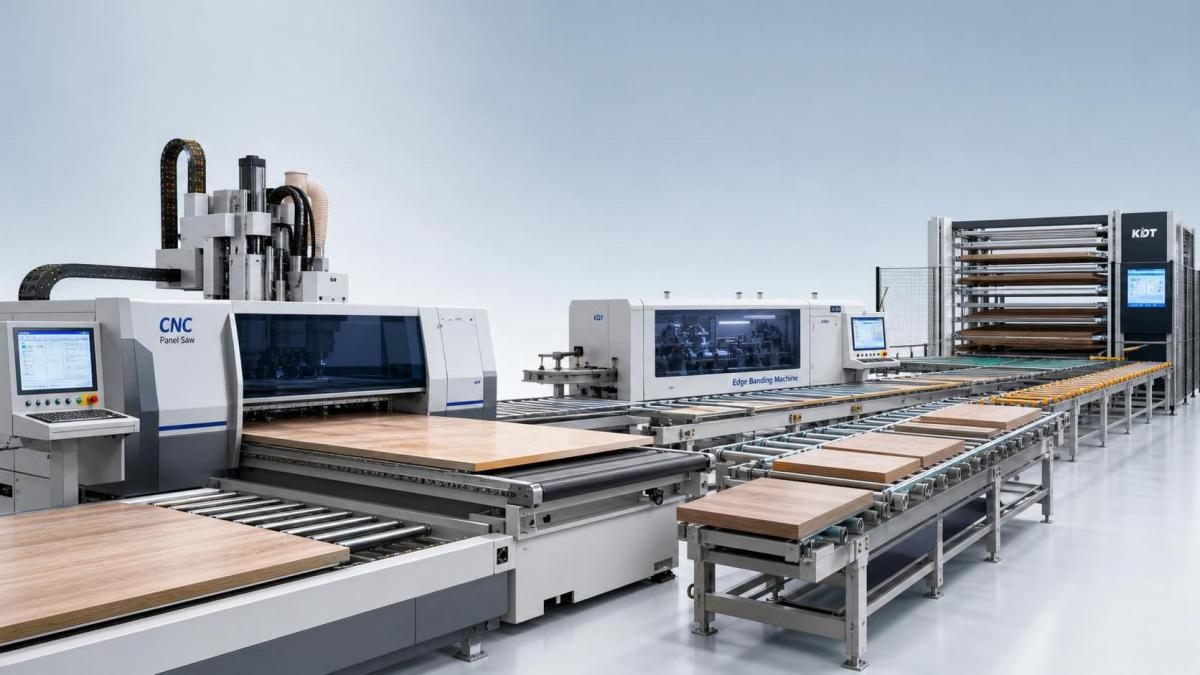
3. Cutting precision and repeatability
In woodworking, poor repeatability quietly damages profitability. Parts may still come off the machine, but downstream fit-up suffers, edge quality declines, drilling alignment drifts, and rework spreads into assembly. Buyers should review positioning accuracy, repeat accuracy, vibration control, spindle stability, and the machine’s ability to maintain consistency over long runs. For edge banders, panel feed stability, glue application control, trimming quality, and corner finish matter just as much as line speed.
4. Software compatibility and digital integration
This is often where expensive disappointment begins. A machine may be mechanically strong but digitally awkward. Procurement should confirm compatibility with CAD/CAM workflows, nesting software, MES, ERP, barcode systems, label printing, production scheduling, and data collection tools. In modern furniture and custom panel processing, equipment that cannot communicate smoothly with design files and shop-floor instructions quickly becomes an operational drag.
PWFS closely tracks this shift because the future of paper and wood manufacturing is increasingly defined by digital stitching between design intent, machine motion, and production visibility. Buyers should not treat software as an add-on discussion at the end of negotiations. It belongs near the top of the evaluation process.
5. Automation level versus labor reality
More automation is not automatically better. The right question is whether the automation level matches your labor structure, maintenance ability, order complexity, and expansion plan. Automatic loading, unloading, sorting, return conveyors, tool measurement, glue management, and fault diagnostics can deliver strong value, but only when the factory is prepared to support them. A partially automated system that operators can run confidently may outperform a highly automated cell that the plant struggles to maintain or schedule properly.
6. Tooling, consumables, and ongoing operating cost
Capital cost gets attention; operating cost often arrives later as a surprise. Review cutter life, tool change frequency, blade availability, glue consumption, edgeband compatibility, dust extraction needs, lubrication requirements, and power demand. Ask how sensitive performance is to consumable quality. A machine that only performs well with expensive or difficult-to-source tooling may create hidden procurement pressure long after installation.
7. Maintenance burden and service accessibility
Every machine requires maintenance, but not every machine is equally maintainable in the field. Buyers should examine access to wear parts, diagnostic support, preventive maintenance intervals, spare parts lead times, and local or regional service coverage. It is also worth checking whether daily care tasks are realistic for the operating team. If routine maintenance depends on highly specialized intervention, downtime risk rises.
For procurement teams, one useful test is simple: if the machine stops on a busy production day, how quickly can the plant identify the problem, get a replacement part, and restore stable output?
8. Dust control, safety, and shop-floor environment
Woodworking equipment operates in conditions where dust, heat, debris, and noise are not side issues. They influence machine life, product quality, and worker safety. Review dust extraction interface requirements, guarding design, emergency stop placement, sensor protection, chip evacuation, and accessibility around the machine footprint. A machine that looks compact in a brochure may create congestion, poor maintenance access, or unsafe material flow in a real workshop.
9. Material handling and line balancing
A standalone machine may perform well while the production line around it underperforms. Buyers should evaluate infeed and outfeed logistics, part identification, stacking, sorting, buffering, and connection with upstream cutting or downstream assembly. In panel furniture production especially, bottlenecks often move from machining to handling. The best sourcing decisions consider the full path of the board, not just the speed of one station.
10. Supplier application knowledge, not just sales responsiveness
Responsiveness is helpful, but technical understanding is more important. Strong suppliers ask detailed questions about board composition, finishes, nesting density, drilling patterns, humidity conditions, glue preferences, and target defect tolerances. They are able to discuss where process instability usually appears and what configuration choices reduce it. Buyers should pay attention to whether the supplier is selling a standard box or helping shape a workable production solution.
In sectors like custom furniture and flexible manufacturing, application knowledge often determines whether the machine will integrate smoothly or require months of correction after installation.
11. Compliance, documentation, and traceability readiness
Procurement cannot leave compliance to engineering alone. Depending on region and end market, buyers may need to verify electrical conformity, safety documentation, material contact considerations, environmental controls, and traceability capabilities. While woodworking equipment is not identical to packaging machinery in regulatory exposure, the broader manufacturing environment is moving toward tighter documentation, cleaner process records, and more transparent production controls. Equipment that supports recipe control, job traceability, and service documentation is becoming easier to justify internally.
12. Scalability and long-term factory direction
The final criterion is strategic fit. Will the equipment still make sense if order volume doubles, product mix changes, labor becomes harder to find, or the business adopts more digital planning? Can modules be added later? Can software be upgraded? Will the control architecture support future integration? Procurement teams are not only buying for today’s order book; they are making a decision that may shape process capability for years.
Common mistakes buyers make during woodworking equipment evaluation
One common mistake is over-prioritizing machine speed while under-prioritizing stability. Another is comparing quotations without normalizing scope: one supplier includes tooling packages, integration support, operator training, and spare parts, while another excludes them. The prices look comparable until the implementation phase begins.
There is also a frequent tendency to separate technical review from commercial review too sharply. In reality, terms such as installation support, commissioning responsibility, software handoff, training depth, and after-sales response are commercial issues with major technical consequences. Procurement works best when operations, maintenance, engineering, and finance all help shape the checklist before the final shortlist is made.
How to use this checklist in supplier comparison
Rather than treating this woodworking equipment selection checklist as a reading exercise, turn it into an evaluation sheet. Assign each criterion a weighting based on your production priorities. For example, a factory moving toward batch-size-one customization may weight software integration and changeover flexibility more heavily than maximum linear feed speed. A plant struggling with downtime may give greater weight to maintenance access and local service capability.
Then ask each supplier to respond against the same framework. Standardized comparison reduces the risk of choosing the best presentation instead of the best-fit solution. It also helps procurement defend the decision internally, especially when stakeholders focus on different risks.
Why this matters more now
Woodworking manufacturing is changing. Customization cycles are shorter, labor is less predictable, material quality can vary, and digital connectivity is no longer optional for many factories. As PWFS continues to observe across CNC woodworking, edge processing, automated conversion, and broader industrial production systems, one pattern is consistent: the best capital decisions are made when buyers connect machine performance with workflow reality, data readiness, and long-term operating discipline.
A good machine can raise output. A well-chosen machine can reshape a factory.
For procurement professionals, that distinction is the whole point of a serious selection process. If you review these 12 criteria carefully, you will be in a stronger position to identify practical value, challenge vague claims, and invest in woodworking equipment that supports not just installation day, but the demands that follow after the machine becomes part of daily production.
Related News
Get weekly intelligence in your inbox.
No noise. No sponsored content. Pure intelligence.
