
How to Evaluate Flexible Wood-Cutting Solutions for Custom Furniture Production
It often starts with a familiar production-floor complaint: a designer releases a custom wardrobe or cabinet set that looks reasonable in CAD, but once the job reaches cutting, everything slows down. Nesting takes longer than expected, parts with similar shapes get mixed into inefficient toolpaths, edge quality changes from one board type to another, and rework begins to eat into delivery time. In custom furniture production, this is not usually caused by one dramatic failure. More often, it comes from choosing a cutting setup that looked capable on paper but does not stay flexible when product variation increases.
That problem becomes more frustrating when order sizes shrink and design complexity rises at the same time. A workshop may no longer be cutting repeated rectangular panels all day. Instead, it is switching between wardrobes, bathroom cabinets, open shelving, curved decorative pieces, and drilled connection parts, often within the same shift. In that environment, evaluating flexible wood-cutting for furniture is less about a machine’s headline speed and more about whether the whole cutting process can absorb variation without losing control of accuracy, waste, or downstream fit-up.
Many teams begin the evaluation in the wrong place. They compare spindle power, table size, or brochure-level cutting speed first. Those things matter, but they rarely explain why one setup handles whole-house customization smoothly while another becomes difficult once special-shaped parts, fast changeovers, and mixed materials enter the schedule. A more reliable approach is to judge the solution from the problem backward: where does instability appear, and which technical capabilities directly reduce it?
Start with the production situation, not the equipment catalog
Before comparing machine configurations, it helps to map the real work mix. A cutting system for standard panel furniture can be judged differently from one used for highly customized interiors. If your daily production includes frequent design revision, one-off components, multiple board thicknesses, hidden connectors, and strict handoff requirements for edge banding and assembly, flexibility is not a secondary feature. It is the core requirement.
A practical review usually starts with a few questions that sound simple but reveal a lot:
- How often do part geometries change during a normal production cycle?
- Are materials mostly one panel type, or do they include melamine board, plywood, MDF, composite boards, and specialty surfaces?
- Does the cutting process need to support drilling, grooving, slotting, and contour work in the same workflow?
- How dependent is the current process on operator experience for tool selection, nesting adjustments, and part sequencing?
- Where do errors show up later: edge banding mismatch, hole-position drift, chipped surfaces, part labeling confusion, or assembly interference?
These are not purchasing questions in the narrow sense. They are process questions. Without them, a buyer may end up selecting a router that is technically strong yet operationally rigid.
Where flexible cutting usually breaks down
In many workshops, the trouble is not that the CNC equipment cannot cut wood-based panels at all. The trouble is that it cannot adapt cleanly when conditions change. One design requires clean top-surface finishing on laminated board; the next needs stable chip evacuation in deeper pockets; another introduces narrow parts that shift risk during vacuum holding. If every variation requires heavy manual intervention, the system is not truly flexible.
Common signs of poor fit include inconsistent edge cleanliness on different board faces, unstable small-part handling, too much time spent re-editing toolpaths, frequent pauses for tooling changes, and poor communication between design software and machine execution. Some operations also discover that the cutting cell itself is acceptable, but the surrounding digital process is weak. CAD output may not translate smoothly into machine-ready instructions, labels may not follow the job reliably, or drilling logic may be split across separate manual steps.
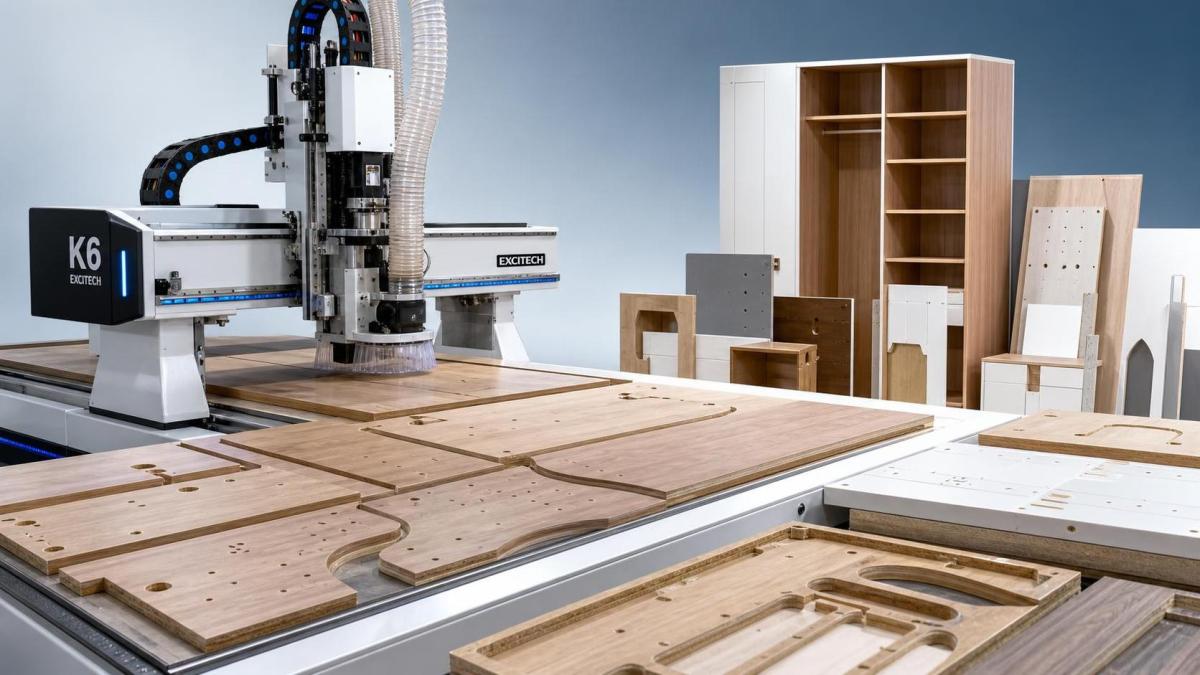
That is why evaluation should cover more than motion hardware. In furniture production, cutting quality and scheduling efficiency are tied to software interpretation, kinematics, chip evacuation behavior, board handling, and process continuity.
A better way to compare options
When the goal is selecting flexible wood-cutting for furniture, it helps to compare solutions across five areas instead of chasing one specification.
1. Geometry adaptability
Look at how the system manages varied part shapes, not just straight-line cuts. Custom furniture often includes arcs, angled pieces, sink openings, handle recesses, connector drilling, and irregular interior contours. A rigid setup may handle basic rectangles well but slow down once contour diversity increases. Ask whether the machine and programming environment support efficient processing of both standard panels and shape-driven components without excessive rework by programmers.
If a supplier references CNC woodworking routers that directly read front-end design data, that point deserves attention. The value is not the phrase itself; it is whether design intent can move into cutting logic with minimal reinterpretation. Every extra manual conversion step increases the chance of mismatch.
2. Toolpath stability across materials
Not all panel materials respond the same way under high-frequency cutting. Surface finish, internal density, glue content, moisture variation, and decorative layers can all affect cut quality. A strong evaluation asks how the proposed setup deals with changing feed conditions, chip removal, tool wear sensitivity, and surface protection.
This is especially important when a factory handles mixed-material custom jobs. A system that performs nicely on one board type may become difficult on another if tool libraries, extraction design, and process recipes are underdeveloped. Ask to review how tool strategies are organized for different materials and whether adjustments are repeatable or dependent on one skilled operator’s memory.
3. Changeover burden
Fast changeover is often discussed as a scheduling issue, but in custom furniture it is also a technical issue. If the machine requires frequent manual setup correction, origin resets, file cleanup, or separate handling for drilling and routing tasks, flexibility suffers. Evaluate how jobs are queued, how parameters are recalled, and how reliably the machine transitions between product types.
One useful test is to imagine a mixed shift with small batches instead of asking about ideal continuous production. That thought exercise usually reveals whether the setup is genuinely designed for customization or mainly optimized for repetitive output.
4. Integration with downstream operations
A cut panel is not a finished panel. It will likely move to edge banding, sorting, assembly preparation, or packaging. So a cutting solution should be judged partly by how well its output supports those next steps. Hole accuracy matters not only because the router can drill precisely, but because assembly depends on those holes aligning under real conditions. Edge condition matters because later sealing and appearance depend on it.
In furniture lines where panel edge treatment is critical, cutting quality has a direct effect on whether edge banding remains consistent and visually acceptable. The cleaner and more predictable the cut, the easier it is to maintain downstream stability.
5. Software continuity and data discipline
Many evaluation mistakes come from underestimating software. A technically capable machine can still become difficult if the digital path from design to production is fragile. For custom furniture work, review whether the system connects smoothly with CAD, nesting software, job management, labeling, and workshop execution. If the factory is moving toward MES or more automated production control, this matters even more.
The question is not whether every module comes from one source. The real question is whether information stays usable and consistent as it passes from design to machine and then to sorting and assembly.
The practical review that saves time later
When comparing alternatives, many evaluators benefit from staging the review in the same order the furniture itself is made.
Begin with the incoming design file. Check how much manual work is required before machining can start. Then review nesting logic for both sheet yield and part handling realism. After that, look closely at machining diversity: contour cutting, blind-slot operations, drilling patterns, and mixed-depth tasks. Finally, trace how the completed parts are identified and transferred downstream.
This sequence often exposes hidden weaknesses. A machine may cut quickly, yet if the nesting output creates fragile part bridges, or if labels fail to correspond cleanly with sorted components, the gain disappears later. In furniture production, problems rarely stay in one station.
It also helps to evaluate with troublesome part types in mind rather than ideal panels. Think of narrow strips, large but thin panels, visible decorative surfaces, internal corners, and pieces with dense hole patterns. Those are the jobs that reveal whether flexibility is real.
Misleading assumptions to avoid
One common mistake is assuming the fastest spindle or highest stated cutting speed will give the best result. In custom work, unstable acceleration behavior, weak hold-down on smaller parts, or poor toolpath planning can offset any theoretical speed advantage. Throughput comes from steady execution, not just aggressive motion.
Another mistake is treating flexibility as a software-only issue. Good nesting and CAD integration matter, but they cannot fully compensate for weak mechanical behavior, poor chip extraction, or inconvenient tool management. The reverse is also true: excellent mechanics cannot make up for fragmented data flow.
A third mistake is judging the solution only on day-one operation. Furniture customization usually expands in complexity over time. New hardware styles, different panel materials, special decorative requests, and tighter delivery windows all place new pressure on the cutting cell. A system that is barely manageable today may become restrictive very quickly.
When a solution is likely to fit
A suitable setup usually shows balance rather than one standout specification. It handles design-driven variety without constant exception handling. It supports high-frequency cutting and drilling with predictable quality. It works with front-end digital data instead of forcing repeated manual translation. It produces panels that can move smoothly into edge treatment and assembly steps. And it reduces reliance on individual operator improvisation.
For operations dealing with whole-house customization, CNC woodworking routers are often central because they bridge design files and physical cutting in one environment. But even then, the router should be assessed as part of a broader workflow. If the cutting cell cannot maintain continuity with labeling, sorting, and subsequent processing, flexibility remains partial.
This is where some evaluators find value in looking beyond isolated machine features and considering the surrounding manufacturing logic: digital connectivity, process discipline, and compatibility with more automated production structures. That perspective is usually more useful than comparing machine brochures line by line.
A grounded decision rule
If you are trying to narrow options, a simple rule helps: choose the solution that reduces production exceptions, not the one that looks strongest under ideal conditions. In custom furniture, exceptions are the real cost. They appear as rushed reprogramming, mixed parts, edge defects, assembly mismatch, and delivery pressure.
So when evaluating flexible wood-cutting for furniture, focus on repeatability under variation. Ask how the system behaves when parts are irregular, materials change, downstream demands are strict, and the schedule is crowded. A solution that remains understandable and controllable under those conditions is usually the safer decision.
The best evaluations are rarely dramatic. They come from patiently tracing how a design becomes a cut panel, how that panel becomes a finished component, and where friction enters the chain. Once that path is clear, the right choice is often less about chasing maximum machine intensity and more about finding a cutting process that stays stable when customization becomes normal.
Related News
Get weekly intelligence in your inbox.
No noise. No sponsored content. Pure intelligence.
